
Maximum residue level for fenazaquin
- Food safety
- Pesticide MRLs
Summary
The European Union (EU) has increased the maximum residue levels (MRLs) for fenazaquin on tomatoes, sweet peppers, and eggplants.
EU increases MRLs for fenazaquin on tomatoes, sweet peppers, and eggplants
Commission Regulation (EU) 2026/742 of 30 March 2026 amending Annexes II and III to Regulation (EC) No 396/2005 of the European Parliament and of the Council as regards maximum residue levels for cyflufenamid, fenazaquin and nicotine in or on certain products
Update
The European Union (EU) has increased the maximum residue levels (MRLs) for fenazaquin on tomatoes, sweet peppers, and eggplants.
Impacted Products
Tomatoes, sweet peppers/bell peppers, aubergines/eggplants, hops
What is changing?
The EU has increased the MRLs for fenazaquin as summarised in Table 1.
Why?
A modification of the existing MRLs was requested for sweet/bell peppers, tomatoes, and aubergines/ eggplants. The European Food Safety Authority has concluded that the new MRLs proposed for these products are acceptable with regard to consumer safety (EFSA 2025).
Timeline
The new MRLs summarised in Table 1 apply from 20 April 2026.
Background
MRLs are set in accordance with the rules set out in Regulation 396/2005. For information on current MRLs for other substances, please consult the EU Pesticide Residues database.
In May 2024, the EU raised the MRL for fenazaquin on hops from 0.05 to 30 mg/kg because EFSA (2023) concluded that there are no risks to consumers at the proposed level. The MRL on hops has applied since 16 June 2024 (Regulation 2024/1439).
Resources
EFSA (2023) Setting of an import tolerance for fenazaquin in hops. EFSA Journal, 21(12): e8424
EFSA (2025) Modification of the existing maximum residue levels for fenazaquin in strawberries, sweet peppers, tomatoes and aubergines. EFSA Journal, 23(7): e9604
Commission Regulation (EU) 2024/1439 as regards maximum residue levels for fenazaquin, mepiquat and propamocarb in or on certain products
Sources
Commission Regulation (EU) 2026/742 as regards maximum residue levels for cyflufenamid, fenazaquin and nicotine in or on certain products
Tables & Figures
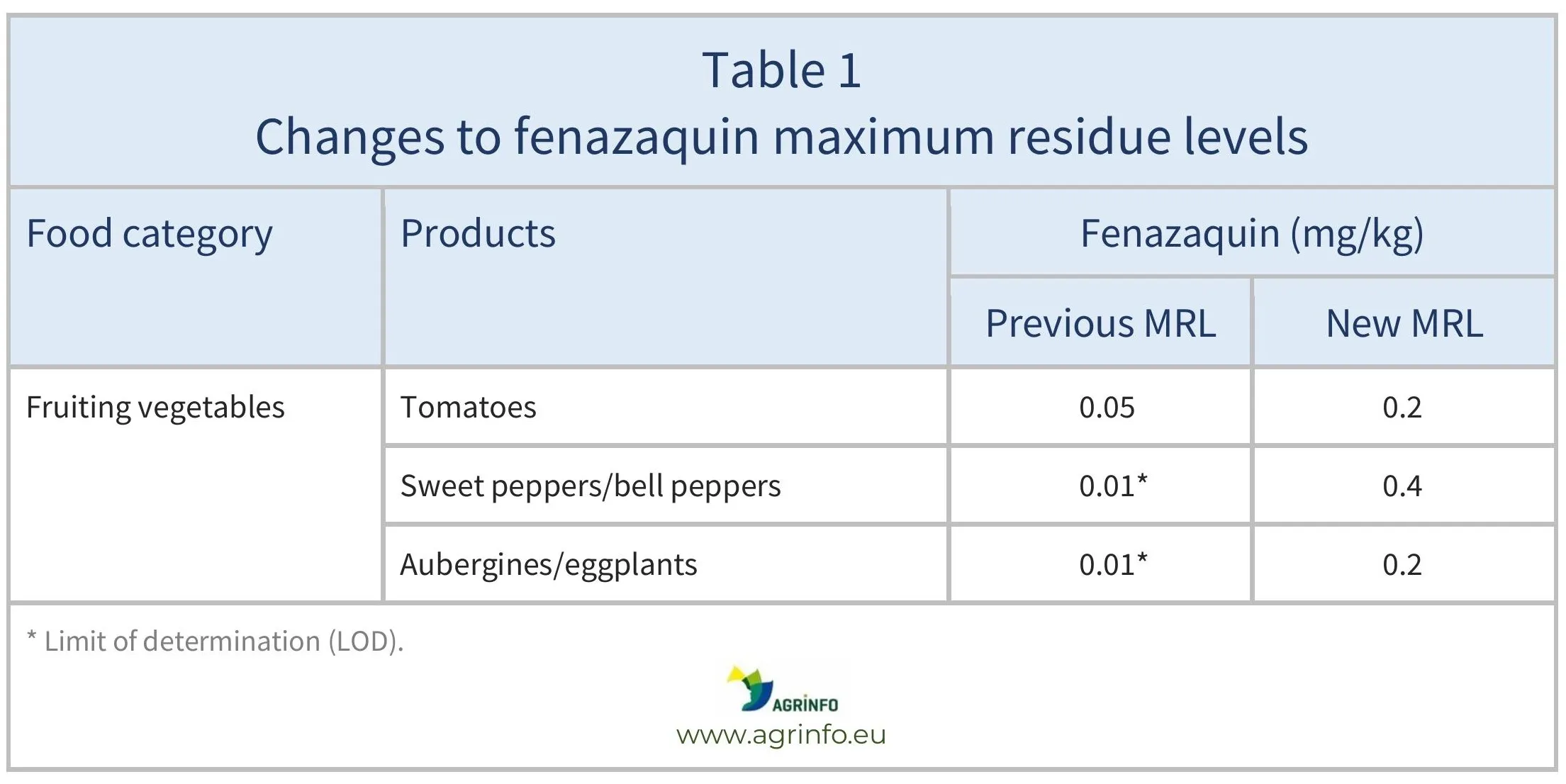
Source: Regulation (EU) 2026/742
Disclaimer: Under no circumstances shall COLEAD be liable for any loss, damage, liability or expense incurred or suffered that is claimed to have resulted from the use of information available on this website or any link to external sites. The use of the website is at the user’s sole risk and responsibility. This information platform was created and maintained with the financial support of the European Union. Its contents do not, however, reflect the views of the European Union.
EU increases MRLs for fenazaquin on tomatoes, sweet peppers, and eggplants
Commission Regulation (EU) 2026/742 as regards maximum residue levels for cyflufenamid, fenazaquin and nicotine in or on certain products
What is changing and why?
The European Union (EU) has increased the maximum residue level (MRL) for fenazaquin on sweet peppers/bell peppers, tomatoes, and aubergines/eggplants, following a request for modification of the existing MRLs. An evaluation by the European Food Safety Authority has concluded that the new MRLs are safe for consumers.
Timeline
The new MRLs, summarised in Table 1, apply from 20 April 2026.
Tables & Figures
Source: Regulation (EU) 2026/742
Disclaimer: Under no circumstances shall COLEAD be liable for any loss, damage, liability or expense incurred or suffered that is claimed to have resulted from the use of information available on this website or any link to external sites. The use of the website is at the user’s sole risk and responsibility. This information platform was created and maintained with the financial support of the European Union. Its contents do not, however, reflect the views of the European Union.