
Maximum residue levels for imazalil
- Food safety
- Pesticide MRLs
Summary
The European Union (EU) is discussing new proposals to increase the maximum residue levels (MRLs) for imazalil on bananas and citrus fruits. It is proposed to reduce the MRL for imazalil on melons to the limit of determination (LOD, the lowest level that can be detected using the most modern and reliable analytical methods), with more minor reductions to MRLs on courgettes, cucumbers, and gherkins.
EU discusses increasing imazalil MRLs on bananas and citrus fruits; and reducing MRLs on courgettes, cucumbers, gherkins, and melons
Draft Commission Regulation amending Annex II to Regulation (EC) No 396/2005 of the European Parliament and of the Council as regards maximum residue levels for azoxystrobin, etofenprox, fenpropidin, flupyradifurone, hexythiazox, imazalil, spinosad and tebufenozide in or on certain products
Draft Commission Regulation amending Annexes II, III and V to Regulation (EC) No 396/2005 of the European Parliament and of the Council as regards maximum residue levels for carbofuran, imazalil, mandipropamid, propaquizafop, quizalofop-P-ethyl and quizalofop-P-tefuryl in or on certain products
Draft Annex II (PLAN/2025/2832)
Update
The European Union (EU) is discussing new proposals to increase the maximum residue levels (MRLs) for imazalil on bananas and citrus fruits. It is proposed to reduce the MRL for imazalil on melons to the limit of determination (LOD, the lowest level that can be detected using the most modern and reliable analytical methods), with more minor reductions to MRLs on courgettes, cucumbers, and gherkins.
Impacted Products
Bananas, grapefruits, oranges, lemons, limes, mandarins, other citrus fruits, courgettes, cucumbers, gherkins, melons
What is changing?
The EU is discussing changes to the MRLs for imazalil as summarised in Table 1.
Why?
The European Food Safety Authority (EFSA) has recommended increasing the MRL for imazalil on citrus fruits to 7 mg/kg, as it did not identify any risk for consumers (EFSA 2025). In this evaluation, EFSA also recommended increasing the MRL on bananas to 3 mg/kg in line with the Codex maximum residue limit (CXL) adopted in July 2019. A good agricultural practice (GAP) for melons submitted for review was not sufficiently supported by data, and no import tolerance has been assessed for this product.
Following a request to modify the MRLs for cucumbers, courgettes, and gherkins, EFSA (2023) proposed MRLs that are safe for consumers.
Timeline
The new MRL for bananas is expected to apply in late 2026.
The other MRLs under discussion are expected to apply from mid-2027.
Recommended Actions
Suppliers of melons to the EU market should start to explore alternative chemical and non-chemical solutions to the use of imazalil. Suppliers of cucumbers, courgettes, and gherkins should review their use of imazalil and assess whether any changes will be needed to existing GAPs to ensure compliance with the new MRL.
Background
MRLs are set in accordance with the rules set out in Regulation 396/2005. For information on current MRLs for other substances, please consult the EU Pesticide Residues database.
The EU takes into account CXLs established by Codex Alimentarius, but will set different MRLs where it considers that a CXL will not give adequate protection to consumers.
Resources
EFSA (2023) Modification of the existing maximum residue levels for imazalil in courgettes, cucumbers and gherkins. EFSA Journal, 21(4): e07980.
EFSA (2025) Evaluation of confirmatory data following the Article 12 MRL review and modification of the existing maximum residue levels in citrus fruits for imazalil. EFSA Journal, 23(8): e9614.
Sources
Draft Commission Regulation as regards maximum residue levels for azoxystrobin, etofenprox, fenpropidin, flupyradifurone, hexythiazox, imazalil, spinosad and tebufenozide in or on certain products
Draft Commission Regulation as regards maximum residue levels for carbofuran, imazalil, mandipropamid, propaquizafop, quizalofop-P-ethyl and quizalofop-P-tefuryl in or on certain products
Draft Annex II (PLAN/2025/2832)
Tables & Figures
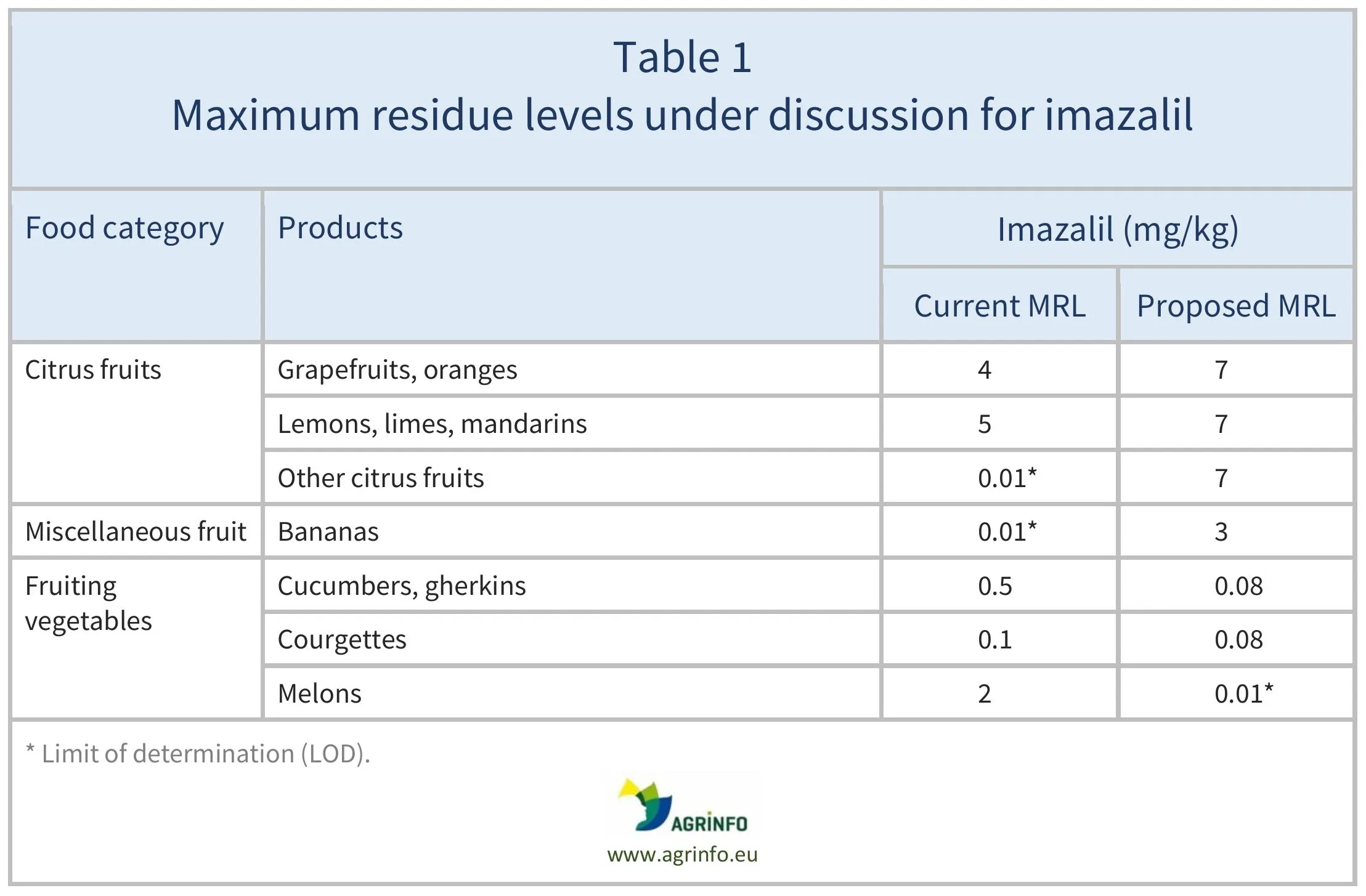
Source: based on Draft Annex II (PLAN/2025/2832)
Disclaimer: Under no circumstances shall COLEAD be liable for any loss, damage, liability or expense incurred or suffered that is claimed to have resulted from the use of information available on this website or any link to external sites. The use of the website is at the user’s sole risk and responsibility. This information platform was created and maintained with the financial support of the European Union. Its contents do not, however, reflect the views of the European Union.
EU discusses increasing imazalil MRLs on bananas and citrus fruits; and reducing MRLs on courgettes, cucumbers, gherkins, and melons
Draft Commission Regulation as regards maximum residue levels for azoxystrobin, etofenprox, fenpropidin, flupyradifurone, hexythiazox, imazalil, spinosad and tebufenozide in or on certain products
Draft Commission Regulation as regards maximum residue levels for carbofuran, imazalil, mandipropamid, propaquizafop, quizalofop-P-ethyl and quizalofop-P-tefuryl in or on certain products
Draft Annex II (PLAN/2025/2832)
What is changing and why?
The European Union (EU) is discussing changes to the maximum residue levels (MRLs) for imazalil as summarised in Table 1.
Actions
Suppliers of melons to the EU market should start to explore alternative chemical and non-chemical solutions to the use of imazalil. Suppliers of cucumbers, courgettes, and gherkins should review their use of imazalil and assess whether any changes will be needed to existing good agricultural practices (GAPs) to ensure compliance with the new MRL.
Timeline
The new MRL for bananas is expected to apply to apply in late 2026.
The other MRLs under discussion are expected to apply from mid-2027.
Tables & Figures
Source: based on Draft Annex II (PLAN/2025/2832)
Disclaimer: Under no circumstances shall COLEAD be liable for any loss, damage, liability or expense incurred or suffered that is claimed to have resulted from the use of information available on this website or any link to external sites. The use of the website is at the user’s sole risk and responsibility. This information platform was created and maintained with the financial support of the European Union. Its contents do not, however, reflect the views of the European Union.