
Temporary increased official controls on foods from certain countries – January 2026 update
- Official controls
Summary
When a potential risk to public health is identified, the European Union (EU) can temporarily increase official controls on certain food products from specific countries. The latest of these Regulations increases controls for products from some countries, and reduces controls for others where the risk has reduced.
The countries for which official controls have increased on certain products are: Bangladesh, Côte d’Ivoire, Egypt, Rwanda, Thailand, and Türkiye.
The countries for which official controls have decreased on certain products are: Brazil, Côte d’Ivoire, Egypt, India, Lebanon, Malaysia, and Türkiye.
An updated list of all products for which there are increased official controls is provided in the Annexes to the Regulation.
For further information on the implementation and impact of these measures, see the AGRINFO guide Temporary increase of official controls of food imports – Regulation 2019/1793: An introduction.
EU increases official controls on certain foods from specific non-EU countries (January 2026)
Commission Implementing Regulation (EU) 2026/194 of 28 January 2026 amending Implementing Regulation (EU) 2019/1793 on the temporary increase of official controls and emergency measures governing the entry into the Union of certain goods from certain third countries implementing Regulations (EU) 2017/625 and (EC) No 178/2002 of the European Parliament and of the Council
Update
When a potential risk to public health is identified, the European Union (EU) can temporarily increase official controls on certain food products from specific countries. The latest of these Regulations increases controls for products from some countries, and reduces controls for others where the risk has reduced.
The countries for which official controls have increased on certain products are: Bangladesh, Côte d’Ivoire, Egypt, Rwanda, Thailand, and Türkiye.
The countries for which official controls have decreased on certain products are: Brazil, Côte d’Ivoire, Egypt, India, Lebanon, Malaysia, and Türkiye.
An updated list of all products for which there are increased official controls is provided in the Annexes to the Regulation.
For further information on the implementation and impact of these measures, see the AGRINFO guide Temporary increase of official controls of food imports – Regulation 2019/1793: An introduction.
Impacted Products
Beans, black pepper, cloves, food additives, grapefruits, lemons, mandarins, nutmeg, okra, oranges, palm oil, peppers, peppers (capsicum), pistachios, rice, sesamum seeds, strawberries, turnips, vanilla
What is changing?
Regulation 2019/1793 lays down the list of food and feed of non-animal origin subject to a temporary increase of official controls, and the rules for these controls.
This list is updated regularly according to the risk of contamination by mycotoxins (including aflatoxins), pesticide residues, pentachlorophenol and dioxins, microbiological contamination, Sudan dyes, Rhodamine B, and plant toxins.
The details of the temporary increases are given in:
- Annex I of the Regulation, which lists products from certain non-EU countries that are subject to a temporary increase of official controls at EU border control posts and control points, and the frequency of controls
- Annex II, which lists products and their countries of origin that are subject to special conditions as well to a temporary increase of official controls on entering the EU, and the frequency of controls.
The listing in the Annexes is very specific: each item refers to a particular product (e.g. groundnut) for an identified hazard (e.g. mycotoxins) from a named country.
Being listed in Annex I or Annex II has significant implications for suppliers. Annex II listing requires laboratory analysis and checks by competent authorities in exporting countries for each consignment of the affected commodities (see below).
Changes to temporary increases in official controls (Annex I)
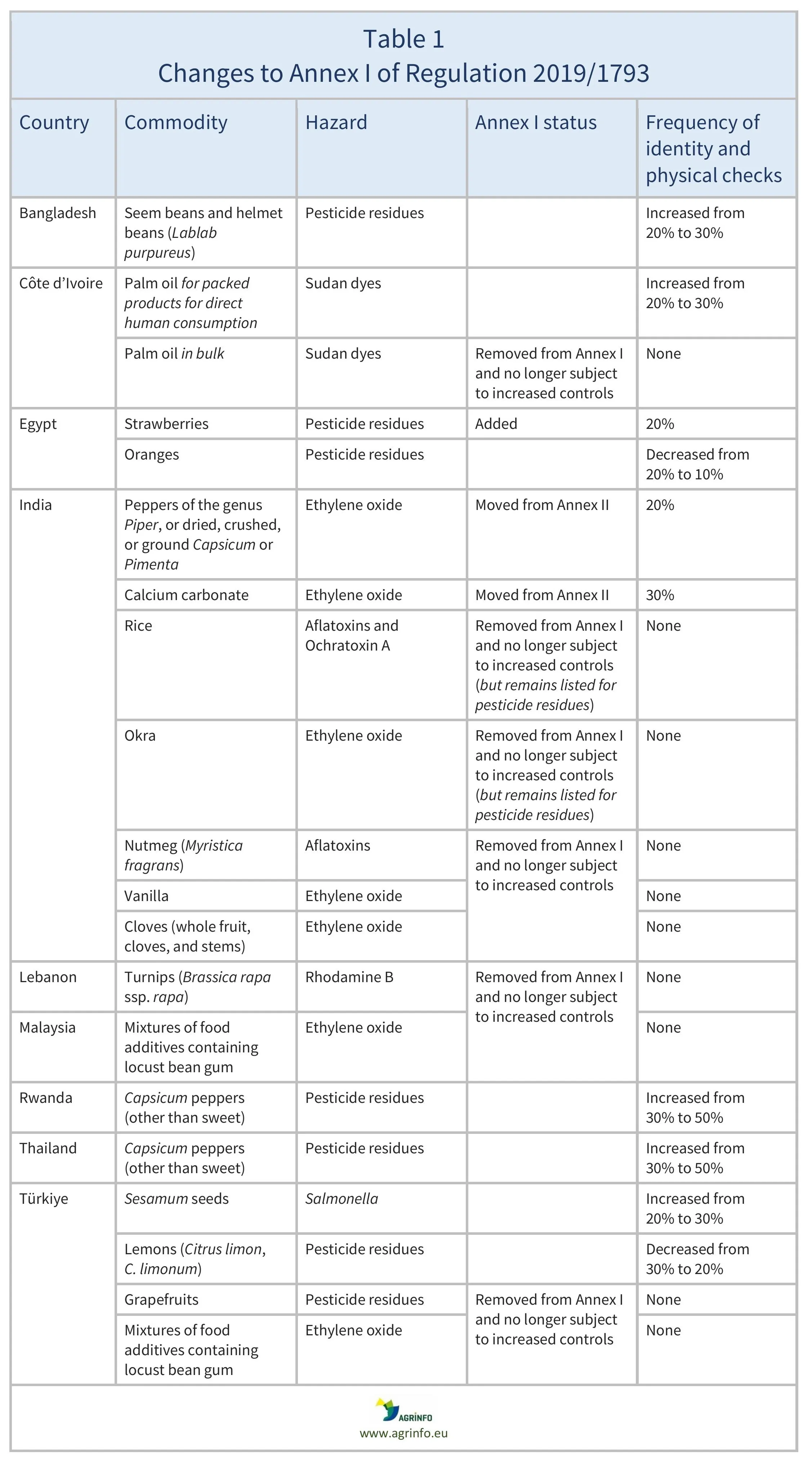
This latest update of Regulation 2019/1793 makes the following changes to the list of consignments of food and feed subject to a temporary increase of official controls at EU border control posts (see Table 1 for details).
The following has been added to the list in Annex I:
- strawberries from Egypt for pesticide residues.
The following, already listed in Annex I, have increased frequency of identity and physical checks:
- seem beans and helmet beans (Lablab purpureus) from Bangladesh for pesticide residues
- palm oil as a packed product for direct human consumption (not in bulk) from Côte d’Ivoire for Sudan dyes
- peppers of the genus Capsicum (other than sweet) from Rwanda for pesticide residues
- peppers of the genus Capsicum (other than sweet) from Thailand for pesticide residues
- Sesamum seeds from Türkiye for Salmonella.
The following, already listed in Annex I, have decreased frequency of identity and physical checks:
- oranges from Egypt for pesticide residues
- lemons (Citrus limon, C. limonum) from Türkiye for pesticide residues.
The following have been moved from Annex II to Annex I (see “What are the major implications for exporting countries?”):
- peppers of genus Piper, or dried, crushed, or ground fruit of the genus Capsicum or of the genus Pimenta from India for ethylene oxide
- calcium carbonate from India for ethylene oxide.
The following have been removed from Annex I and are therefore no longer subject to increased controls in relation to the specific contaminant mentioned:
- palm oil in bulk from Côte d’Ivoire for Sudan dyes
- rice from India for aflatoxins and Ochratoxin A (it remains listed for pesticide residues)
- okra from India for ethylene oxide (it remains listed for pesticide residues)
- nutmeg (Myristica fragrans) from India for aflatoxins
- vanilla and cloves (whole fruit, cloves, and stems) from India for ethylene oxide
- turnips (Brassica rapa ssp. rapa) from Lebanon for Rhodamine B
- mixtures of food additives containing locust bean gum from Malaysia for ethylene oxide
- grapefruits from Türkiye for pesticide residues
- mixtures of food additives containing locust bean gum from Türkiye for ethylene oxide.
Changes to special conditions and temporary increases in official controls (Annex II)
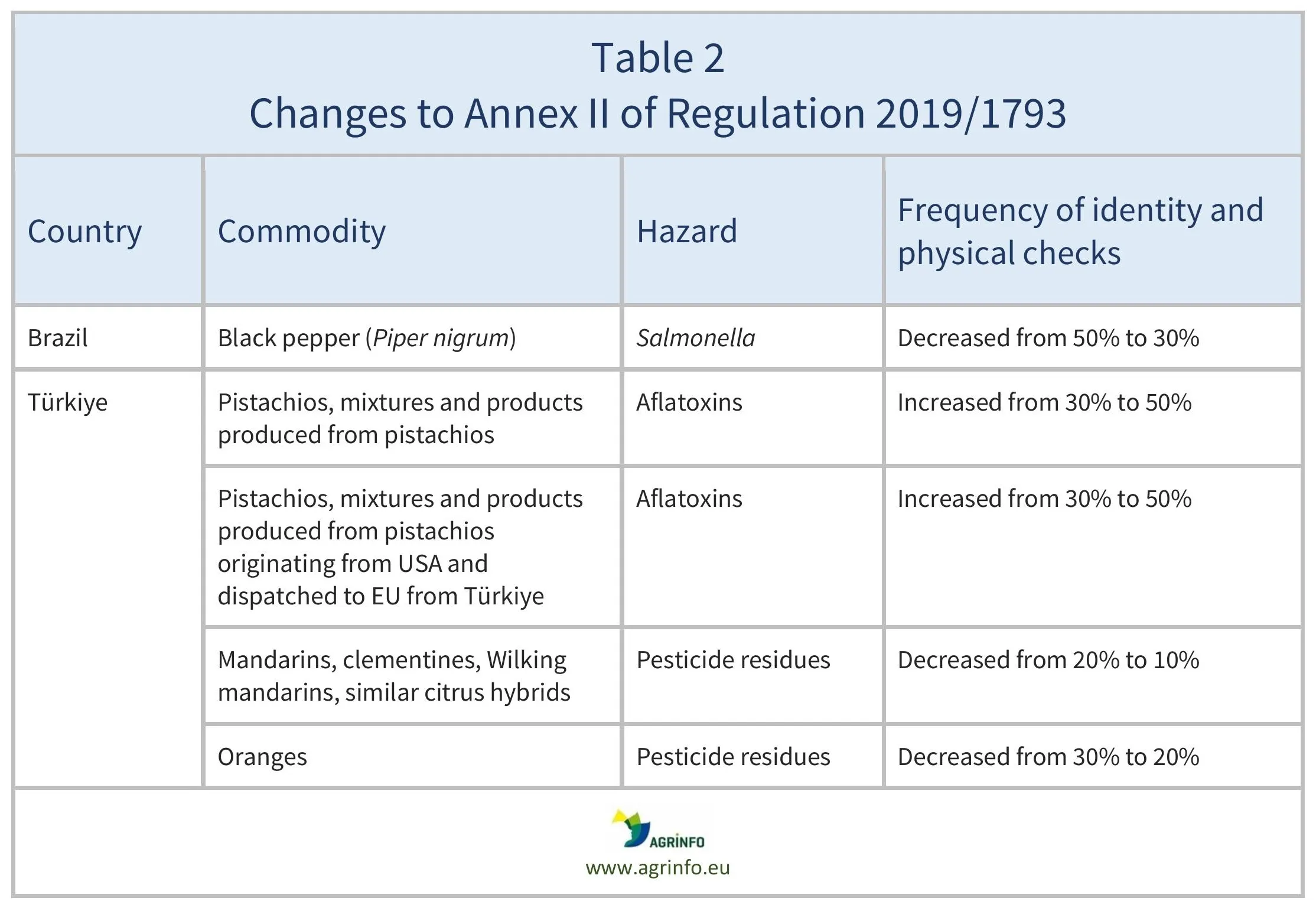
This new update of Regulation 2019/1793 makes the following changes under Annex II (see Table 2 for details).
The following products have increased frequency of identity checks (visual inspection to ensure documentation corresponds with the products) and physical checks (checks on the product including sampling and laboratory testing):
- pistachios, mixtures and products produced from pistachios from Türkiye for aflatoxins
- pistachios, mixtures and products produced from pistachios originating from the USA and dispatched to the EU from Türkiye for aflatoxins.
The following products have decreased frequency of identity checks and physical checks:
- black pepper (Piper nigrum) from Brazil for Salmonella
- mandarins (including tangerines and satsumas), clementines, Wilking mandarins, and similar citrus hybrids from Türkiye for pesticide residues
- oranges from Türkiye for pesticide residues.
For specific information on the products concerned (e.g. relevant customs codes, details of hazards that need to be analysed), and a complete list of all products/ product origins subject to increased frequency of controls, please consult the draft Annexes of Regulation 2024/3153.
Why?
The EU assesses the potential risks, and the associated need for additional controls, based on information from various sources. These include: data from EU Member State authorities and exporting countries; European Commission audits carried out in exporting countries; and notifications reported to the Rapid Alert System for Food and Feed (RASFF) and the Trade Control and Expert System (TRACES). This information is normally reviewed every 6 months.
For commodities that are already listed, the Commission decides on a case-by-case basis, in consultation with EU Member States, whether risks have changed as a result of action taken by exporting countries, and if the increased controls or the special conditions can be relaxed or removed entirely. Further information on this decision-making process is provided in the Commission Notice on information related to risks and non-compliance.
Timeline
This Regulation applies from 18 February 2026.
What are the major implications for exporting countries?
Temporary increases of official controls place significant additional demands on private sector operators and competent authorities in exporting countries.
Exporters of the following products newly added to Annex I should urgently review current practices and adopt additional measures to ensure compliance:
- strawberries from Egypt for pesticide residues.
Implications of being put in Annex I
Increased controls create greater uncertainty in supply because of delays and possible rejections of consignments. This may weaken the reputation and competitive position of suppliers from a listed country. It also may have cost implications when operators must cover all or part of the cost of increased controls (e.g. storage, inspection, analysis, or destruction of consignments in an EU Member State).
Operators and competent authorities in countries supplying products listed in Annex I (additional controls) must ensure that they put in place the necessary measures to prevent any new non-compliances and thus avoid a further increase in controls, or listing in Annex II.
What does it mean to be put in Annex II instead of Annex I?
Annex II listing is triggered when there is evidence of a serious risk to human health, leading to stricter entry conditions for affected food and feed products exported to the EU.
For consignments of Annex II-listed food and feed, the following actions must be taken before export, in the country of origin (or in the country from which the product is dispatched).
- Each consignment must be accompanied by the results of sampling and laboratory analyses conducted by the competent authorities in the country of origin, or the country where it is dispatched from, if different.
- Laboratory analyses must be performed by laboratories that are accredited with the ISO/IEC 17025 Standard.
- Each consignment must have an identification code, and each individual bag or packaging in the consignment must be identified with that code.
- Each consignment must be accompanied by an official certificate issued by the competent authority of the exporting country, or the non-EU country where it is dispatched from, if different. This certificate must be based on a specific model and must state the identification code; must be issued before the consignment leaves the control of the competent authority; and must be valid for not more than 4 months from the date of issue, and no longer than 6 months from the date of the results of laboratory analyses.
- Suppliers of products listed in Annex II may face practical problems and high costs when they try to access appropriate testing facilities, particularly if there is no in-country accredited laboratory. Competent authorities have to put in place all the necessary procedures before listed consignments can be exported. They may also face technical and administrative constraints that make it difficult to respond to requests for mandatory certification. In practice, the listing of products in Annex II can lead to a temporary stop in exports from the countries concerned.
- Suppliers must ensure rigorous routine analysis of contaminants and pesticides to avoid listing in either of these Annexes.
Recommended Actions
Exporters of all products listed in Annexes I and II of Regulation 2024/3153 must take steps to ensure full compliance with EU rules.
- Exporters of strawberries from Egypt for risks related to pesticide residues (newly added to Annex I) should urgently review current practices and adopt additional measures to ensure compliance.
Resources
Online resources from the European Commission:
Commission Notice on information related to risks and non-compliance in the context of periodic reviews of Commission Implementing Regulation (EU) 2019/1793 2022/C 265/01
Commission Implementing Regulation (EU) 2024/286 on the temporary increase of official controls and emergency measures governing the entry into the Union of certain goods from certain third countries
Commission Implementing Regulation (EU) 2019/1793 on the temporary increase of official controls and emergency measures governing the entry into the Union of certain goods from certain third countries
Regulation (EU) 2017/625 on official controls and other official activities performed to ensure the application of food and feed law, rules on animal health and welfare, plant health and plant protection products
Regulation (EC) No 178/2002 laying down the general principles and requirements of food law, establishing the European Food Safety Authority and laying down procedures in matters of food safety
Sources
Commission Implementing Regulation (EU) 2026/194 on the temporary increase of official controls and emergency measures governing the entry into the Union of certain goods from certain third countries
Disclaimer: Under no circumstances shall COLEAD be liable for any loss, damage, liability or expense incurred or suffered that is claimed to have resulted from the use of information available on this website or any link to external sites. The use of the website is at the user’s sole risk and responsibility. This information platform was created and maintained with the financial support of the European Union. Its contents do not, however, reflect the views of the European Union.
EU increases official controls on certain foods from specific non-EU countries (January 2026)
Commission Implementing Regulation (EU) 2026/194 on the temporary increase of official controls and emergency measures governing the entry into the Union of certain goods from certain third countries
What is changing and why?
When a potential risk to public health is identified, the European Union (EU) introduces Regulations to temporarily increase official controls on certain food products from specific countries.
The countries for which official controls have increased on certain products are: Bangladesh, Côte d’Ivoire, Egypt, Rwanda, Thailand, and Türkiye.
The countries for which official controls have decreased on certain products are: Brazil, Côte d’Ivoire, Egypt, India, Lebanon, Malaysia, and Türkiye.
An updated list of all increased official controls is provided in the Annexes to the Regulation.
- Annex I of the Regulation lists products from certain non-EU countries that are subject to a temporary increase of official controls at EU border control posts and control points.
- Annex II lists products and their countries of origin that are subject to special conditions, as well as to a temporary increase of official controls on entering the EU.
For details of changes to the Annex I and II lists, see Tables 1 and 2.
For further information on the implications of being placed in Annex I or II, please see the Full report and the AGRINFO guidance Temporary increase of official controls of food imports – Regulation 2019/1793: An introduction.
Actions
Exporters of all products listed in Annexes I and II of Regulation 2025/1441 must take steps to ensure full compliance with EU law.
Exporters of strawberries from Egypt for risks related to pesticide residues (newly added to Annex I) should urgently review current practices and adopt additional measures to ensure compliance.
Timeline
This Regulation applies from 18 February 2026.
Disclaimer: Under no circumstances shall COLEAD be liable for any loss, damage, liability or expense incurred or suffered that is claimed to have resulted from the use of information available on this website or any link to external sites. The use of the website is at the user’s sole risk and responsibility. This information platform was created and maintained with the financial support of the European Union. Its contents do not, however, reflect the views of the European Union.