
Unfair Trading Practices (UTP) Directive
- Trade
- Trade policy
Summary
The Unfair Trading Practices (UTP) Directive aims to achieve a more efficient and fairer food supply chain by protecting agri-food suppliers who sell directly to buyers in the European Union (EU). It protects farmers, farmers’ organisations, and other agri-food suppliers, including those based outside the EU if the buyer is based in the EU.
The UTP Directive bans 16 specific trading practices that are considered to be unfair. Each EU Member State can decide to introduce stricter rules than those set out in the Directive. Authorities in each EU country are responsible for the enforcement of the Directive.
The UTP Directive has applied since 2022, and is currently being reviewed by the European Commission.
Relevance of the Unfair Trading Practices Directive to non-EU agri-food suppliers
Directive (EU) 2019/633 of the European Parliament and of the Council of 17 April 2019 on unfair trading practices in business-to-business relationships in the agricultural and food supply chain
Update
The Unfair Trading Practices (UTP) Directive aims to achieve a more efficient and fairer food supply chain by protecting agri-food suppliers who sell directly to buyers in the European Union (EU). It protects farmers, farmers’ organisations, and other agri-food suppliers, including those based outside the EU if the buyer is based in the EU.
The UTP Directive bans 16 specific trading practices that are considered to be unfair. Each EU Member State can decide to introduce stricter rules than those set out in the Directive. Authorities in each EU country are responsible for the enforcement of the Directive.
The UTP Directive has applied since 2022, and is currently being reviewed by the European Commission.
Background
While most EU measures aimed towards achieving a more efficient and fairer food supply chain are focused on EU farmers, the UTP Directive also offers protection to agri-food suppliers based outside the EU when they are selling products to EU-based buyers.
Impacted Products
All products
What is changing?
The UTP Directive aims to protect agri-food suppliers who sell directly to EU buyers (not via an intermediary) from unfair practices by business partners. Non-EU agri-food suppliers are also protected by these rules if the buyer is based in the EU. The Directive does not apply in relation to food sold directly to end consumers.
The UTP Directive has applied since 2022, and is currently being reviewed.
Unfair trading practices
The UTP Directive (2019/633) bans 16 "black" and "grey" trading practices.
Black trading practices are never allowed. They currently include:
- making payments later than 30 days after purchase for perishable agricultural and food products, or 60 days for other agri-food products
- short-notice cancellations of perishable agri-food product orders
- unilateral contract changes by the buyer
- requiring payments not related to a specific transaction
- transferring the risk of loss and deterioration of products to the supplier
- refusal of the buyer to confirm a supply agreement in writing, despite a request from the supplier
- misuse of trade secrets by the buyer
- commercial retaliation by the buyer
- transferring the costs of examining customer complaints to the supplier.
Grey trading practices are only allowed if the supplier and the buyer agree on them beforehand. They include:
- return of unsold products
- payment by the supplier for stocking, display, and listing; promotion; marketing; advertising; staff of the buyer, fitting out premises.
Scope of protection
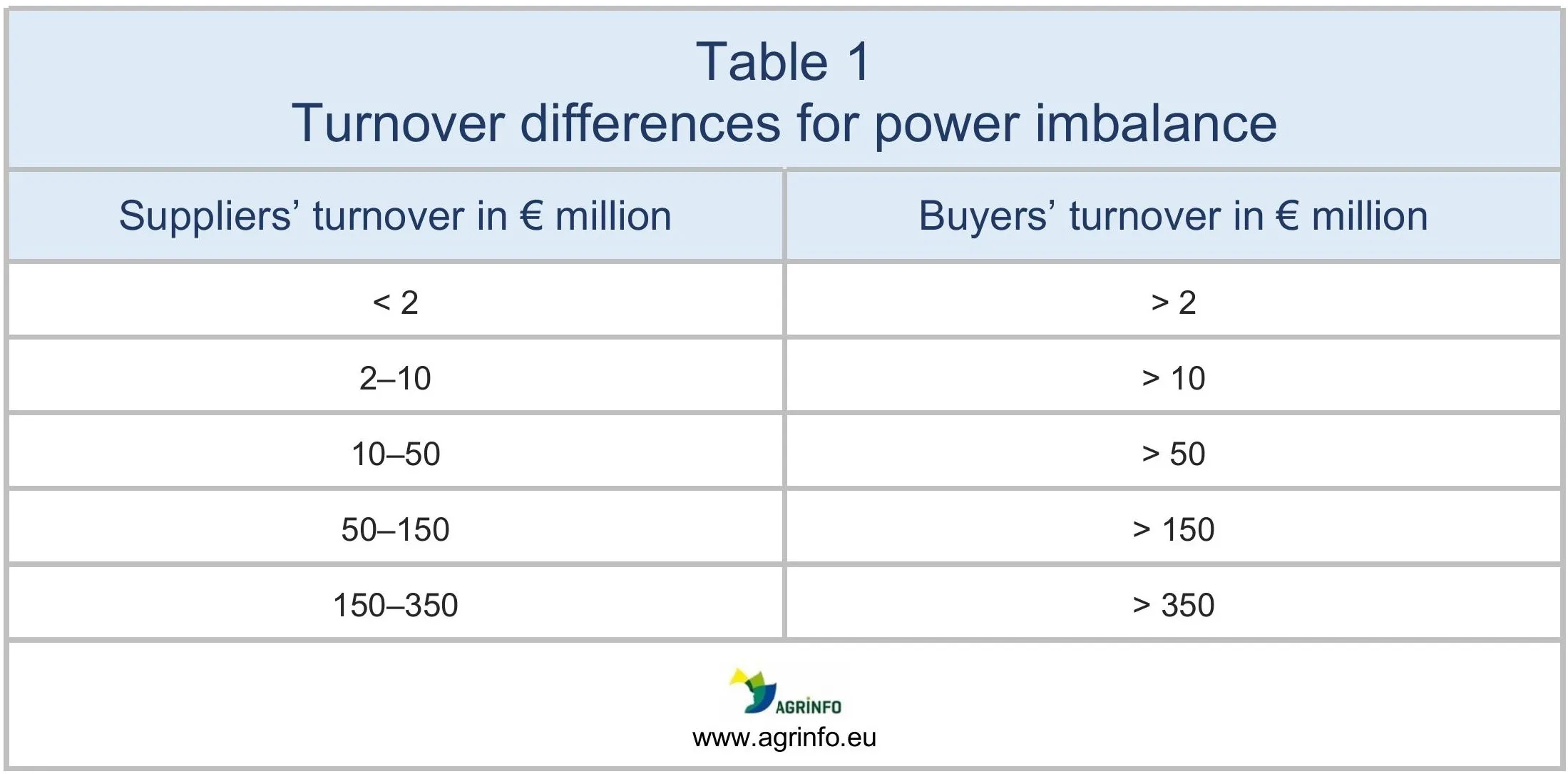
The UTP Directive intends to protect suppliers from UTPs by economically stronger buyers. Suppliers with a turnover of up to €350 million are protected by the UTP Directive, but EU Member States can also choose to protect larger suppliers under their national laws.
The Directive protects suppliers who face a bargaining power imbalance between themselves and buyers, based on the turnover difference shown in Table 1.
Enforcement
To file a complaint, suppliers must contact the relevant authorities of one EU country (usually the country where the EU buyer is located). The list of enforcement authorities is given on the EU webpage Unfair trading practices in the food chain. These national authorities have the power to launch investigations and to impose fines on operators who break the rules. However, buyers are not obliged to compensate suppliers under the UTP Directive.
The complainant can request to remain anonymous when filling in a complaint. Suppliers can also contact a producer organisation (e.g. a cooperative), or other organisations with a legitimate interest in representing them, to file the complaint on their behalf.
Evaluation of the UTP Directive
The European Commission carried out five annual surveys on UTPs experienced by food chain operators between 2020 and 2024 (see Unfair trading practices in the food supply chain).
An assessment of measures taken by EU Member States when applying the UTP Directive resulted in an evaluation report published in December 2025.
Why?
The stark imbalances between small- and large-scale operators in the agricultural and food supply chain can lead to UTPs in business-to-business (B2B) relationships, where farmers and small-scale operators do not have sufficient bargaining power to defend themselves.
The UTP Directive aims to achieve a more efficient and fairer food supply chain by protecting agri-food suppliers who sell directly to buyers in the EU against UTPs.
Resources
Directive 2019/633 on unfair trading practices in business-to-business relationships in the agricultural and food supply chain
European Commission. Unfair trading practices in the food chain
European Commission (2025) Evaluation of the Unfair Trading Practices Directive
Sources
Directive 2019/633 on unfair trading practices in business-to-business relationships in the agricultural and food supply chain
Tables & Figures
Disclaimer: Under no circumstances shall COLEAD be liable for any loss, damage, liability or expense incurred or suffered that is claimed to have resulted from the use of information available on this website or any link to external sites. The use of the website is at the user’s sole risk and responsibility. This information platform was created and maintained with the financial support of the European Union. Its contents do not, however, reflect the views of the European Union.