
Feed additives: March–May 2026 authorisations, reauthorisations, and changes
- Feed additives
- Feed safety
Summary
Overview of the latest European Union (EU) authorisations and reauthorisations of feed additives and their use in animal nutrition in target animals, including changes to existing authorisations.
EU authorises and reauthorises certain feed additives
Authorisations
Commission Implementing Regulations 2026/528, 2026/534, 2026/1012, 2026/1013, 2026/1014, 2026/1017, 2026/1018, 2026/1019, 2026/1020, 2026/1036, 2026/1037
Reauthorisations
Commission Implementing Regulations 2026/532, 2026/538, 2026/540, 2026/549, 2026/553, 2026/1016, 2026/1036,2026/1146, 2026/1148, 2026/1150, 2026/1151
Changes
Commission Implementing Regulations 2026/553, 2026/1036, 2026/1115, 2026/1158
Update
Overview of the latest European Union (EU) authorisations and reauthorisations of feed additives and their use in animal nutrition in target animals, including changes to existing authorisations.
Impacted Products
Feed additives, prepared fodder
What is changing?
Authorisations
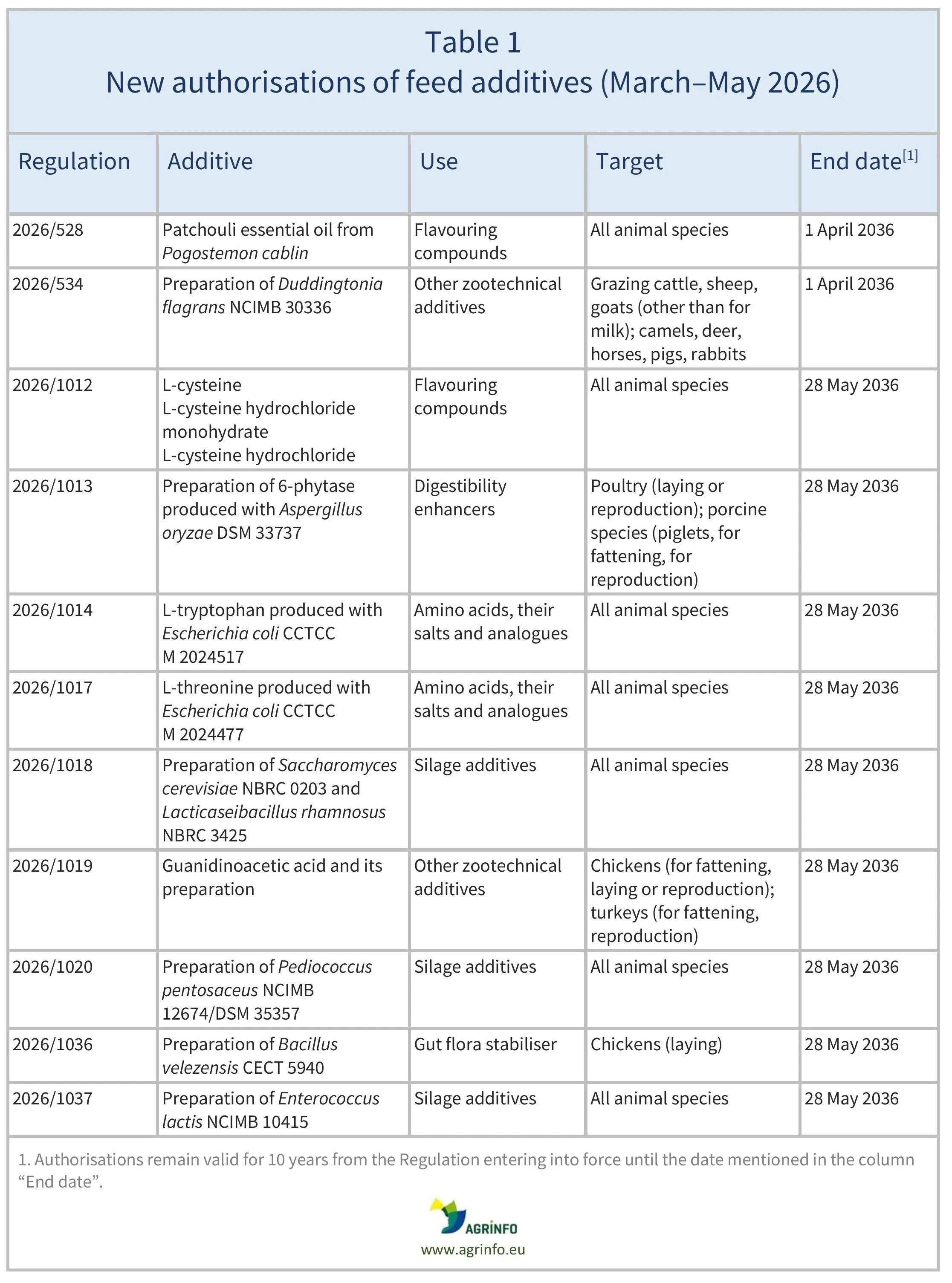
In March–May 2026, the EU authorised the feed additives listed in Table 1, based on opinions published by the European Food Safety Authority (EFSA) [1–15]. The conditions of use are described in the respective Regulations.
Reauthorisations
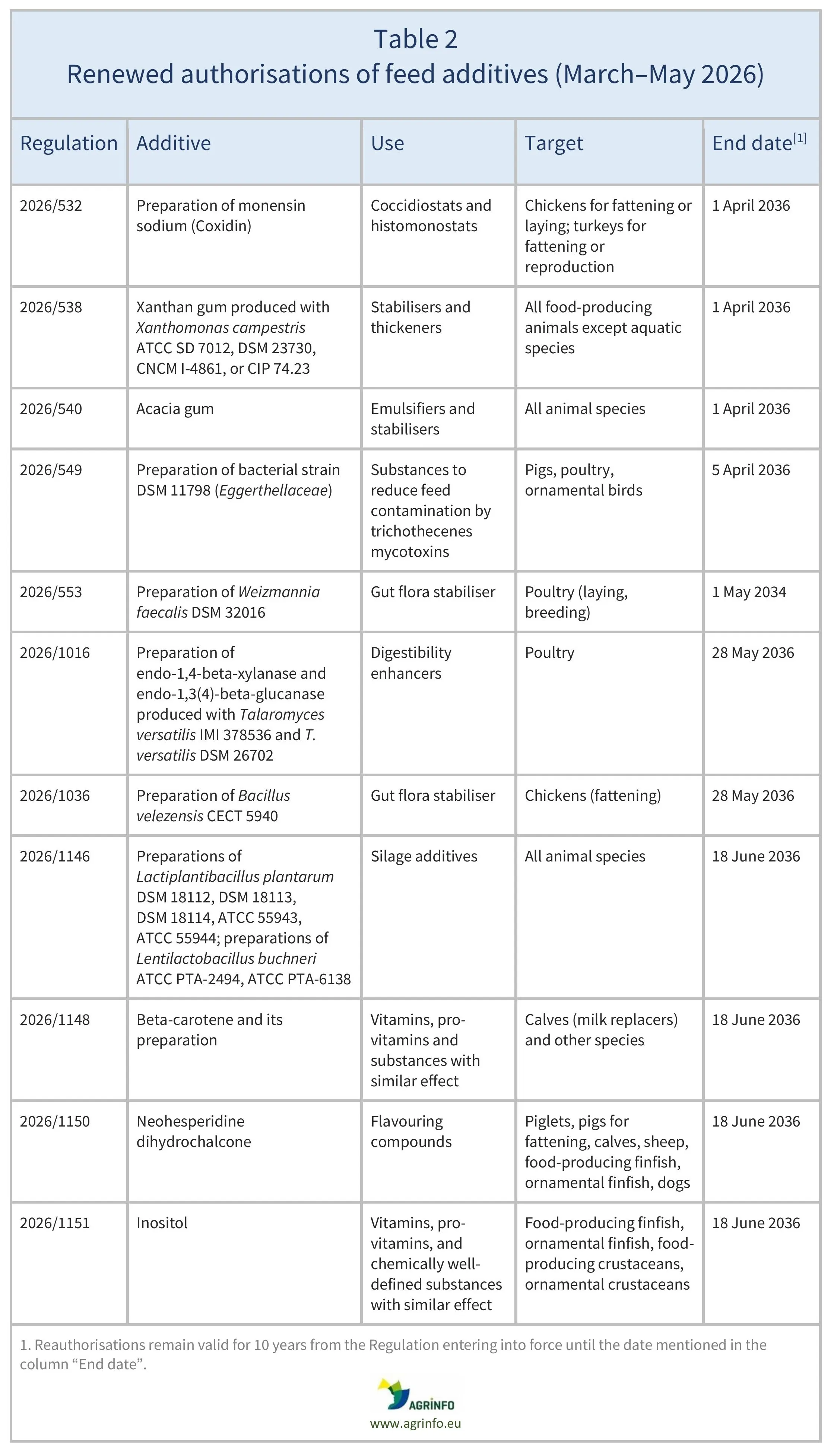
In March–May 2026, the EU reauthorised the feed additives listed in Table 2, based on opinions published by EFSA [16–35]. The conditions of use are described in the respective Regulations.
Changes
- Regulation 2026/553 allows the combined use of a preparation of Weizmannia faecalis DSM 32016 with certain coccidiostats (amprolium, narasin, nicarbazin) as a feed additive for use in feed and drinking water for all poultry species [36].
- Regulation 2026/1036 extends authorisation for the use of Bacillus velezensis CECT 5940 as a gut flora stabiliser in laying hens and other bird species kept for egg production, and modifies existing Regulations to update its taxonomic identification from B. amyloliquefaciens CECT 5940 to B. velezensis CECT 5940 [37].
- Regulation 2026/1115 introduces changes to the electronic application form for authorisations of feed additives (set out in Regulation 429/2008), and introduces a definition of target animals as “major species” complementing the definition of “minor species”.
- Regulation 2026/1158 updates the name of the authorisation holder for conjugated linoleic acid (t10, c12)-methylester to Louis Dreyfus Company Ingredients GmbH.
Timeline
The authorisations and reauthorisations remain valid until the end dates listed in Tables 1 and 2.
What are the major implications for exporting countries?
With these authorisations, more feed additives will be available on the market. Authorisations and renewals are valid for 10 years. The use of all preparations and substances specified as feed additives must comply with the provisions of use specified in the Annex to each Regulation.
Recommended Actions
Non-EU countries producing feed additives, compound feed, and feed materials for export to the EU are advised to check the status of feed additives in the EU Feed Additives register.
To be able to filter and to see more information, it is advised to download the register in Excel format (listed under “Feed Additives” on the Food and Feed Information Portal webpage).
Background
The procedure for authorising the sale and use of feed additives is set out in Regulation (EC) 1831/2003. For the latest updates on feed additives see the EU Feed Additives register.
Resources
EU Feed Additives register
Regulation (EC) No 1831/2003 on additives for use in animal nutrition
Commission Regulation (EC) No 429/2008 on detailed rules for the implementation of Regulation (EC) No 1831/2003 as regards the preparation and the presentation of applications and the assessment and the authorisation of feed additives.
Authorisations
1. EFSA (2017) Guidance on the assessment of the safety of feed additives for the target species. EFSA Journal, 15(10): 5021.
2. EFSA (2018) Safety and efficacy of L-threonine produced by fermentation using Escherichia coli CGMCC 7.232 for all animal species. EFSA Journal, 16(10): 5458.
3. EFSA (2020) Safety and efficacy of BioWorma® (Duddingtonia flagrans NCIMB 30336) as a feed additive for all grazing animals. EFSA Journal, 18(7): 6208.
4. EFSA (2023) Safety of a feed additive consisting of Duddingtonia flagrans NCIMB 30336 (BioWorma®) for all grazing animals (International Animal Health Products Pty Ltd). EFSA Journal, 21: e8465.
5. EFSA (2024) Safety and efficacy of a feed additive consisting of 6-phytase produced by Aspergillus oryzae DSM 33737 (HiPhorius™) for all poultry, all Suidae and all fin fish (DSM Nutritional Products Ltd). EFSA Journal, 22: e8663.
6. EFSA (2025) Safety and efficacy of a feed additive consisting of an essential oil derived from the leaves of Pogostemon cablin Benth. (patchouli oil) for use in all animal species (FEFANA asbl). EFSA Journal, 23: e9357.
7. EFSA (2025) Safety of a feed additive consisting of Duddingtonia flagrans NCIMB 30336 (BioWorma®) for all grazing animals (International Animal Health Products Pty Ltd). EFSA Journal, 23: e9366.
8. EFSA (2025) Safety and efficacy of a feed additive consisting of Pediococcus pentosaceus NCIMB 12674 for all animal species (Danstar Ferment AG). EFSA Journal, 23: e9634.
9. EFSA (2025) Safety and efficacy of a feed additive consisting of L-tryptophan produced with Escherichia coli CCTCC M 2024517 for all animal species (Anhui Huaheng Biotechnology Co., Ltd.). EFSA Journal, 23: e9677.
10. EFSA (2025) Safety and efficacy of a feed additive consisting of L-threonine produced with Escherichia coli CCTCC M 2024477 for all animal species (Kempex Holland B.V.). EFSA Journal, 23: e9678.
11. EFSA (2025) Safety and efficacy of a feed additive consisting of Enterococcus lactis NCIMB 10415 for all animal species (Agri-King, Inc.). EFSA Journal, 23: e9679.
12. EFSA (2025) Safety and efficacy of the feed additives L-cysteine and L-cysteine hydrochloride (monohydrate and anhydrous) for all animal species (Wacker Chemie AG). EFSA Journal, 23: e9689.
13. EFSA (2025) Efficacy of a feed additive consisting of 6-phytase produced with Aspergillus oryzae DSM 33737 (HiPhorius™) for all poultry, all porcine species and all fin fish (DSM Nutritional Products Ltd). EFSA Journal, 23: e9696.
14. EFSA (2025) Safety and efficacy of a feed additive consisting of Saccharomyces cerevisiae NBRC 0203 and Lacticaseibacillus rhamnosus NBRC 3425 as a silage additive for all animal species (EM-Agriton B.V.). EFSA Journal, 23: e9698.
15. EFSA (2025) Safety and efficacy of a feed additive consisting of guanidinoacetic acid and its preparation (GuanAMINO®) for chickens for fattening, chickens reared for laying, chickens reared for reproduction, turkeys for fattening, turkeys reared for reproduction (Evonik Operations GmbH). EFSA Journal, 23: e9784.
Reauthorisations
16. EFSA (2021) Safety and efficacy of an additive consisting of xanthan gum produced by Xanthomonas campestrisstrains ■■■■■, ■■■■■ for all animal species (Biopolymer International). EFSA Journal, 19(7): 6710.
17. EFSA (2022) Safety and efficacy of a feed additive consisting of acacia gum (gum Arabic) for all animal species(A.I.P.G. Association for International Promotion of Gums). EFSA Journal, 20(4): 7252.
18. EFSA (2024) Safety and efficacy of a feed additive consisting of monensin sodium (Coxidin®) for chickens for fattening, chickens reared for laying, turkeys for fattening and turkeys reared for breeding (Huvepharma N.V.). EFSA Journal, 22: e8628.
19. EFSA (2024) Assessment of the feed additive consisting of Lactiplantibacillus plantarum DSM 18114 for all animal species for the renewal of its authorisation (Pioneer Hi-Bred International, Inc.). EFSA Journal, 22: e8767.
20. EFSA (2024) Assessment of the feed additive consisting of Lactiplantibacillus plantarum ATCC 55944 for all animal species for the renewal of its authorisation (Pioneer Hi-Bred International, Inc.). EFSA Journal, 22: e8768.
21. EFSA (2024) Assessment of the feed additive consisting of Lactiplantibacillus plantarum ATCC 55943 for all animal species for the renewal of its authorisation (Pioneer Hi-Bred International, Inc.). EFSA Journal, 22: e8782.
22. EFSA (2024) Assessment of the feed additive consisting of Lactiplantibacillus plantarum DSM 18113 for all animal species for the renewal of its authorisation (Pioneer Hi-Bred International, Inc.). EFSA Journal, 22: e8783.
23. EFSA (2024) Assessment of the feed additive consisting of Lactiplantibacillus plantarum DSM 18112 for all animal species for the renewal of its authorisation (Pioneer Hi-Bred International, Inc.). EFSA Journal, 22: e8784.
24. EFSA (2024) Assessment of the feed additive consisting of Lentilactobacillus buchneri ATCC PTA-2494 for all animal species for the renewal of its authorisation (Pioneer Hi-Bred International, Inc.). EFSA Journal, 22: e8786.
25. EFSA (2024) Assessment of the feed additive consisting of Lentilactobacillus buchneri ATCC PTA-6138 for all animal species for the renewal of its authorisation (Pioneer Hi-Bred International, Inc.). EFSA Journal, 22: e8787.
26. EFSA (2025) Assessment of the feed additive neohesperidine dihydrochalcone for piglets, pigs for fattening, calves, sheep, fish and dogs for the renewal of its authorisation (HealthTech Bio Actives S.L.U.). EFSA Journal, 23: e9358.
27. EFSA (2025) Assessment of the feed additive consisting of a strain belonging to Eggerthellaceae family (DSM 11798) for pigs and all avian species (1m01) for the renewal of its authorisation (BIOMIN GmbH). EFSA Journal, 23: e9360.
28. EFSA (2025) Safety of a feed additive consisting of xanthan gum (produced with Xanthomonas campestris strains ATCC SD-7012, DSM 23730, CNCM I-4861 and CIP 74.23) for all animal species with the exception of cats and aquatic species (BIOPOLYMER International). EFSA Journal, 23(6): e9466.
29. EFSA (2025) Safety of the preparation of monensin sodium (Coxidin®) produced with Streptomyces sp. LMG S-19095 as a coccidiostat for chickens for fattening and chickens reared for laying (Huvepharma N.V.). EFSA Journal, 23: e9541.
30. EFSA (2025) Safety and efficacy of a feed additive consisting of acacia gum (gum Arabic) for all animal species(A.I.P.G. Association for International Promotion of Gums). EFSA Journal, 23(7): e9542.
31. EFSA (2025) Assessment of the feed additive consisting of endo‐1,3(4)‐beta‐glucanase and endo‐1,4‐beta‐xylanase (ROVABIO® ADVANCE) for chickens for fattening and reared for laying, laying hens, turkeys for fattening and reared for breeding, and minor poultry species for fattening and reared for laying for the renewal of its authorisation and for its extension of use to all poultry species (Adisseo France SAS). EFSA Journal, 23: e9547.
32. EFSA (2025) Assessment of the feed additive beta-carotene (3a160(a)) for all animal species for the renewal of its authorisation (BASF SE, DSM Nutritional Products Ltd., Europe-Asia GmbH, JYB Europe BV, NHU Europe GmbH). EFSA Journal, 23: e9549.
33. EFSA (2025) Assessment of seven feed additives consisting of Lactiplantibacillus plantarum ATCC 55943, DSM 18112, DSM 18113, DSM 18114 and ATCC 55944, Lentilactobacillus buchneri ATCC PTA-2494 and ATCC PTA-6138, for all animal species (Pioneer Hi-Bred International, Inc.). EFSA Journal, 23: e9591.
34. EFSA (2025) Assessment of the feed additive neohesperidine dihydrochalcone (2b959) for piglets, pigs for fattening, calves, sheep, fish and dogs for the renewal of its authorisation (Adisseo S.A.S., ADM International Sàrl, Lucta S.A. and Norel S.A.). EFSA Journal, 23: e9681.
35. EFSA (2025) Assessment of the feed additive consisting of inositol (3a900) for fish and crustaceans for the renewal of its authorisation (Zhucheng Haotian Pharm Co., Ltd.). EFSA Journal, 23: e9701.
Changes
36. EFSA (2025) Assessment of the application for modification of the terms of the authorisation of the feed additive consisting of Weizmannia faecalis DSM 32016 (TechnoSpore50®) for all poultry species for fattening, reared for laying/breeding and ornamental birds (Biochem Zusatzstoffe Handels- und Produktionsges. mbH). EFSA Journal, 23: e9548.
37. EFSA (2025) Safety and efficacy of a feed additive consisting of Bacillus velezensis CECT 5940 (Ecobiol®) for laying hens and other birds for egg production (Evonik Operations GmbH). EFSA Journal, 23: e9554.
Sources
Authorisations
Commission Implementing Regulations 2026/528, 2026/534, 2026/1012, 2026/1013, 2026/1014, 2026/1017, 2026/1018, 2026/1019, 2026/1020, 2026/1036, 2026/1037
Reauthorisations
Commission Implementing Regulations 2026/532, 2026/538, 2026/540, 2026/549, 2026/553, 2026/1016, 2026/1036,2026/1146, 2026/1148, 2026/1150, 2026/1151
Changes
Commission Implementing Regulations 2026/553, 2026/1036, 2026/1115, 2026/1158
Tables & Figures
Disclaimer: Under no circumstances shall COLEAD be liable for any loss, damage, liability or expense incurred or suffered that is claimed to have resulted from the use of information available on this website or any link to external sites. The use of the website is at the user’s sole risk and responsibility. This information platform was created and maintained with the financial support of the European Union. Its contents do not, however, reflect the views of the European Union.
EU authorises and reauthorises certain feed additives
Authorisations
Commission Implementing Regulations 2026/528, 2026/534, 2026/1012, 2026/1013, 2026/1014, 2026/1017, 2026/1018, 2026/1019, 2026/1020, 2026/1036, 2026/1037
Reauthorisations
Commission Implementing Regulations 2026/532, 2026/538, 2026/540, 2026/549, 2026/553, 2026/1016, 2026/1036,2026/1146, 2026/1148, 2026/1150, 2026/1151
Changes
Commission Implementing Regulations 2026/553, 2026/1036, 2026/1115, 2026/1158
What is changing and why?
Authorisations and reauthorisations
In March–May 2026 the European Union (EU) authorised and reauthorised the feed additives listed in Tables 1 and 2, respectively. These authorisations are based on opinions published by the European Food Safety Authority (EFSA). The conditions of use are described in the Regulations.
Changes
- Regulation 2026/553 allows the combined use of a preparation of Weizmannia faecalis DSM 32016 with certain coccidiostats as a feed additive for use in feed and drinking water for all poultry species.
- Regulation 2026/1036 extends authorisation for the use of Bacillus velezensis CECT 5940 as a gut flora stabiliser to laying hens and other bird species kept for egg production. It also modifies existing Regulations to update its taxonomic identification from B. amyloliquefaciens CECT 5940 to B. velezensis CECT 5940.
- Regulation 2026/1115 introduces changes to the electronic application form for authorisations of feed additives (set out in Regulation 429/2008), and introduces a definition of “major species” complementing the definition of “minor species”.
- Regulation 2026/1158 updates the name of the authorisation holder for conjugated linoleic acid (t10, c12)-methylester to Louis Dreyfus Company Ingredients GmbH.
Actions
Non-EU countries producing feed additives, compound feed, and feed materials for export to the EU are advised to check the status of the feed additives in the EU Feed Additives register.
To be able to filter and to see more information, it is advised to download the register in Excel format (listed under “Feed Additives” on the Food and Feed Information Portal webpage).
Timeline
The authorisations and reauthorisations remain valid until the end dates listed in Tables 1 and 2.
Tables & Figures
Disclaimer: Under no circumstances shall COLEAD be liable for any loss, damage, liability or expense incurred or suffered that is claimed to have resulted from the use of information available on this website or any link to external sites. The use of the website is at the user’s sole risk and responsibility. This information platform was created and maintained with the financial support of the European Union. Its contents do not, however, reflect the views of the European Union.