
Latest pesticide approvals, renewals, and extensions 2026
- Food safety
- Pesticides
Summary
This report summarises new and renewed approvals so far in 2026. It also lists extensions of European Union (EU) approval in 2026 (Table 1), and changes in conditions of use.
EU pesticide approvals, renewals, and extensions in 2026
Commission Implementing Regulations 2026/312, 2026/321, 2026/351, 2026/355, 2026/372
Update
This report summarises new and renewed approvals so far in 2026. It also lists extensions of European Union (EU) approval in 2026 (Table 1), and changes in conditions of use.
What is changing?
Approvals and renewals
In February 2026, the EU renewed its approval of:
- maltodextrin (as a low-risk substance) until 3 March 2041
- spinosad until 1 April 2041
- pyrimethanil until 30 April 2041.
Amendments to conditions of approval
In February 2026, the EU amended the conditions of use for maleic hydrazide:
- the requirement to indicate on the label of treated crops that they had been treated with this substance is now removed
- the restriction that this substance may not be used on crops intended to be fed to livestock is now removed.
Extensions and amendments
So far in 2026, the EU has extended approval of the substances listed in Table 1.
Timeline
A comprehensive list of active substances, their legal status, and expiry dates can be found in the European Commission’s Active substances, safeners and synergists database.
Recommended Actions
Suppliers to the EU market should monitor developments in EU approvals when considering longer-term strategies on agricultural practices.
Background
Approvals
A plant protection product or pesticide contains one or several active substances. Active substances must meet the established approval criteria (Regulation 1107/2009, Art. 4), which include no harmful effects on human health or the environment.
Depending on their characteristics, some active substances can be approved as low-risk substances that fulfil certain criteria [Regulation 1107/2009, Annex II(5)]. Low-risk substances are approved for 15 years instead of the standard 10 years, and enjoy more favourable data protection (13 years). Authorisation procedures are generally also shorter.
Approval renewals
The Commission has established a series of work programmes to manage the renewal process. The latest work programme, Active Ingredient Renewal Programme 6 (AIR 6), covers substances with approval expiring between 31 March 2025 and 27 December 2028. Each substance is allocated to an EU Member State for evaluation.
For active substances whose approval period ends on/after 27 March 2024, the renewal rules laid down in Regulation 2020/1740 apply.
If no application is received for extension of approval, the initial expiry date will remain.
Extension of approvals
If an application for renewal cannot be fully evaluated before the expiry date, the approval can be extended to allow the evaluation to be completed.
Resources
Online resources from the European Commission:
Sources
Tables & Figures
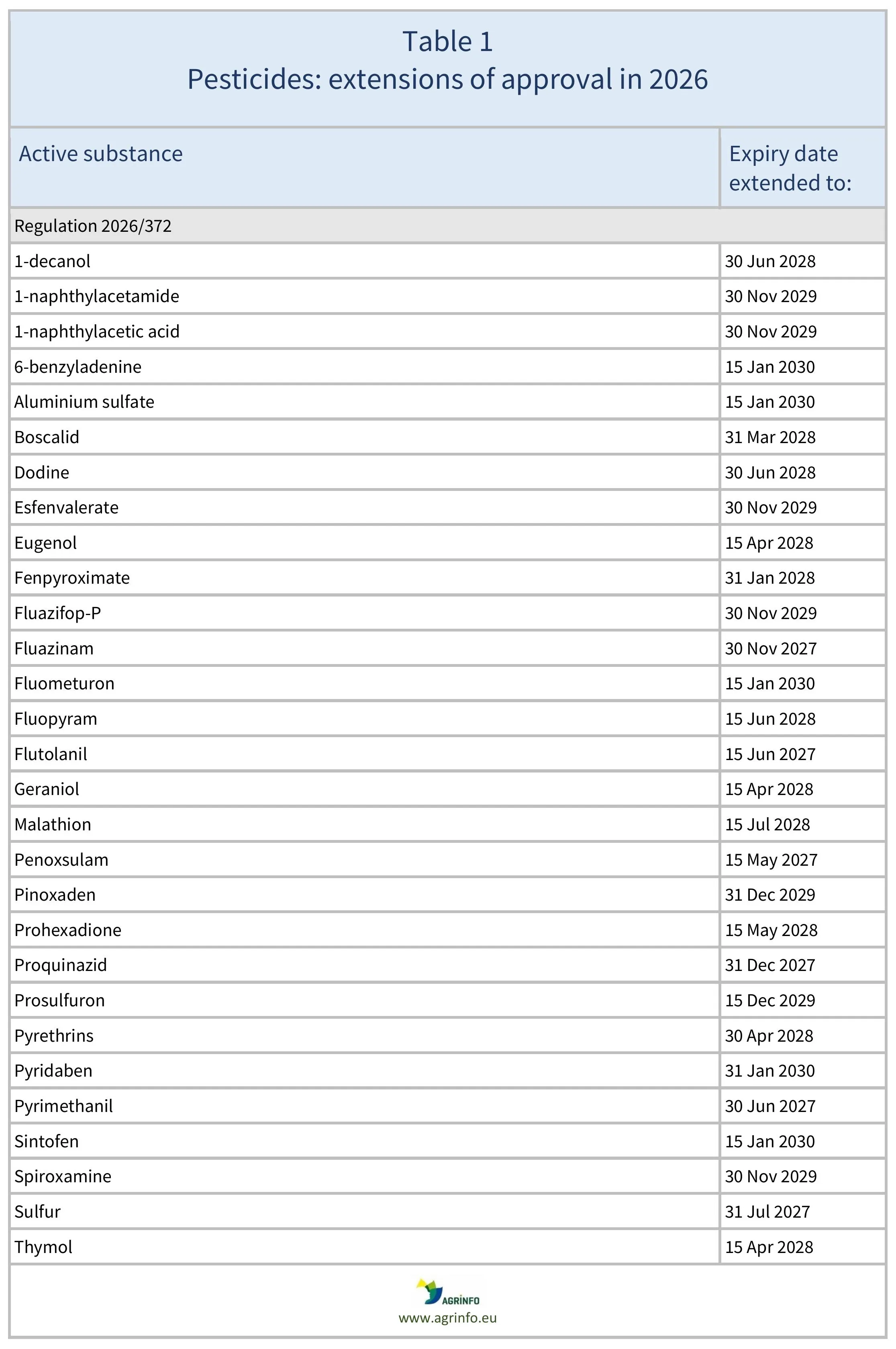
Source: based on Regulation 2026/372
Disclaimer: Under no circumstances shall COLEAD be liable for any loss, damage, liability or expense incurred or suffered that is claimed to have resulted from the use of information available on this website or any link to external sites. The use of the website is at the user’s sole risk and responsibility. This information platform was created and maintained with the financial support of the European Union. Its contents do not, however, reflect the views of the European Union.
EU pesticide approvals, renewals, and extensions in 2026
Commission Implementing Regulations 2026/312, 2026/321, 2026/351, 2026/355, 2026/372
What is changing and why?
Approvals and renewals
In February 2026, the European Union (EU) renewed its approval of:
- maltodextrin (as a low-risk substance) until 3 March 2041
- spinosad until 1 April 2041
- pyrimethanil until 30 April 2041.
Amendments to conditions of approval
In February 2026, the EU amended the conditions of use for maleic hydrazide:
- the requirement to indicate on the label of treated crops that they had been treated with this substance is now removed
- the restriction that this substance may not be used on crops intended to be fed to livestock is now removed.
Extensions and amendments
So far in 2026, the EU has extended approval of the substances listed in Table 1.
Actions
Suppliers to the EU market should monitor developments in EU approvals when considering longer-term strategies on agricultural practices.
Timeline
A comprehensive list of active substances, their legal status, and expiry dates can be found in the European Commission’s Active substances, safeners and synergists database.
Tables & Figures
Source: based on Regulation 2026/372
Disclaimer: Under no circumstances shall COLEAD be liable for any loss, damage, liability or expense incurred or suffered that is claimed to have resulted from the use of information available on this website or any link to external sites. The use of the website is at the user’s sole risk and responsibility. This information platform was created and maintained with the financial support of the European Union. Its contents do not, however, reflect the views of the European Union.