
Lists of non-EU countries for public health and animal health – explained
- Animal health
- Third country lists
- Food safety
- Third country lists
- Animal health controls
- Food safety controls
- Official controls
Summary
Countries wishing to export animals and food of animal origin to the European Union (EU) must provide evidence that they can fulfil the EU’s public and animal health requirements. Once adequate guarantees have been provided, the country is approved and included on a list of authorised countries. The country must be listed for the specific type of animal product to be exported, and in accordance with the relevant listing requirements. This explainer provides an overview of the public and animal health listings required for each product.
Lists of non-EU countries approved for export of animals and animal products
Commission Implementing Regulation (EU) 2021/404 of 24 March 2021 laying down the lists of third countries, territories or zones thereof from which the entry into the Union of animals, germinal products and products of animal origin is permitted in accordance with Regulation (EU) 2016/429 of the European Parliament and of the Council
Commission Implementing Regulation (EU) 2021/405 of 24 March 2021 laying down the lists of third countries or regions thereof authorised for the entry into the Union of certain animals and goods intended for human consumption in accordance with Regulation (EU) 2017/625 of the European Parliament and of the Council
Update
Countries wishing to export animals and food of animal origin to the European Union (EU) must provide evidence that they can fulfil the EU’s public and animal health requirements. Once adequate guarantees have been provided, the country is approved and included on a list of authorised countries. The country must be listed for the specific type of animal product to be exported, and in accordance with the relevant listing requirements. This explainer provides an overview of the public and animal health listings required for each product.
Impacted Products
Animals and animal products
What is changing?
Animals and animal products can only be exported to the EU from non-EU countries that have been approved and listed as meeting the EU’s public health and animal health requirements. The lists of approved countries are found in the Annexes to the Regulations that set out these requirements:
- residue control plans (Regulation 2021/405, Annex -I)
- food safety (Regulation 2021/405, Annexes I to XVI)
- animal health (Regulation 2021/404).
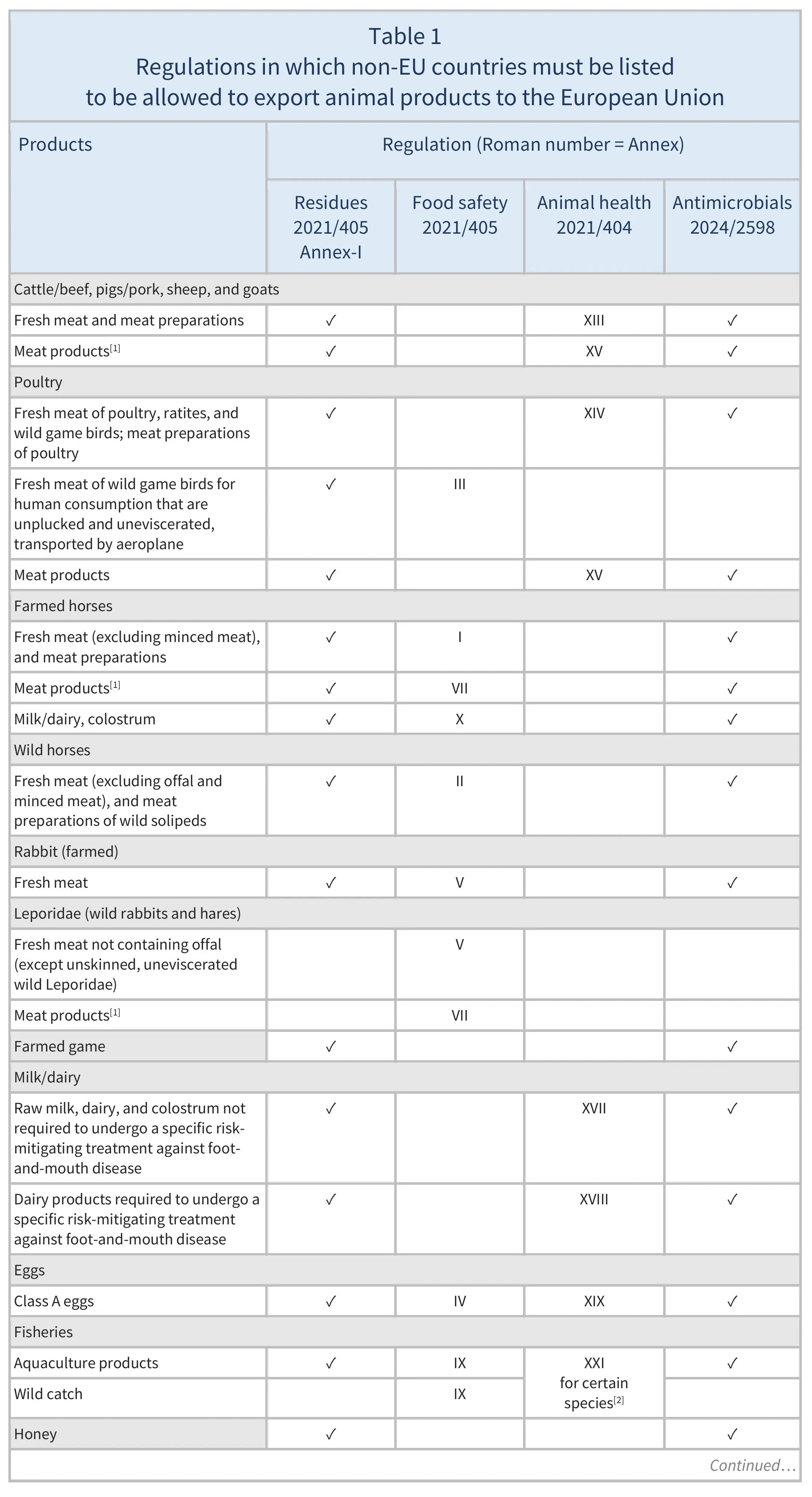
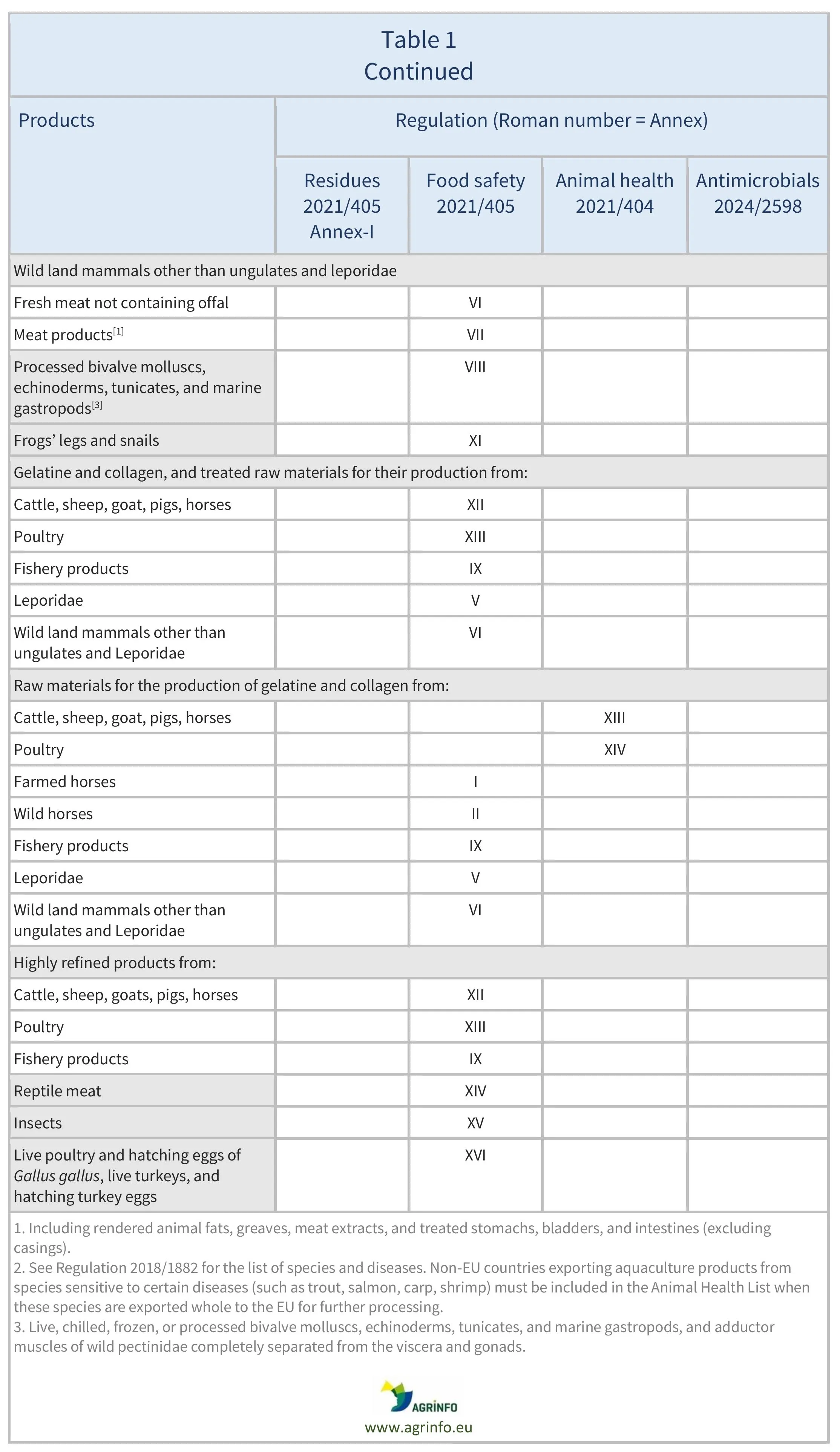
The requirement to be listed in one or more of these lists depends on the specific animal product. Table 1 provides an overview of products and the listings required.
From September 2026, there is an additional requirement to be listed in relation to the management of antimicrobial medicines (see List of non-EU countries compliant with new EU antimicrobial requirements). This requirement is also shown in Table 1.
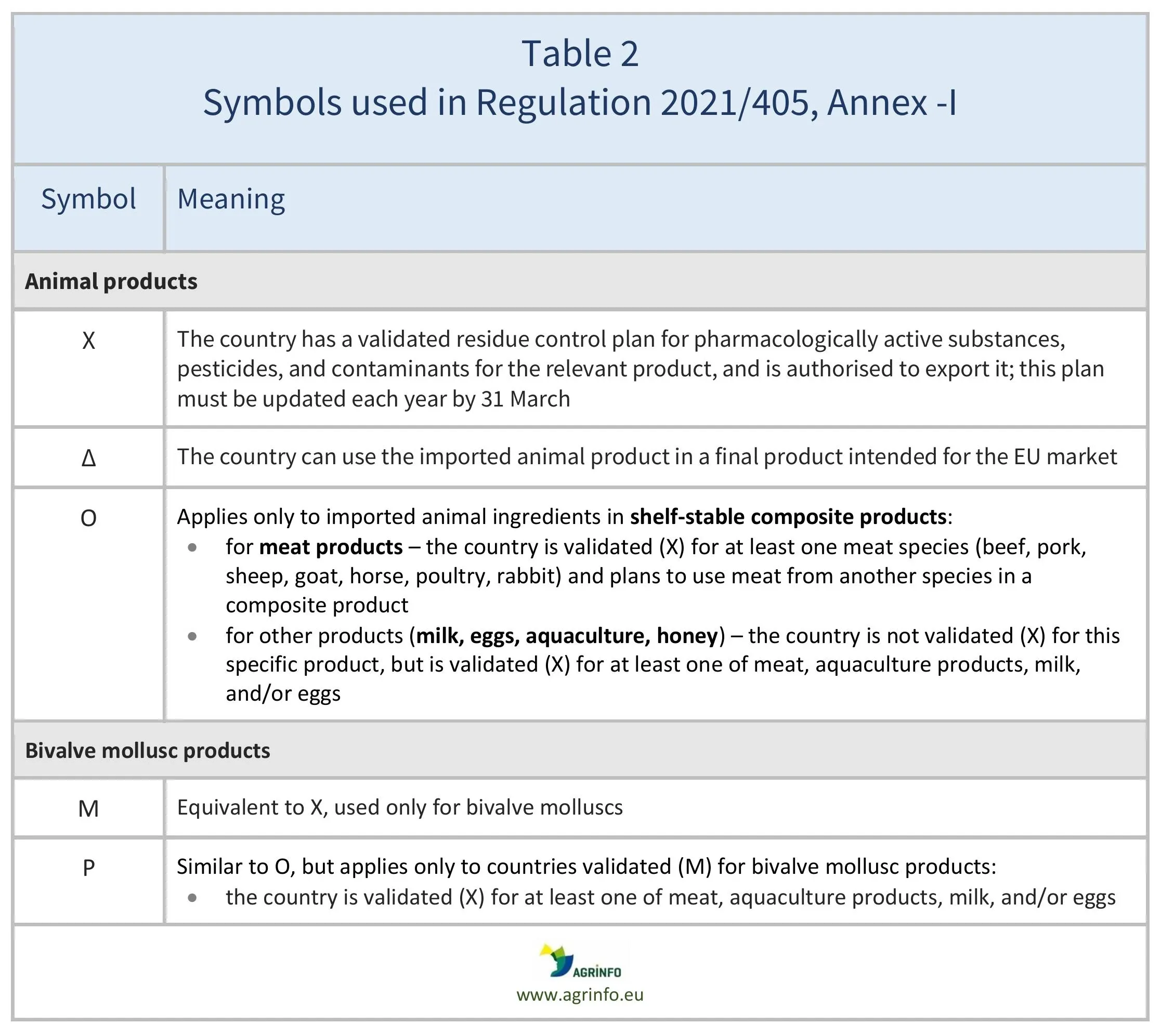
The symbols used in Annex -I of Regulation 2021/405 are explained in Table 2.
Why?
From the public and animal health perspectives, animal products imported into the EU from non-EU countries must be as safe as animal products produced within the EU. The EU therefore checks that non-EU countries have appropriate regulatory and control systems in place. This does not require non-EU countries to have exactly the same rules for official controls, but they must have a system that provides an equivalent level of animal and public safety.
If problems arise in relation to food safety or animal health, the EU can temporarily remove an approved non-EU country from the relevant list. Countries will be reapproved and listed once sufficient guarantees have been provided that EU standards are met.
Regarding animal health, the aim is to prevent, control, or eradicate animal diseases. When an animal disease occurs in a particular region, and measures have been taken to prevent it from spreading to other regions, the EU can potentially list one or more regions that are free from disease within a country, rather than the whole country. This is the principle of “regionalisation”.
Recommended Actions
Competent authorities
Competent authorities of non-EU countries exporting food-producing animals and food of animal origin to the EU should take the following actions.
If already listed: ensure compliance is maintained. The EU regularly audits both its partner countries and EU Member States. The work programme and audit reports are published by the European Commission (see 2026 food audit programme: non-EU countries targeted for controls).
- For animal health, the EU works closely with the World Organisation for Animal Health (WOAH) regarding which diseases need to be notified. The EU also regularly audits its partner countries: the work programme and reports are published on the Commission’s Audit Reports webpage.
- For public health, the residue control plans must be updated every year by 31 March.
If not yet listed: start the procedure for recognition of the country’s animal health and public requirements as soon as possible. Competent authorities of partner countries may raise questions with SANTE-CONSULT-A5@ec.europa.eu; and if specifically on residues, with sante-tcresidueplans@ec.europa.eu.
Companies
For companies in non-EU countries wishing to export food-producing animals and products of animal origin to the EU:
- inform the competent authority of your interest
- stay in regular contact with the competent authority to facilitate the approval process
- comply with EU requirements so that your authority can list your establishment as approved to export to the EU (see Approval of third country establishments explained).
Background
The EU has strict rules on the animal and public health requirements for products of animal origin entering the European Union. These rules are set out in various EU Regulations, summarised on the European Commission webpage Products of animal origin for human consumption.
To be listed, non-EU countries must meet the following requirements.
Public health
Competent authorities must demonstrate that there is in place a legal framework and a system of official controls enabling them to guarantee that establishments producing animal products comply with EU requirements. See Official Controls Regulation – explained and Public health requirements for exporting live animals, products of animal origin, composite products and sprouted seeds to the EU (Regulations 2017/625, Art. 126(2) and 2022/2292).
Animal health
Exporting countries must, in particular, have in place:
- a legal framework and efficient official controls when importing and exporting animals and animal products, including certification procedures
- a notification system for animal diseases
- a system to detect emerging diseases and to prevent contamination via swill feeding
- the ability to ensure that animals and animal products are not from restricted zones or establishments subject to national restriction measures for animal health reasons, and that animals do not show symptoms of transmissible diseases at the time of loading for dispatch to the EU
(Regulations 2016/429, Art. 230(1) and 2020/692, e.g. Arts. 6,7).
After an exporting country has been approved and listed by the EU, individual establishments producing animal products for the EU market must be listed by the competent authorities of that exporting country. For further information, see List of non-EU country establishments explained.
Consignments of animal products must be accompanied by the relevant health certificate. See Approval of third country establishments explained).
Resources
Online resources from the European Commission:
- EU entry conditions
- Establishment Lists
- Products of animal origin for human consumption
- Access2Markets: Exporting from the EU, importing into the EU – all you need to know
The procedure for non-EU countries to apply for listing is described at the end of the following factsheets:
- European Union import conditions for poultry and poultry products
- EU import conditions for fresh meat and meat products
- EU import conditions for seafood and other fishery products
Commission Delegated Regulation (EU) 2022/2292 with regard to requirements for the entry into the Union of consignments of food-producing animals and certain goods intended for human consumption
Commission Delegated Regulation (EU) 2020/692 as regards rules for entry into the Union, and the movement and handling after entry of consignments of certain animals, germinal products and products of animal origin
Regulation (EU) 2017/625 on official controls and other official activities performed to ensure the application of food and feed law, rules on animal health and welfare, plant health and plant protection products
Regulation (EU) 2016/429 on transmissible animal diseases and amending and repealing certain acts in the area of animal health (Animal Health Law)
Commission Implementing Regulation (EU) 2024/2598 laying down the list of third countries or regions thereof authorised for the entry into the Union of certain animals and products of animal origin intended for human consumption in accordance with Regulation (EU) 2017/625 as regards the application of the prohibition on the use of certain antimicrobial medicinal products
Sources
Commission Implementing Regulation (EU) 2021/404 laying down the lists of third countries, territories or zones thereof from which the entry into the Union of animals, germinal products and products of animal origin is permitted
Commission Implementing Regulation (EU) 2021/405 laying down the lists of third countries or regions thereof authorised for the entry into the Union of certain animals and goods intended for human consumption
Disclaimer: Under no circumstances shall COLEAD be liable for any loss, damage, liability or expense incurred or suffered that is claimed to have resulted from the use of information available on this website or any link to external sites. The use of the website is at the user’s sole risk and responsibility. This information platform was created and maintained with the financial support of the European Union. Its contents do not, however, reflect the views of the European Union.