
Maximum residue levels for dicofol
- Food safety
- Pesticide MRLs
Summary
The European Union (EU) has notified the World Trade Organization Sanitary and Phytosanitary Measures (WTO SPS) Committee of a draft proposal to reduce the maximum residue levels (MRLs) for dicofol on certain products to the limit of determination (LOD) (G/SPS/N/EU/959). (The LOD is the lowest level that can be detected using the most modern and reliable analytical methods.) There will be particular impacts on melons, cotton seeds, teas, hops, and poultry products.
The EU also proposes to reduce the current LODs on some other products.
EU proposes to reduce MRLs for dicofol with particular impacts on melons, cotton seeds, teas, hops, and poultry products
Draft Commission Regulation amending Annexes II, III and V to Regulation (EC) No 396/2005 of the European Parliament and of the Council as regards maximum residue levels for azocyclotin, chlorfenapyr, cyhexatin, diazinon, dicofol, endosulfan, fenarimol, fenpropathrin and profenofos in or on certain products
Draft Annex V
Update
The European Union (EU) has notified the World Trade Organization Sanitary and Phytosanitary Measures (WTO SPS) Committee of a draft proposal to reduce the maximum residue levels (MRLs) for dicofol on certain products to the limit of determination (LOD) (G/SPS/N/EU/959). (The LOD is the lowest level that can be detected using the most modern and reliable analytical methods.) There will be particular impacts on melons, cotton seeds, teas, hops, and poultry products.
The EU also proposes to reduce the current LODs on some other products.
Impacted Products
Almonds, Brazil nuts, cashew nuts, chestnuts, coconuts, hazelnuts/cobnuts, macadamias, pecans, pine nut kernels, pistachios, walnuts, garlic, onions, shallots, spring onions/green onions, Welsh onions, melons, linseeds, peanuts/groundnuts, poppy seeds, sesame seeds, sunflower seeds, rapeseed/canola seeds, soyabeans, mustard seeds, pumpkin seeds, safflower seeds, borage seeds, gold of pleasure seeds, hemp seeds, castor beans, cotton seeds, olives for oil production, oil palm kernels, oil palm fruits, kapok, teas, chamomile, hibiscus/roselle, rose, jasmine, lime/linden, other flower infusions, strawberry, rooibos, mate/maté, other leaves/herb infusions, valerian, ginseng, other root infusions, cocoa beans, carobs, hops, anise/aniseed, black caraway/black cumin, celery, coriander, cumin, dill, fennel, fenugreek, nutmeg, other seed spices, allspice/pimento, Sichuan pepper, caraway, juniper berry, peppercorn (black, green, white), vanilla, tamarind, other fruit spices, cinnamon, other bark spices, liquorice, ginger, turmeric/curcuma, horseradish, other root/rhizome spices, cloves, capers, other bud spices, saffron, other flower pistil spices, mace, other aril spices, muscle, liver, kidney, edible offals (poultry), milk (cattle, sheep, goat, horse), bird eggs (chicken, duck, geese, quail), honey and other apiculture products
What is changing?
The EU proposes to reduce the MRLs for dicofol as summarised in Table 1.
Why?
Dicofol has never been approved for use within the EU, and the MRLs for imported produce that have been in place since the adoption of Regulation 396/2005 have never been reviewed. Following a series of evaluations and a stakeholder consultation (see EFSA invites submission of data to support review of certain MRLs), the European Food Safety Authority has concluded that there is not sufficient toxicological data for melons, cotton seeds, teas, hops, and poultry products to allow a complete exposure assessment (EFSA 2023).
Timeline
The proposed new MRLs are expected to apply from September 2027.
Recommended Actions
Suppliers to the EU market of melons, cotton seeds, teas, hops, and poultry products should review their existing use of dicofol and start to look for alternative (chemical or non-chemical) solutions in anticipation of the MRL reductions.
The WTO consultation on this proposal closed on 25 August 2026.
Background
MRLs are set in accordance with the rules set out in Regulation 396/2005. For information on current MRLs for other substances, please consult the EU Pesticide Residues database.
For further information on the EU’s process and principles for setting MRLs, see Regulation of pesticide residues in the EU - Questions and Answers.
Resources
EFSA (2023) Targeted review of maximum residue levels (MRLs) for dicofol. EFSA Journal, 21: e8425.
Sources
Draft Commission Regulation as regards maximum residue levels for azocyclotin, chlorfenapyr, cyhexatin, diazinon, dicofol, endosulfan, fenarimol, fenpropathrin and profenofos in or on certain products
Draft Annex V
Tables & Figures
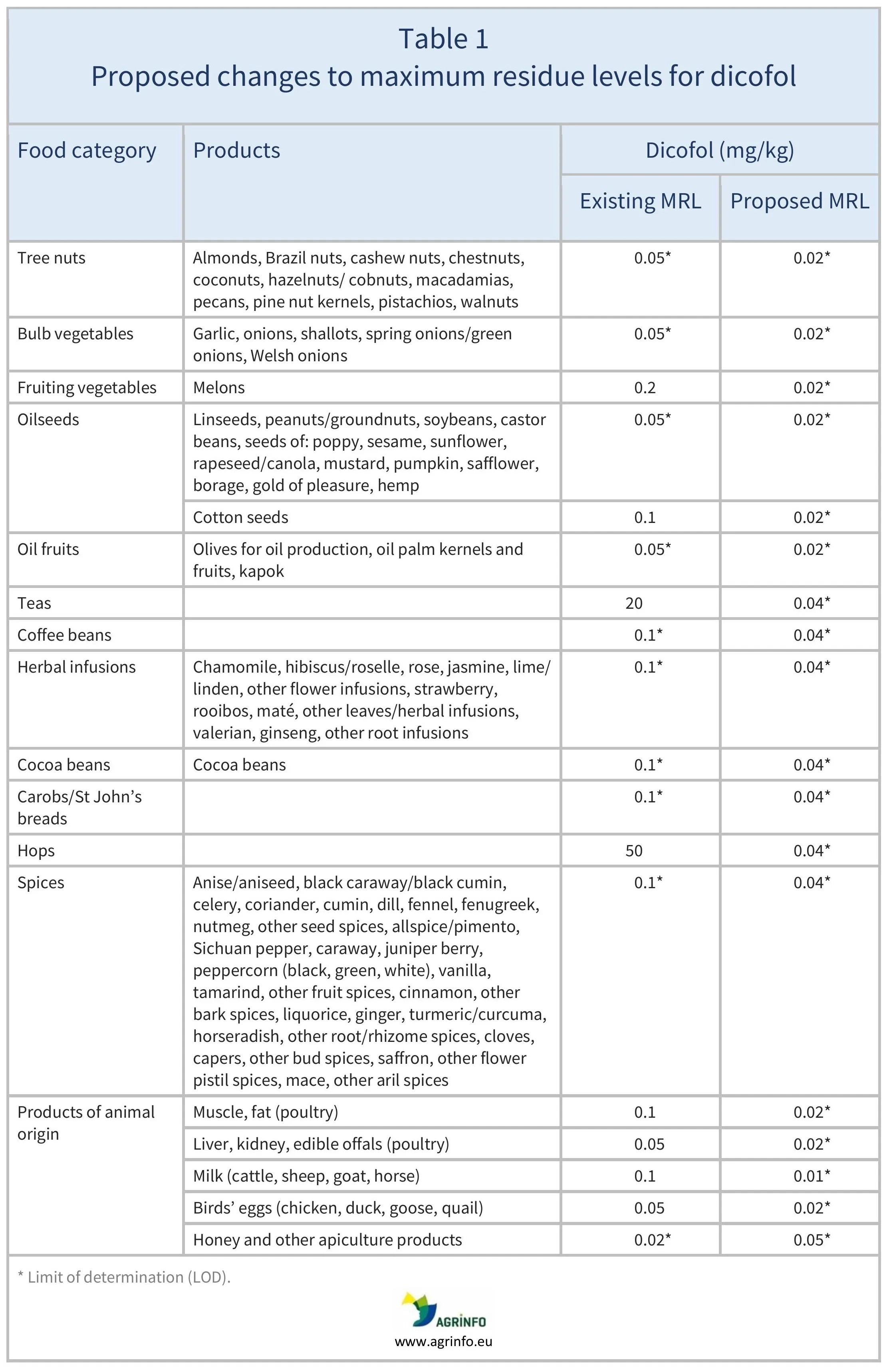
Source: based on Draft Annex V
Disclaimer: Under no circumstances shall COLEAD be liable for any loss, damage, liability or expense incurred or suffered that is claimed to have resulted from the use of information available on this website or any link to external sites. The use of the website is at the user’s sole risk and responsibility. This information platform was created and maintained with the financial support of the European Union. Its contents do not, however, reflect the views of the European Union.
EU proposes to reduce MRLs for dicofol with particular impacts on melons, cotton seeds, teas, hops, and poultry products
Draft Commission Regulation as regards maximum residue levels for azocyclotin, chlorfenapyr, cyhexatin, diazinon, dicofol, endosulfan, fenarimol, fenpropathrin and profenofos in or on certain products
Draft Annex V
What is changing and why?
The European Union (EU) proposes to reduce the maximum residue levels (MRLs) for dicofol to the limit of determination (LOD) on several products, with the most significant impacts on melons, cotton seeds, teas, hops, and poultry products (see Table 1). This is because the European Food Safety Authority was unable to complete a risk assessment of this pesticide due to a lack of relevant data. Dicofol has never been approved for use within the EU.
The EU also proposes to reduce the current LODs on some other products.
Actions
Suppliers to the EU market of melons, cotton seeds, teas, hops, and poultry products should review their existing use of dicofol and start to look for alternative solutions.
The World Trade Organization consultation on this proposal closed on 25 August 2026.
Timeline
The proposed new MRLs are expected to apply from September 2027.
Tables & Figures
Source: based on Draft Annex V
Disclaimer: Under no circumstances shall COLEAD be liable for any loss, damage, liability or expense incurred or suffered that is claimed to have resulted from the use of information available on this website or any link to external sites. The use of the website is at the user’s sole risk and responsibility. This information platform was created and maintained with the financial support of the European Union. Its contents do not, however, reflect the views of the European Union.