
Maximum residue levels for mandipropamid
- Food safety
- Pesticide MRLs
Summary
The European Union (EU) has notified the World Trade Organization Sanitary and Phytosanitary Measures (WTO SPS) Committee of a draft proposal to lower the maximum residue levels (MRLs) for mandipropamid on sweet peppers and melons (G/SPS/N/EU/943).
EU to lower MRLs for mandipropamid on sweet peppers and melons in line with Codex standards
Draft Commission Regulation amending Annexes II, III and V to Regulation (EC) No 396/2005 of the European Parliament and of the Council as regards maximum residue levels for carbofuran, imazalil, mandipropamid, propaquizafop, quizalofop-P-ethyl and quizalofop-P-tefuryl in or on certain products
Draft Annex (PLAN/2025/2832)
Update
The European Union (EU) has notified the World Trade Organization Sanitary and Phytosanitary Measures (WTO SPS) Committee of a draft proposal to lower the maximum residue levels (MRLs) for mandipropamid on sweet peppers and melons (G/SPS/N/EU/943).
Impacted Products
Sweet peppers, melons
What is changing?
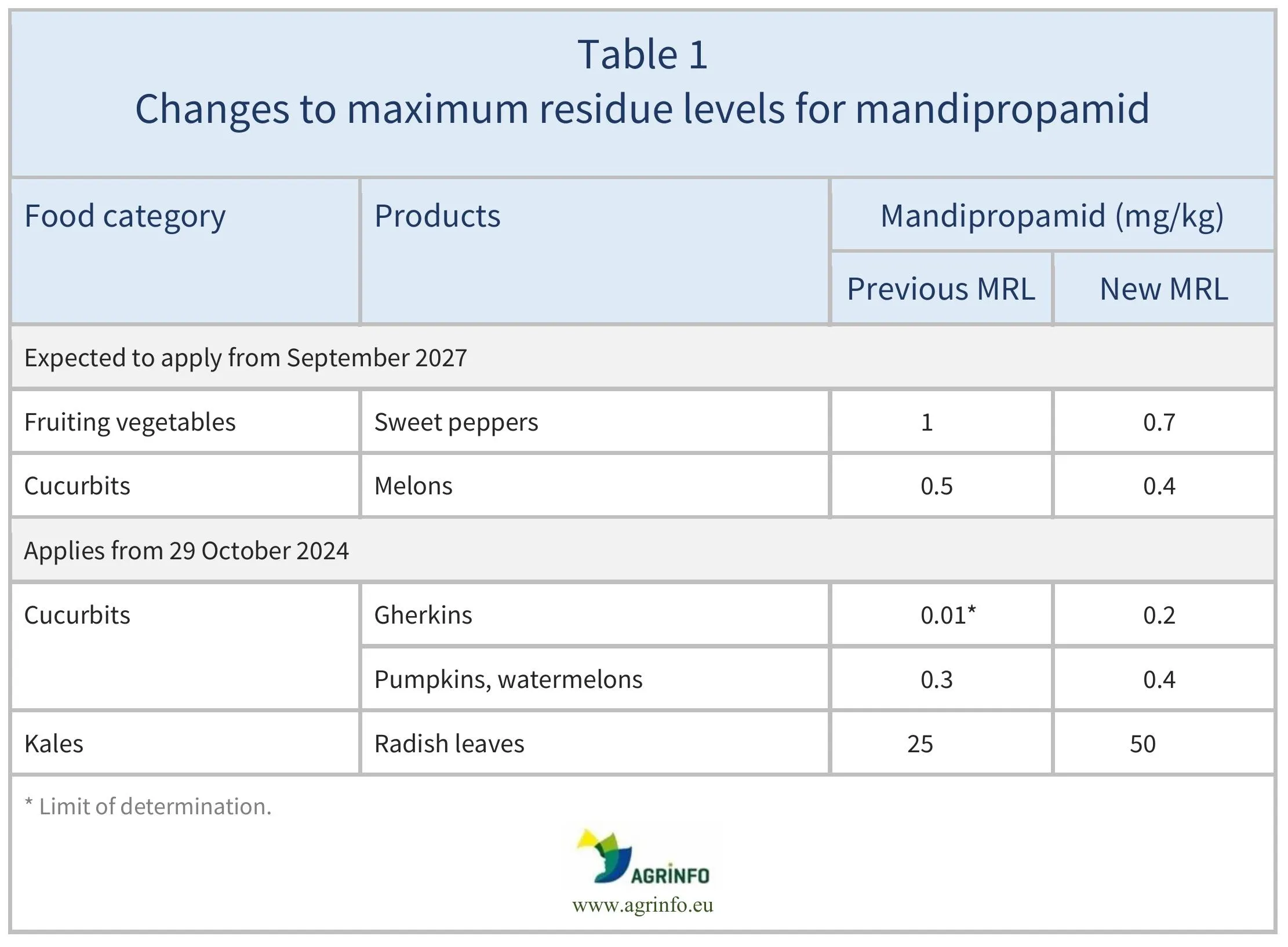
The EU is proposing to lower the MRLs for mandipropamid on sweet peppers from 1 to 0.7 mg/kg, and on melons from 0.5 to 0.4 mg/kg.
This follows MRL increases for mandipropamid on gherkins, pumpkins, watermelons and radish leaves in October 2024, as summarised in Table 1.
Why?
The proposed MRLs for sweet peppers and melons are aligned with Codex Alimentarius Commission maximum residue limits (CXLs) for mandipropamid on these products, and with a view to setting MRLs at levels as low as reasonably achievable. The European Food Safety Authority (EFSA 2023a) did not identify risks to consumers at these levels.
Timeline
The proposed new MRLs for sweet peppers and melons are expected to apply from September 2027.
The MRLs on gherkins, pumpkins, watermelons, and radish leaves have applied since 29 October 2024.
Recommended Actions
To ensure compliance with the new MRLs, suppliers of sweet peppers and melons should review their use of mandipropamid and assess where changes will be needed to existing good agricultural practices (GAPs).
The consultation on this proposal closed on 30 June 2026.
Background
In October 2024, the EU raised the MRL on gherkins from 0.01 to 0.2 mg/kg; and on pumpkins and watermelons from 0.3 to 0.4 mg/kg, based on new CXLs. The MRL on radish leaves was raised from 25 to 50 mg/kg after a request for modification of the MRL and after EFSA (2023b) concluded that the modification was acceptable for consumer safety.
MRLs are set in accordance with the rules set out in Regulation 396/2005. For information on current MRLs for other substances, please consult the EU Pesticide Residues database.
For further information on the setting of import tolerances, see Pesticide residue import tolerance MRLs explained.
Resources
Commission Regulation (EU) 2024/2633 as regards maximum residue levels for azoxystrobin, famoxadone, flutriafol, mandipropamid and mefentrifluconazole in or on certain products
EFSA (2023a) Scientific support for preparing an EU position in the 54th Session of the Codex Committee on Pesticide Residues (CCPR). EFSA Journal, 21(8): e08111.
EFSA (2023b) Modification of the existing maximum residue level for mandipropamid in radish leaves. EFSA Journal, 21(12): e8421.
Sources
Disclaimer: Under no circumstances shall COLEAD be liable for any loss, damage, liability or expense incurred or suffered that is claimed to have resulted from the use of information available on this website or any link to external sites. The use of the website is at the user’s sole risk and responsibility. This information platform was created and maintained with the financial support of the European Union. Its contents do not, however, reflect the views of the European Union.
EU to lower MRLs for mandipropamid on sweet peppers and melons in line with Codex standards
Draft Commission Regulation as regards maximum residue levels for carbofuran, imazalil, mandipropamid, propaquizafop, quizalofop-P-ethyl and quizalofop-P-tefuryl in or on certain products
Draft Annex (PLAN/2025/2832)
What is changing and why?
The European Union (EU) is proposing to lower the maximum residue levels (MRLs) for mandipropamid on sweet peppers from 1 to 0.7 mg/kg, and on melons from 0.5 to 0.4 mg/kg.
The proposed MRLs are aligned with Codex Alimentarius Commission maximum residue limits (CXLs) for mandipropamid on these products. The European Food Safety Authority did not identify risks to consumers at the current levels.
This follows MRL increases for mandipropamid on several products in 2024, as summarised in Table 1.
Actions
To ensure compliance with the new MRLs, suppliers of sweet peppers and melons should review their use of mandipropamid and assess where changes will be needed to existing good agricultural practices (GAPs).
The consultation on this proposal closed on 30 June 2026.
Timeline
The proposed new MRLs for sweet peppers and melons are expected to apply from September 2027.
The MRLs on gherkins, pumpkins, watermelons, and radish leaves have applied since 29 October 2024.
Disclaimer: Under no circumstances shall COLEAD be liable for any loss, damage, liability or expense incurred or suffered that is claimed to have resulted from the use of information available on this website or any link to external sites. The use of the website is at the user’s sole risk and responsibility. This information platform was created and maintained with the financial support of the European Union. Its contents do not, however, reflect the views of the European Union.