
Composite products exempted from official controls at border control posts
- Official controls
Summary
The European Union (EU) has updated the list of shelf-stable composite products that are exempted from official controls at border control posts. The list now includes certain cereal products such as popcorn, corn sticks and puffs; potato chips and crisps suitable for immediate consumption; prepared or preserved vegetables, fruits, nuts, and other edible parts of plants that contain honey as the only ingredient of animal origin; sauces containing oyster or fish extracts; sauces and preparations, condiments, and seasonings that contain honey as the only ingredient of animal origin; and sweets, gums etc. that contain synthetic sweetening agents.
EU extends the list of composite products exempted from official controls at border control posts
Commission Delegated Regulation (EU) 2026/908 of 27 April 2026 amending Delegated Regulation (EU) 2021/630 as regards the private attestation requirements of the composite products exempted from official controls at border control posts, and the inclusion of certain cereal products, prepared or preserved vegetables, fruits, nuts, sauces, condiments, seasonings and confectionery in the list of exempted composite products
Update
The European Union (EU) has updated the list of shelf-stable composite products that are exempted from official controls at border control posts. The list now includes certain cereal products such as popcorn, corn sticks and puffs; potato chips and crisps suitable for immediate consumption; prepared or preserved vegetables, fruits, nuts, and other edible parts of plants that contain honey as the only ingredient of animal origin; sauces containing oyster or fish extracts; sauces and preparations, condiments, and seasonings that contain honey as the only ingredient of animal origin; and sweets, gums etc. that contain synthetic sweetening agents.
Impacted Products
Cereal products such as popcorn, corn sticks and puffs; potato chips and crisps suitable for immediate consumption; prepared or preserved vegetables, fruits, nuts, and other edible parts of plants that contain honey as the only ingredient of animal origin; sauces containing oyster or fish extracts; sauces and preparations, condiments, and seasonings that contain honey as the only ingredient of animal origin; and sweets, gums etc. that contain synthetic sweetening agents
What is changing?
Most animal products exported to the EU are subject to official controls at border control posts. Certain composite products (that contain a mixture of plant-based and processed animal ingredients) are considered to be low risk and do not need to undergo these controls, provided they fulfil certain requirements (see Background).
The complete list of products exempted from mandatory controls is given in the Annex to Regulation 2021/630.
This new Regulation:
- updates the list of exempted products, adding those listed in Table 1
- clarifies that private attestations are not required for shelf-stable composite products containing gelatine or collagen that is not derived from ruminant bones (in line with Regulation 2025/637 – see Clarification of import requirements for certain animal products).
The Annex to Regulation 2021/630 will be replaced by the Annex to this new Regulation.
Why?
The shelf-stable composite products in listed Table 1 are considered to pose a low risk to human and animal health.
Timeline
This Regulation applies from 23 July 2026.
What are the major implications for exporting countries?
Regulation 2026/908 clarifies that there are no mandatory official controls at EU border control posts of the shelf-stable composite products listed in Table 1, removing the confusion that has surrounded many of these products.
Competent authorities can still choose to control these products at the place of destination, during customs controls, or at the premises of the operator responsible for the consignment, based on a risk assessment of the need for controls.
Background
Regulation 2022/2292 lays down requirements for composite products entering the EU from non-EU countries.
The rules specifying which animal products require official controls at border control posts are set out in:
- Regulation 2021/630: composite products exempt from official controls
- Regulation 2021/632: composite products that must undergo official controls.
Composite products are only exempt from official controls at border control posts if they:
- are shelf-stable (do not need to be transported or stored under controlled temperatures) and do not contain shelf-stable processed meat
- are exported from countries that are authorised to export the specific ingredients contained in the EU composite products
- contain only dairy and egg ingredients that have undergone appropriate risk-mitigating treatments (Regulation 2020/692, Art. 163)
- are identified for human consumption
- are securely packaged or sealed.
Regulation 2022/2292 (Art. 20.4) states that no private attestation is required for composite products where the only animal ingredient is food additives (Regulation 1333/2008), flavourings (Regulation 1334/2008), enzymes (Regulation 1332/2008), or vitamin D3 or gelatine capsules not derived from ruminant bones (Regulation 2025/637 – see Clarification of import requirements for certain animal products).
Resources
Commission Delegated Regulation (EU) 2022/2292 with regard to requirements for the entry into the Union of consignments of food-producing animals and certain goods intended for human consumption
Commission Delegated Regulation (EU) 2021/630 as regards certain categories of goods exempted from official controls at border control posts and amending
Commission Implementing Regulation (EU) 2021/632 as regards the lists of animals, products of animal origin, germinal products, animal by-products and derived products, composite products, and hay and straw subject to official controls at border control posts
Commission Delegated Regulation (EU) 2020/692 as regards rules for entry into the Union, and the movement and handling after entry of consignments of certain animals, germinal products and products of animal origin
Regulation (EC) No 1333/2008 on food additives
Regulation (EC) No 1334/2008 on flavourings and certain food ingredients with flavouring properties for use in and on foods
Regulation (EC) No 1332/2008 on food enzymes
Regulation (EC) No 853/2004 laying down specific hygiene rules for food of animal origin
Sources
Commission Delegated Regulation (EU) 2026/908 as regards the private attestation requirements of the composite products exempted from official controls at border control posts, and the inclusion of certain cereal products, prepared or preserved vegetables, fruits, nuts, sauces, condiments, seasonings and confectionery in the list of exempted composite products
Tables & Figures
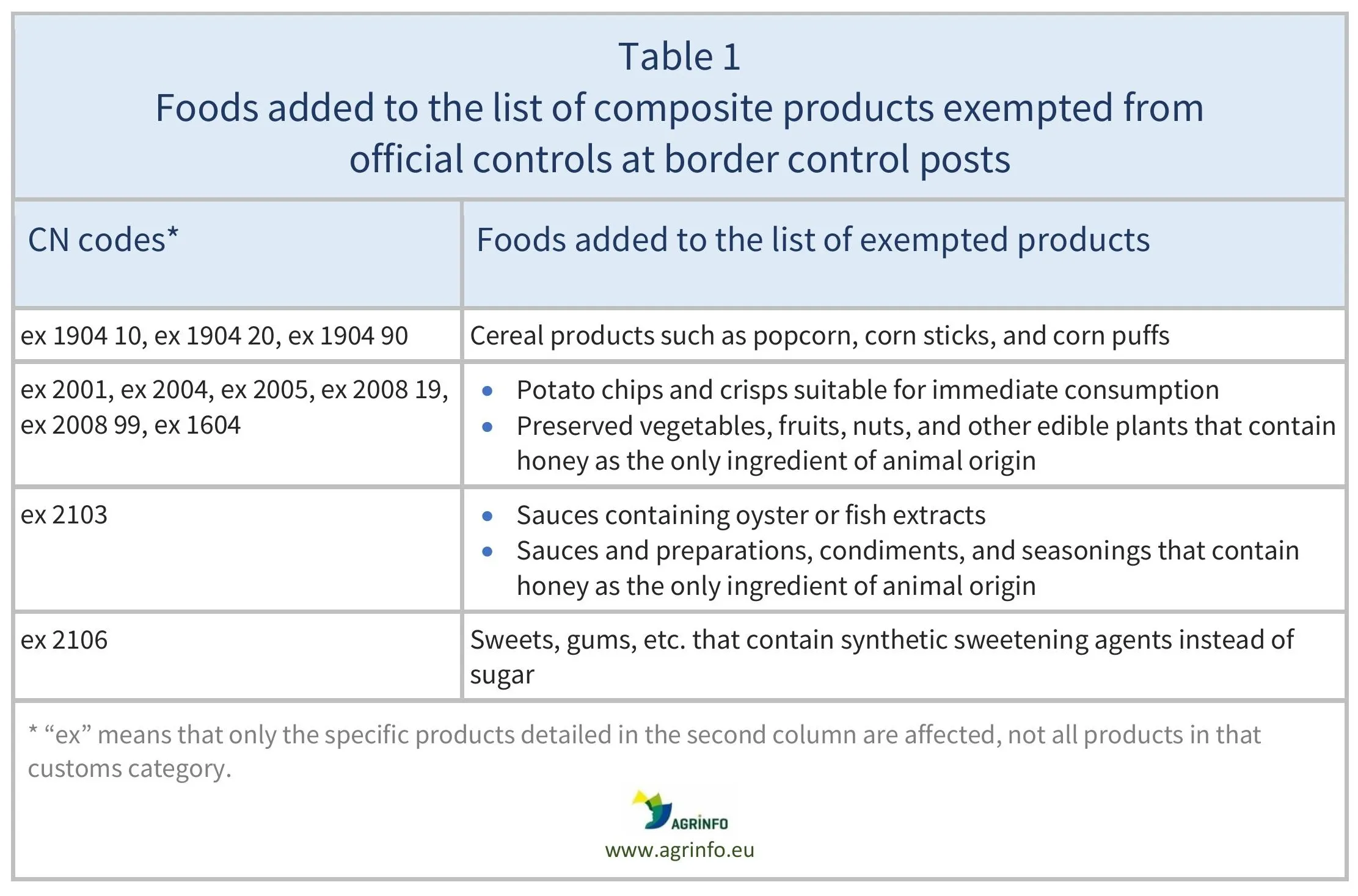
Source: based on Regulation 2026/908, Annex
Disclaimer: Under no circumstances shall COLEAD be liable for any loss, damage, liability or expense incurred or suffered that is claimed to have resulted from the use of information available on this website or any link to external sites. The use of the website is at the user’s sole risk and responsibility. This information platform was created and maintained with the financial support of the European Union. Its contents do not, however, reflect the views of the European Union.
EU extends the list of composite products exempted from official controls at border control posts
Commission Delegated Regulation (EU) 2026/908 as regards the private attestation requirements of the composite products exempted from official controls at border control posts, and the inclusion of certain cereal products, prepared or preserved vegetables, fruits, nuts, sauces, condiments, seasonings and confectionery in the list of exempted composite products
What is changing and why?
Certain composite products (that contain a mixture of plant-based and animal ingredients) are considered to be low risk and do not need to undergo mandatory official controls at European Union (EU) border control posts.
The complete list of products exempted from official controls is listed in the Annex to Regulation 2021/630 and will be updated by this new Regulation.
The new Regulation:
- updates the list of exempted products to include those in Table 1
- clarifies that private attestations are not required for shelf-stable composite products containing gelatine or collagen that is not derived from ruminant bones.
Timeline
This Regulation applies from 23 July 2026.
Tables & Figures
Source: based on Regulation 2026/908, Annex
Disclaimer: Under no circumstances shall COLEAD be liable for any loss, damage, liability or expense incurred or suffered that is claimed to have resulted from the use of information available on this website or any link to external sites. The use of the website is at the user’s sole risk and responsibility. This information platform was created and maintained with the financial support of the European Union. Its contents do not, however, reflect the views of the European Union.