
EU fishing opportunities for 2026–2028
- Common Fisheries Policy
Summary
Regulation 2026/249 fixes EU fishing opportunities for 2026–2028, including for EU vessels fishing outside EU waters. This Regulation also implements the latest resolutions of several regional fisheries management organisations (RFMOs).
Regulation 2026/786 amends Regulation 2026/249 regarding EU fishing opportunities for stocks managed by RFMOs, and for certain stocks jointly managed with non-EU countries. It takes into account the latest scientific advice, and outcomes of consultations with non-EU countries and RFMOs.
European Commission fixes its fishing opportunities for 2026–2028
Council Regulation (EU) 2026/786 of 30 March 2026 amending Regulation (EU) 2026/249 fixing for 2026, 2027 and 2028 the fishing opportunities for certain fish stocks, applicable in Union waters and, for Union fishing vessels, in certain non-Union waters
Council Regulation (EU) 2026/249 of 26 January 2026 fixing for 2026, 2027 and 2028 the fishing opportunities for certain fish stocks, applicable in Union waters and, for Union fishing vessels, in certain non-Union waters, and amending Regulation (EU) 2025/202
Update
Regulation 2026/249 fixes EU fishing opportunities for 2026–2028, including for EU vessels fishing outside EU waters. This Regulation also implements the latest resolutions of several regional fisheries management organisations (RFMOs).
Regulation 2026/786 amends Regulation 2026/249 regarding EU fishing opportunities for stocks managed by RFMOs, and for certain stocks jointly managed with non-EU countries. It takes into account the latest scientific advice, and outcomes of consultations with non-EU countries and RFMOs.
Impacted Products
Fish (marine capture)
What is changing?
Regulation 2026/249 fixes EU fishing opportunities, including catch and fishing effort limits for the years 2026, 2027, and 2028 for certain fish stocks. The Regulation also adopts several decisions that were taken by regional fisheries management organisations (RFMOs) during 2025 and 2026. Regulation 2026/786 amends certain fishing opportunities based on these decisions, and on outcomes of further consultations with non-EU countries and RFMOs taking into account new scientific advice.
The decisions concerning EU fishing opportunities outside EU waters include the following:
Tuna RFMOs
Commission for the Conservation of Southern Bluefin Tuna (CCSBT)
- Adopts the total allowable catch (TAC) for Southern bluefin tuna (Thunnus maccoyii) for the period 2024–2026.
International Commission for the Conservation of Atlantic Tunas (ICCAT)
- Increases the TAC for Atlantic bluefin tuna (Thunnus thynnus) in the eastern Atlantic, and decreases the retention allowance for shortfin mako (Isurus oxyrinchus) in the southern Atlantic for 2026 compared with 2025.
- Limits fishing effort ceilings in the ICCAT Convention area, including for EU vessels fishing eastern Atlantic bluefin tuna east of 45°W. Approved the European Commission’s request to carry over unfished EU quotas for that stock from 2025 to 2026.
- For certain EU Member States, transfers from 2024 to 2026 annual quotas in the ICCAT Convention area (both north and south of 5°N) for bigeye tuna (Thunnus obesus), albacore (Thunnus alalunga), and swordfish (Xiphias gladius). EU Member States’ quotas for those stocks for 2026 should be amended accordingly.
- Prohibits direct fishing in the ICCAT Convention area for species of thresher sharks (Alopias). Also prohibits retaining on board, in transhipment, or on land any part or whole carcass of shortfin mako (I. oxyrinchus) caught in the ICCAT Convention area north of 5°N.
- Prohibits the use of fish aggregating devices (FADs) in the ICCAT Convention area from 17 March to 30 April each year.
Inter-American Tropical Tuna Commission (IATTC)
- Revises its purse-seine closure arrangements for tuna fisheries. The closure period from 6 August to 8 October 2026 now applies across the whole IATTC area, while a closure period from 9 November 2026 to 11 January 2027 remains area-specific. Additional closure days linked to bigeye tuna catches apply only to the first closure period.
- Regulation 2021/56 covers management, conservation, and control measures for oceanic whitetip sharks (Carcharhinus longimanus) in the IATTC Convention Area; Art. 40 of Regulation 2026/249 duplicates this and is therefore deleted.
Indian Ocean Tuna Commission (IOTC)
- Reviews the catch limits for bigeye tuna (Thunnus obesus) in the IOTC Convention area for 2026, and adopts catch limits for skipjack tuna (Katsuwonus pelamis) for the first time.
- Sets a maximum number for EU vessels fishing for tropical tunas, swordfish (Xiphias gladius), and albacore (Thunnus alalunga) in its Area of Competence, and for the corresponding capacity in gross tonnage (Regulation 2026/249, Annex VIII).
- Sets conditions for the deployment of drifting FADs and supply vessels operating in support of purse seine fishing vessels. The EU will not register new or additional supply vessels in the IOTC record of authorised fishing vessels.
- Establishes a programme for transhipment by large-scale fishing vessels; and introduces requirements to declare the International Maritime Organization (IMO) identification number of the carrier vessel and fishing vessel, and to use Coordinated Universal Time (UTC) to indicate the time of transhipment (resolutions at IOTC 2025 Annual Meeting; Delegated Regulation (EU) 2026/117).
Antarctic
Commission for the Conservation of Antarctic Marine Living Resources (CCAMLR)
- Adopts Total Allowable Catch (TAC) and certain other limits for longline exploratory fisheries for toothfish (Dissostichus spp.) outside areas of national jurisdiction the CCAMLR Convention area for 1 December 2025 to 30 November 2026 (decision taken at CCAMLR 2025 Annual Meeting).
- Prohibits targeted fishing for sharks and sets by-catch restrictions. Any by-catch of shark taken accidentally in the toothfish fishery shall be released alive.
Atlantic Ocean
Fishery Committee for the Eastern Central Atlantic (CECAF)
- To provide legal certainty, 2026/786 adds to the TAC the scientific name Pegusa lascaris for sand sole (previously wrongly listed as “Solea spp.”). Regulation 2026/249 set a TAC for sole in certain International Council for the Exploration of the Sea (ICES) divisions in international waters and EU waters of CECAF but referred to “Solea spp.” which does not cover sand sole. The amended TAC applies retroactively from 1 January 2026.
Northwest Atlantic Fisheries Organization (NAFO)
- Adopts fishing opportunities for certain stocks in the NAFO Convention Area for 2026.
- Maintains for 2026 measures aimed at minimising the levels of by-catches of non-target species in fisheries of shortfin squid (Illex illecebrosus) and yellowtail flounder (Limanda ferruginea) in certain parts of the NAFO Convention Area.
South East Atlantic Fisheries Organisation (SEAFO)
- Maintains existing TACs in the SEAFO Convention Area for 2026.
- Prohibits directed fishing for deep-water sharks in the SEAFO Convention area (Regulation 2026/249, Art. 41).
Indian Ocean
Southern Indian Ocean Fisheries Agreement (SIOFA)
- Revises existing measures for deep-water sharks, including the closure of fishing areas, and the list of shark species for which directed fishing in the SIOFA Agreement Area is prohibited.
- Adopts a new measure for benthic fisheries, including closing certain areas for all bottom-fishing activities, and in certain areas allowing only bottom longline fishing.
Pacific
North Pacific Fisheries Commission (NPFC)
- Establishes fishing opportunities for chub mackerel (Scomber japonicus) in the NPFC Convention Area for 1 June 2026 to 31 May 2027, allowing EU fishing vessels holding a fishing authorisation to start fishing for chub mackerel from 1 June 2026.
South Pacific Regional Fisheries Management Organisation (SPRFMO)
- Adopts 2026 catch limits for jack mackerel (Trachurus murphyi) and maintains exploratory fisheries for toothfishes (Dissostichus spp.) (SPRFMO 2026 Annual Meeting).
Western and Central Pacific Fisheries Commission (WCPFC)
- Adopts a by-catch limit for Pacific bluefin tuna (Thunnus orientalis) for the WCPFC Convention Area.
- Sets a maximum number for EU purse seine fishing vessels authorised to fish for tropical tuna and swordfish (Xiphias gladius); and sets catch, effort, and area limits for swordfish. EU fishing vessels must not target South Pacific albacore (Thunnus alalunga) in the WCPFC Convention Area south of 20° S (Regulation 2026/249, Arts. 42, 44, 45).
- Sets conditions and closure periods for the deployment of FADs. None of the EU’s purse seine fishing vessels should at any time deploy at sea more than 350 FADs with activated instrumented buoys (Regulation 2026/249, Art. 43).
Fishing opportunities for non-EU country vessels in EU waters
In the exclusive economic zone off the coast of French Guiana, the EU has fixed the maximum number of fishing authorisations for snapper available to Venezuela for 2026.
Why?
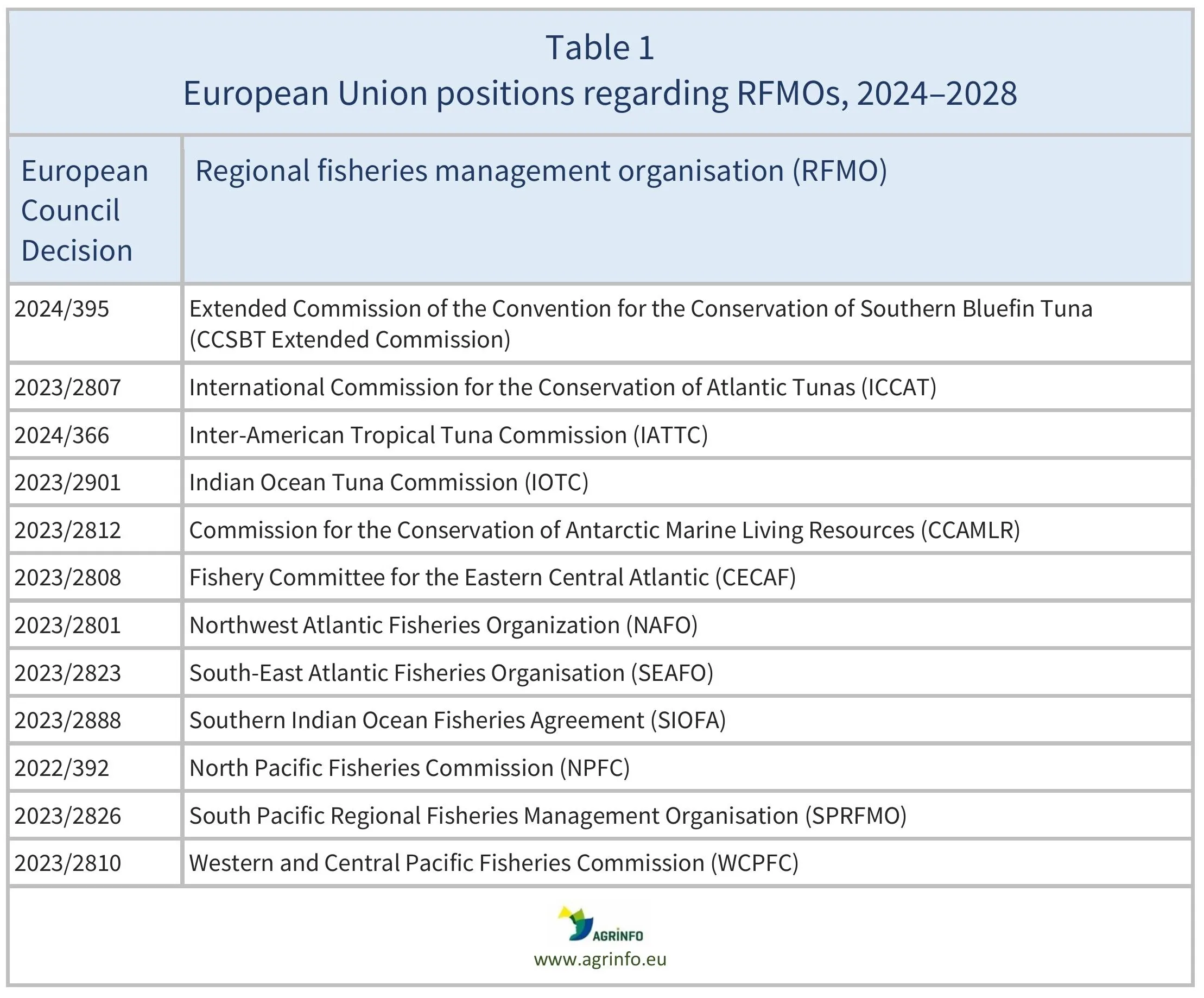
As a member of RFMOs and fisheries bodies worldwide, the EU participates in, and votes on, their decisions. The European Commission proposes, and the European Council adopts, positions on behalf of the EU. The guiding principles of the EU’s position in each RFMO for the period 2024–2028 are set out in the latest European Council Decisions (see Table 1). Positions are then adjusted and specified year-to-year before each annual meeting of the relevant RFMO or fisheries body. Catch limits and other measures agreed in RFMOs of which the EU is a member are then adopted in EU law and implemented.
Timeline
Regulations 2026/249 and 2026/786 apply from 1 January 2026 to 31 December 2026.
However, where specified, certain Articles and Annexes apply at different dates (see Regulation 2026/249, Art. 62 for details).
Background
Regulations on fishing opportunities aim to limit fish harvests to levels that are consistent with the objectives of the EU’s Common Fisheries Policy (see EU external fisheries policy explained). Fishing opportunities are set for most stocks every year, and for certain stocks every 2–3 years. The European Commission (2025) has published an overview of the state of play of sustainable fishing, and orientations for 2026, based on scientific advice.
Resources
European Commission (2025) Sustainable fishing in the EU: state of play and orientations for 2026.
Regulation 2025/202 fixing for 2025 and 2026 the fishing opportunities for certain fish stocks, applicable in Union waters and, for Union fishing vessels, in certain non-Union waters
Regulation 2026/117 amending Regulation (EU) 2022/2343 laying down management, conservation and control measures applicable in the Indian Ocean Tuna Commission (IOTC) Area of Competence
Sources
Council Regulation (EU) 2026/786 amending Regulation (EU) 2026/249 fixing for 2026, 2027 and 2028 the fishing opportunities for certain fish stocks, applicable in Union waters and, for Union fishing vessels, in certain non-Union waters
Council Regulation (EU) 2026/249 fixing for 2026, 2027 and 2028 the fishing opportunities for certain fish stocks, applicable in Union waters and, for Union fishing vessels, in certain non-Union waters, and amending Regulation (EU) 2025/202
Disclaimer: Under no circumstances shall COLEAD be liable for any loss, damage, liability or expense incurred or suffered that is claimed to have resulted from the use of information available on this website or any link to external sites. The use of the website is at the user’s sole risk and responsibility. This information platform was created and maintained with the financial support of the European Union. Its contents do not, however, reflect the views of the European Union.
European Commission fixes its fishing opportunities for 2026–2028
Council Regulation (EU) 2026/786 amending Regulation (EU) 2026/249 fixing for 2026, 2027 and 2028 the fishing opportunities for certain fish stocks, applicable in Union waters and, for Union fishing vessels, in certain non-Union waters
Council Regulation (EU) 2026/249 fixing for 2026, 2027 and 2028 the fishing opportunities for certain fish stocks, applicable in Union waters and, for Union fishing vessels, in certain non-Union waters, and amending Regulation (EU) 2025/202
What is changing and why?
Regulation 2026/249 fixes fishing opportunities for 2026–2028, including for EU vessels fishing outside EU waters. This Regulation adopts the latest decisions taken in Regional Fisheries Management Organisations (RFMOs).
Regulation 2026/786 amends Regulation 2026/249 regarding fishing opportunities for stocks managed by RFMOs and for certain stocks jointly managed with non-EU countries. It takes into account the latest scientific advice, and outcomes of consultations with non-EU countries and RFMOs.
As a member of RFMOs and fisheries bodies worldwide, the EU participates in, and votes on, their decisions. The European Commission proposes, and the European Council adopts, positions on behalf of the EU.
The guiding principles of the EU’s position in RFMOs for the period 2024–2028 are set out in the latest European Council Decisions (Table 1). Positions are then adjusted and specified year-to-year before each annual meeting of a given RFMO or fisheries body. Catch limits and other measures agreed in RFMOs of which the EU is a member are adopted in EU law and then implemented.
Timeline
Regulations 2026/249 and 2026/786 apply from 1 January 2026 to 31 December 2026.
However, where specified, certain Articles and Annexes apply at different dates.
Tables & Figures
Disclaimer: Under no circumstances shall COLEAD be liable for any loss, damage, liability or expense incurred or suffered that is claimed to have resulted from the use of information available on this website or any link to external sites. The use of the website is at the user’s sole risk and responsibility. This information platform was created and maintained with the financial support of the European Union. Its contents do not, however, reflect the views of the European Union.