
Maximum residue levels for benomyl
- Pesticide MRLs
- Pesticides
Summary
The European Union (EU) has set maximum residue levels (MRLs) for benomyl on all products at the limit of determination (LOD), the lowest level that can be detected using the most modern and reliable analytical methods.
EU sets MRLs for benomyl to limit of determination on all products
Commission Regulation (EU) 2026/1546 of 8 July 2026 amending Annexes II, III and V to Regulation (EC) No 396/2005 of the European Parliament and of the Council as regards maximum residue levels for benomyl, carbendazim and thiophanate-methyl in or on certain products
Update
The European Union (EU) has set maximum residue levels (MRLs) for benomyl on all products at the limit of determination (LOD), the lowest level that can be detected using the most modern and reliable analytical methods.
Impacted Products
All products
What is changing?
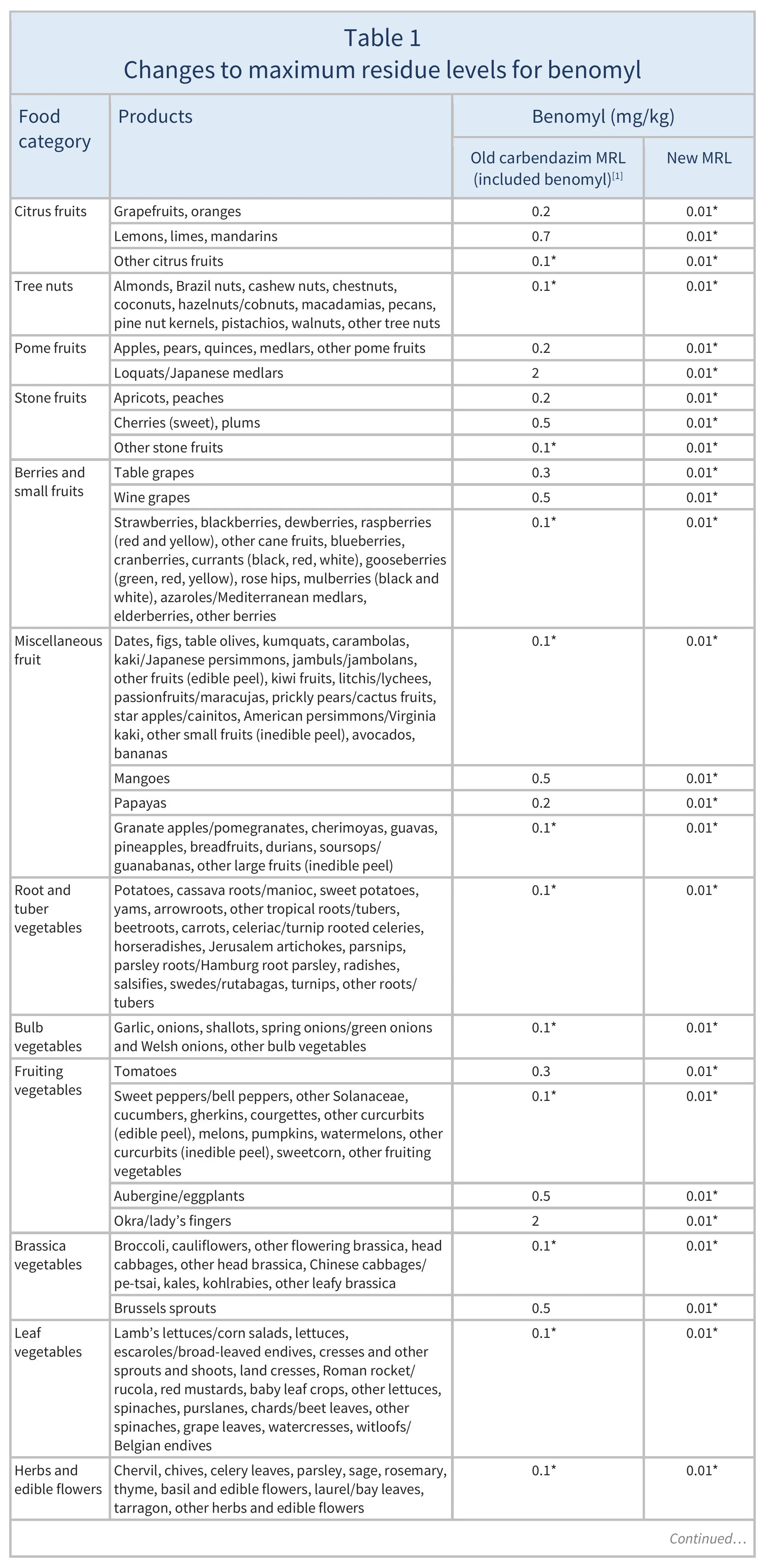
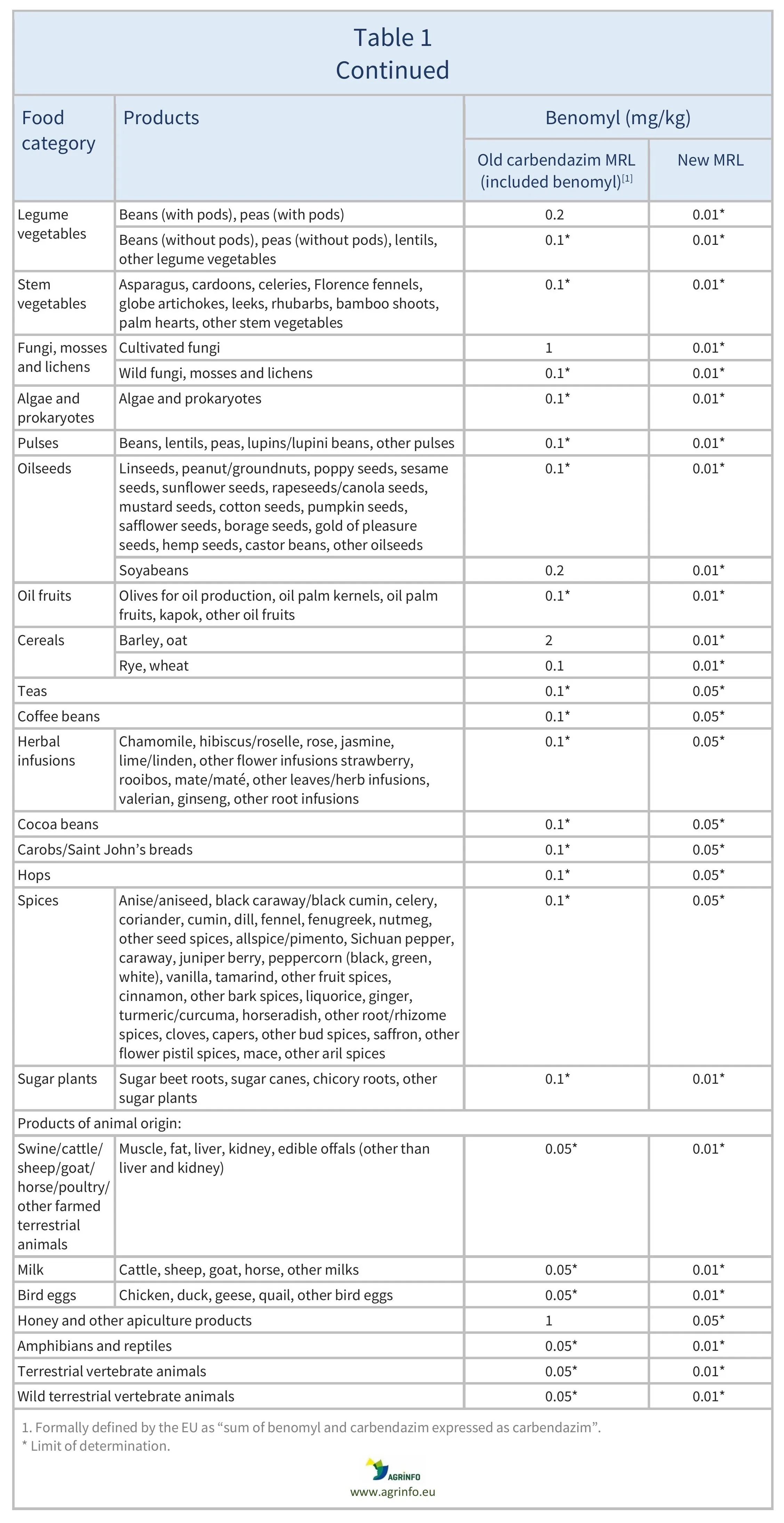
Benomyl was previously included within the definition of carbendazim. The MRLs for benomyl were therefore the same as those for carbendazim. The EU has now set MRLs for benomyl at the default level of 0.01 mg/kg for all products (except for teas, coffee, herbal infusions, cocoa, carobs, hops, spices, and honey, for which an MRL of 0.05 mg/kg applies). The changes in comparison to the previous carbendazim MRLs are set out in Table 1.
Why?
In 2021, the European Food Safety Authority suggested establishing separate MRLs for benomyl and carbendazim (EFSA 2021). Benomyl is not approved as an active substance for plant protection products in the EU. Therefore no EU toxicological reference values for benomyl are available, making it challenging to assess the safety of MRLs for this substance. As benomyl lacks authorisation for use in the EU, and no import tolerances or Codex maximum residue limits (CXLs) exist, the European Commission decided that the default MRL of 0.01 mg/kg should be applied (or the LOD of 0.05 mg/kg where 0.01 mg/kg cannot be achieved analytically).
Timeline
The new MRLs apply from 29 January 2027.
Recommended Actions
Suppliers to the EU market of all products should seek alternatives to the use of benomyl.
Background
In the EU, benomyl was previously included within the definition of carbendazim (“sum of benomyl and carbendazim expressed as carbendazim”). Products that complied with carbendazim MRLs were therefore considered to be compliant regarding benomyl. In November 2024, the European Commission informed the WTO SPS Committee that it intended to set separate MRLs for benomyl at the default level of 0.01 mg/kg on all products, or 0.05 mg/kg where testing to 0.01 mg/kg is not technically possible (G/SPS/N/EU/696).
MRLs are set in accordance with the rules set out in Regulation 396/2005. For information on current MRLs for other substances, please consult the EU Pesticide Residues database.
Resources
EFSA (2021) Reasoned opinion on the toxicological properties and maximum residue levels (MRLs) for the benzimidazole substances carbendazim and thiophanate-methyl. EFSA Journal, 19(7): 6773.
Sources
Regulation (EU) 2026/1546 as regards maximum residue levels for benomyl, carbendazim and thiophanate-methyl in or on certain products
Tables & Figures
Disclaimer: Under no circumstances shall COLEAD be liable for any loss, damage, liability or expense incurred or suffered that is claimed to have resulted from the use of information available on this website or any link to external sites. The use of the website is at the user’s sole risk and responsibility. This information platform was created and maintained with the financial support of the European Union. Its contents do not, however, reflect the views of the European Union.
EU sets MRLs for benomyl to limit of determination on all products
Regulation (EU) 2026/1546 as regards maximum residue levels for benomyl, carbendazim and thiophanate-methyl in or on certain products
What is changing and why?
The European Union (EU) has set the maximum residue levels (MRLs) for benomyl at the limit of determination (LOD) for all products. (The LOD is the lowest level that can be detected using the most modern and reliable analytical methods.)
Previously there were no MRLs for benomyl, which was included in the definition of carbendazim. This Regulation sets separate MRLs for these two substances.
Actions
Suppliers to the EU market of all products should seek alternatives to the use of benomyl.
Timeline
The new MRLs apply from 29 January 2027.
Tables & Figures
Disclaimer: Under no circumstances shall COLEAD be liable for any loss, damage, liability or expense incurred or suffered that is claimed to have resulted from the use of information available on this website or any link to external sites. The use of the website is at the user’s sole risk and responsibility. This information platform was created and maintained with the financial support of the European Union. Its contents do not, however, reflect the views of the European Union.