
Maximum residue levels for thiophanate-methyl
- Food safety
- Pesticide MRLs
- Pesticides
Summary
The European Union (EU) has reduced the maximum residue levels (MRLs) for thiophanate-methyl to the limit of determination (LOD) for all products. (The LOD is the lowest level that can be detected using the most modern and reliable analytical methods.)
EU reduces thiophanate-methyl MRLs to limit of determination on all products
Commission Regulation (EU) 2026/1546 of 8 July 2026 amending Annexes II, III and V to Regulation (EC) No 396/2005 of the European Parliament and of the Council as regards maximum residue levels for benomyl, carbendazim and thiophanate-methyl in or on certain products
Update
The European Union (EU) has reduced the maximum residue levels (MRLs) for thiophanate-methyl to the limit of determination (LOD) for all products. (The LOD is the lowest level that can be detected using the most modern and reliable analytical methods.)
Impacted Products
All products
What is changing?
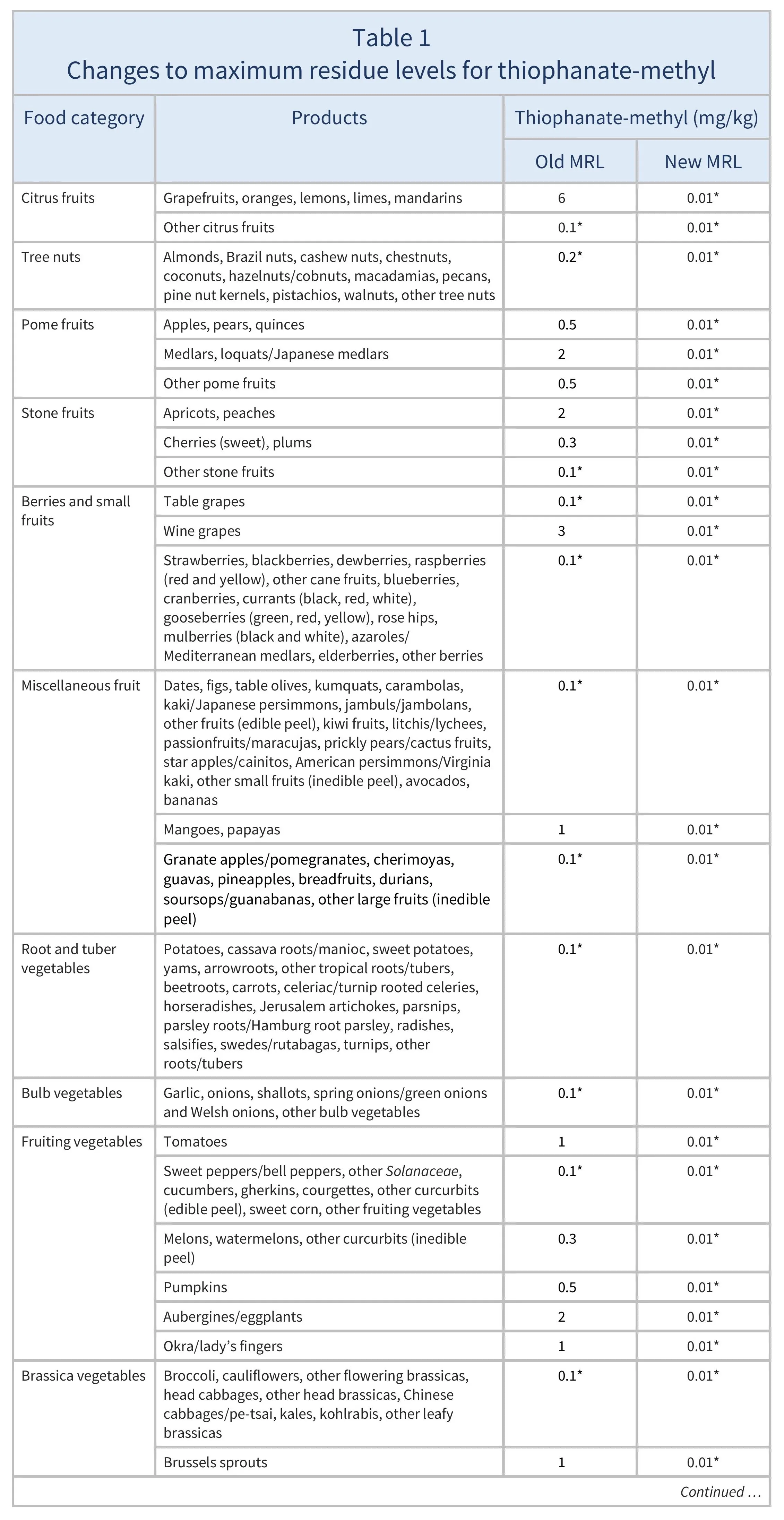
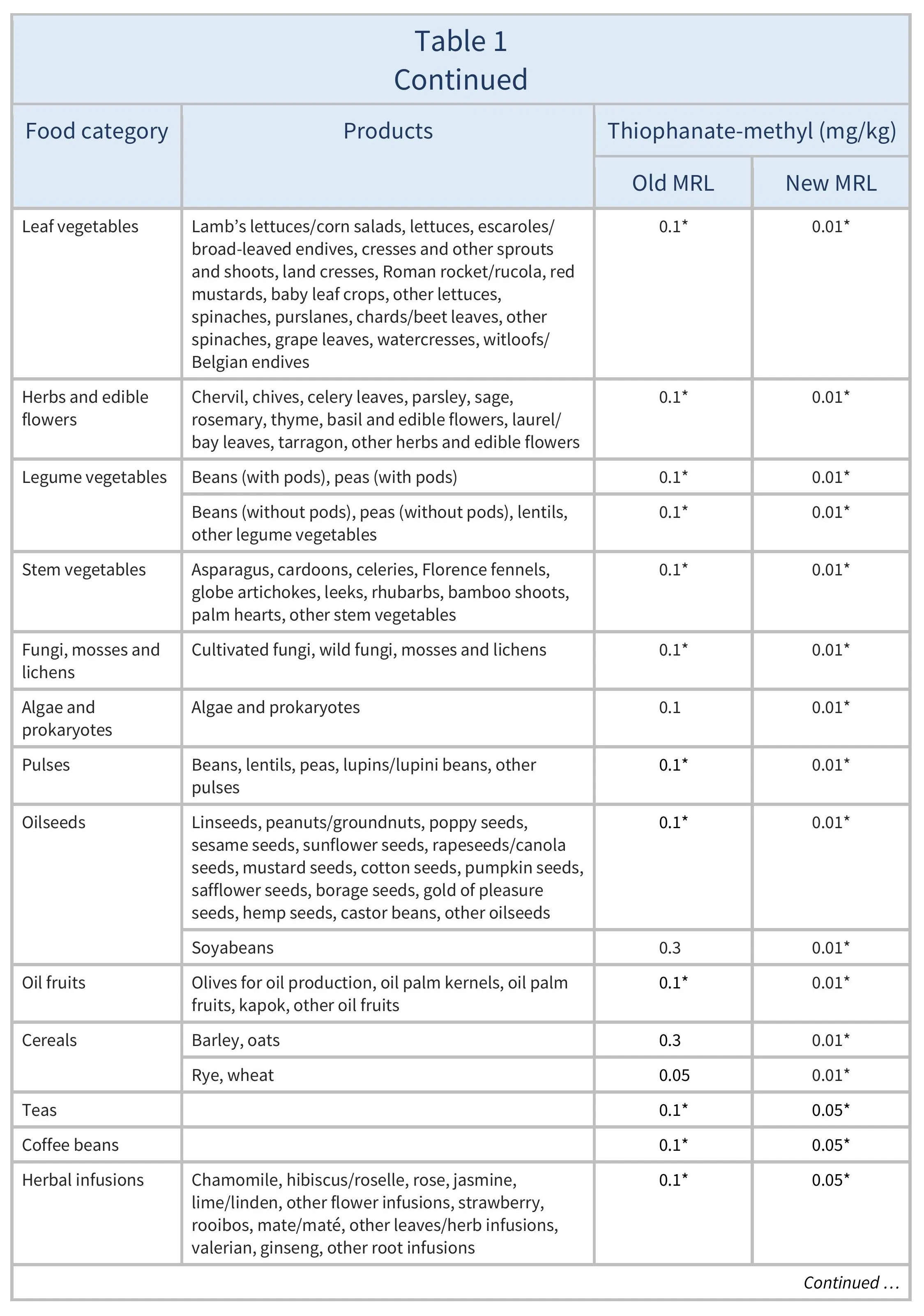
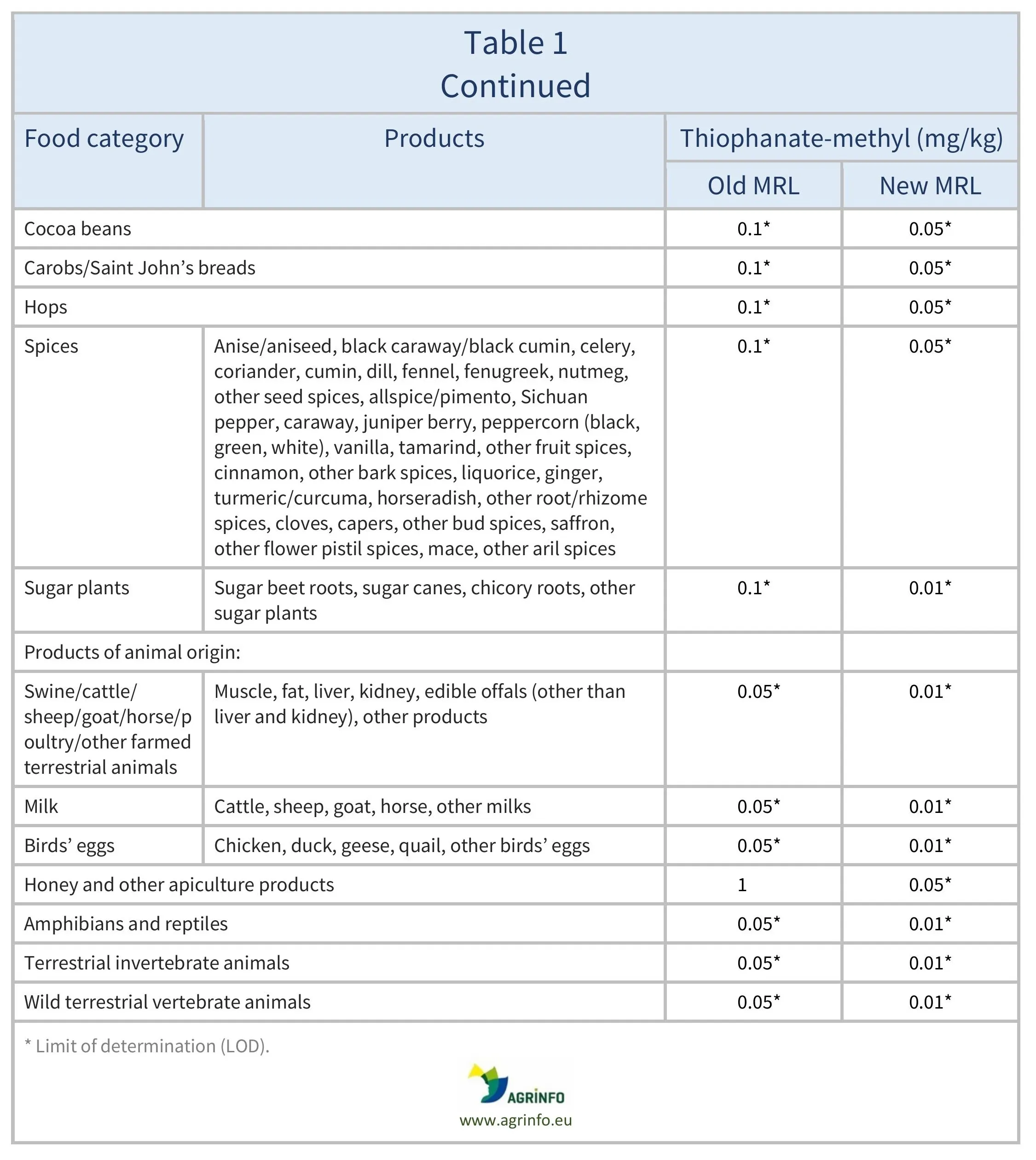
The EU has lowered the MRLs for thiophanate-methyl to 0.01 mg/kg on all products. The changes are summarised in Table 1.
For animal products, thiophanate-methyl was previously included in the definition of carbendazim: “carbendazim and thiophanate-methyl, expressed as carbendazim”. The current Regulation separates out thiophanate-methyl on these products.
Why?
The European Food Safety Authority, in its combined risk assessment for residues of carbendazim and thiophanate-methyl, identified unacceptable risks for the current carbendazim MRLs in grapefruits, oranges, mangoes, and papayas, and for thiophanate-methyl in grapefruits, oranges, mandarins, mangoes, and papayas (EFSA 2024).
Good agricultural practices (GAPs) are in place in some non-EU countries for plant protection products containing carbendazim and thiophanate-methyl separately, as well as for products containing a mixture of both. The GAPs supporting the import tolerances for citrus fruits are no longer authorised in the EU. GAPs previously submitted for limes are no longer authorised in South Africa.
In addition, there are concerns about the risks of combined residues from carbendazim and thiophanate-methyl on okra/lady’s fingers. To ensure a high level of consumer protection, the European Commission decided to lower the MRLs for both substances on okra/lady’s fingers to the LOD.
Timeline
The new MRLs apply from 29 January 2027.
Products put on the EU market before 29 January 2027 that comply with current EU MRLs may remain on the market after that date, even if residues in the products exceed the new MRLs.
Exception: due to concerns about risks to consumers, grapefruits, oranges, papayas, mandarins, and mangoes that exceed thiophanate-methyl MRLs after 29 January 2027 may not remain on the market, even if they were compliant with current MRLs when put on the market before that date.
Recommended Actions
Suppliers to the EU market of all products should seek chemical and non-chemical alternatives to the use of thiophanate-methyl.
Background
In September 2024, the European Parliament rejected a European Commission Regulation that proposed to reduce the MRLs for thiophanate-methyl to the LOD on all products except limes and okra (see Maximum residue levels for benomyl, carbendazim, thiophanate-methyl, cyproconazole, and spirodiclofen). The Parliament requested the Commission to withdraw its draft Regulation and present a new one, setting the MRLs for thiophanate-methyl MRL on all products to the LOD.
MRLs are set in accordance with the rules set out in Regulation 396/2005. For information on current MRLs for other substances, please consult the EU Pesticide Residues database.
Resources
EFSA (2024) Updated reasoned opinion on the toxicological properties and maximum residue levels (MRLs) for the benzimidazole substances carbendazim and thiophanate-methyl. EFSA Journal, 22(2): e8569.
European Commission (2025a) Standing Committee on Plants, Animals, Food and Feed: Section Phytopharmaceuticals – Pesticide Residues, 17–18 February 2025. Summary Report.
European Commission (2025b) Standing Committee on Plants, Animals, Food and Feed: Section Phytopharmaceuticals – Pesticide Residues, 23–24 June 2025. Agenda.
Sources
Regulation (EU) 2026/1546 as regards maximum residue levels for benomyl, carbendazim and thiophanate-methyl in or on certain products
Tables & Figures
Disclaimer: Under no circumstances shall COLEAD be liable for any loss, damage, liability or expense incurred or suffered that is claimed to have resulted from the use of information available on this website or any link to external sites. The use of the website is at the user’s sole risk and responsibility. This information platform was created and maintained with the financial support of the European Union. Its contents do not, however, reflect the views of the European Union.
EU reduces thiophanate-methyl MRLs to limit of determination on all products
Regulation (EU) 2026/1546 as regards maximum residue levels for benomyl, carbendazim and thiophanate-methyl in or on certain products
What is changing and why?
The European Union (EU) has reduced the maximum residue levels (MRLs) for thiophanate-methyl to the limit of determination (LOD) for all products (see Table 1). (The LOD is the lowest level that can be detected using the most modern and reliable analytical methods.)
Actions
Suppliers to the EU market of all products should seek chemical and non-chemical alternatives to the use of thiophanate-methyl.
Timeline
The new MRLs apply from 29 January 2027.
Products put on the EU market before 29 January 2027 that comply with current EU MRLs may remain on the market after that date, even if residues in the products exceed the new MRLs.
Exception: due to concerns about risks to consumers, grapefruits, oranges, papayas, mandarins, and mangoes that exceed thiophanate-methyl MRLs after 29 January 2027 may not remain on the market, even if they were compliant with current MRLs when put on the market before that date.
Tables & Figures
Disclaimer: Under no circumstances shall COLEAD be liable for any loss, damage, liability or expense incurred or suffered that is claimed to have resulted from the use of information available on this website or any link to external sites. The use of the website is at the user’s sole risk and responsibility. This information platform was created and maintained with the financial support of the European Union. Its contents do not, however, reflect the views of the European Union.