
Maximum residue levels for diazinon
- Food safety
- Pesticide MRLs
Summary
The European Union (EU) has notified the World Trade Organization Sanitary and Phytosanitary Measures (WTO SPS) Committee of a new draft proposal to reduce the maximum residue levels (MRLs) for diazinon on various products to the limit of determination (LOD) (G/SPS/N/EU/963). (The LOD is the lowest level that can be detected using the most modern and reliable analytical methods.) This could have particular impacts on exports of almonds, cranberries, pineapples, radishes, onions, sweet peppers, sweet corn, Chinese cabbage, kohlrabies, hops, seed spices, root and rhizome spices, and sugar beet roots.
EU proposes reducing MRLs for diazinon on various products
Draft Commission Regulation amending Annexes II and III to Regulation (EC) No 396/2005 of the European Parliament and of the Council as regards maximum residue levels for diazinon in or on certain products
Draft Annex II v2
Update
The European Union (EU) has notified the World Trade Organization Sanitary and Phytosanitary Measures (WTO SPS) Committee of a new draft proposal to reduce the maximum residue levels (MRLs) for diazinon on various products to the limit of determination (LOD) (G/SPS/N/EU/963). (The LOD is the lowest level that can be detected using the most modern and reliable analytical methods.) This could have particular impacts on exports of almonds, cranberries, pineapples, radishes, onions, sweet peppers, sweet corn, Chinese cabbage, kohlrabies, hops, seed spices, root and rhizome spices, and sugar beet roots.
What is changing?
The European Commission initially proposed to reduce the MRLs for diazinon on certain products to the LOD of 0.01 mg/kg. This new draft Regulation considers maintaining the MRLs for certain animal products due to the presence of diazinon in authorised veterinary medicinal products. The MRLs for liver and kidney of swine, sheep, and goats are lowered from 0.03 to 0.02 mg/kg.
The proposed changes are summarised in Table 1.
Why?
The MRLs for diazinon that have been in place since the adoption of Regulation 396/2005 have never been reviewed. Following a series of evaluations and a stakeholder consultation (see EFSA invites submission of data to support review of certain MRLs), the European Food Safety Authority (EFSA) has concluded that the existing MRLs are not substantiated (EFSA 2023). This new proposal also takes into account the presence of this substance in veterinary medicinal products.
The MRLs for liver and kidney of swine, sheep, and goats are lowered to align with Regulation 37/2010.
Timeline
The Regulation is expected to be published on 1 March 2027, and will apply 6 months after publication.
Recommended Actions
Suppliers of almonds, cranberries, pineapples, radishes, onions, sweet peppers, sweet corn, Chinese cabbage, kohlrabies, hops, seed spices, root and rhizome spices, and sugar beet roots should explore chemical and non-chemical solutions as an alternative to the use of diazinon.
The WTO consultation on this proposal closed on 8 September 2026.
Background
MRLs are set in accordance with the rules set out in Regulation 396/2005. For information on current MRLs for other substances, please consult the EU Pesticide Residues database.
For further information on the EU’s process and principles for setting MRLs, see Regulation of pesticide residues in the EU – Questions and Answers.
Resources
EFSA (2023) Targeted review of maximum residue levels (MRLs) for diazinon. EFSA Journal, 21(11): e08426.
European Commission (2025) Standing Committee on Plants, Animals, Food and Feed, Section Phytopharmaceuticals – Residues, 24–25 November 2025.
Regulation (EU) No 37/2010 on pharmacologically active substances and their classification regarding maximum residue limits in foodstuffs of animal origin
Sources
Draft Commission Regulation as regards maximum residue levels for diazinon in or on certain products
Draft Annex II v2
Tables & Figures
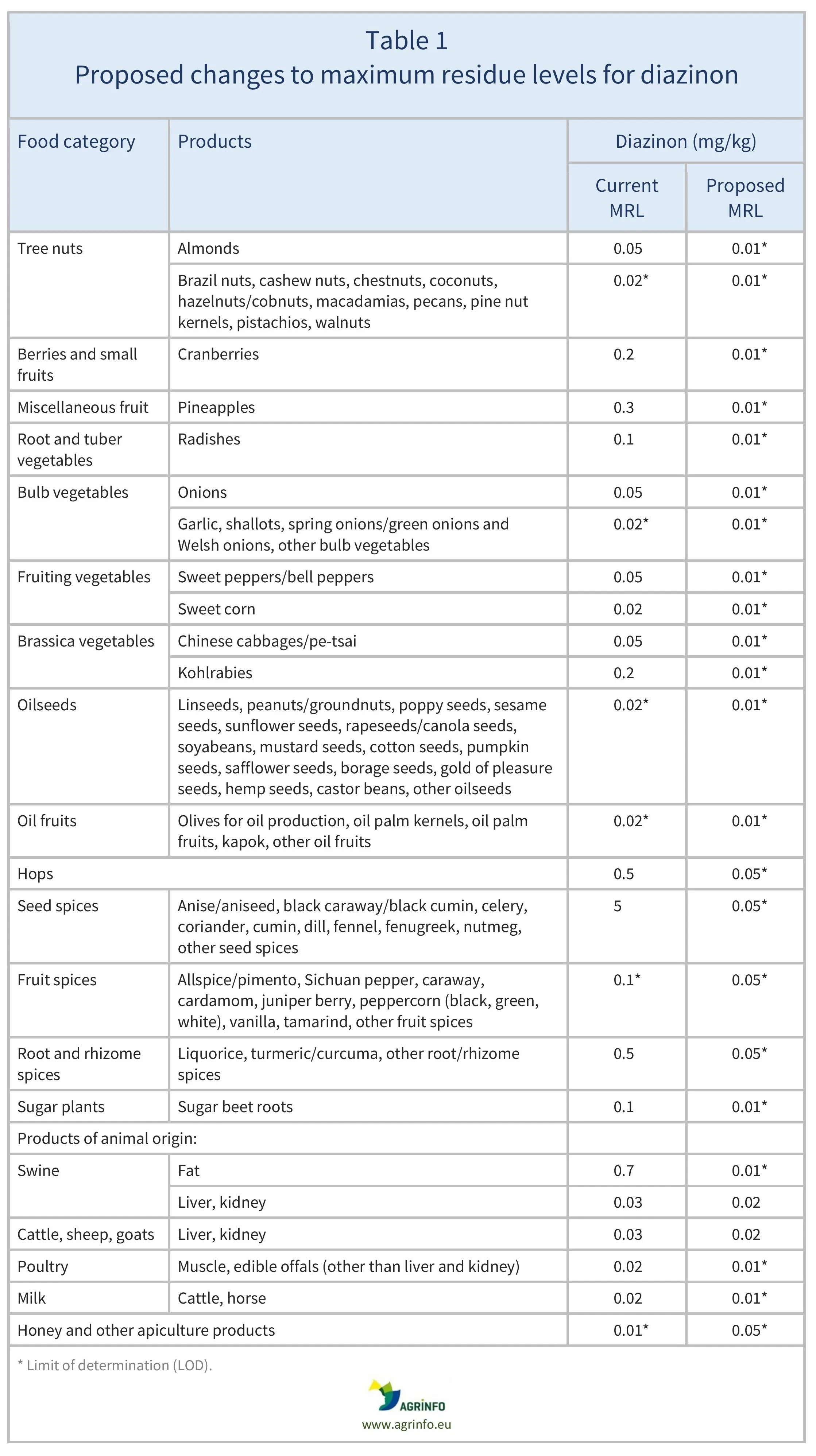
Source: based on Draft Annex II v2
Disclaimer: Under no circumstances shall COLEAD be liable for any loss, damage, liability or expense incurred or suffered that is claimed to have resulted from the use of information available on this website or any link to external sites. The use of the website is at the user’s sole risk and responsibility. This information platform was created and maintained with the financial support of the European Union. Its contents do not, however, reflect the views of the European Union.
EU proposes reducing MRLs for diazinon on various products
Draft Commission Regulation as regards maximum residue levels for diazinon in or on certain products
Draft Annex II v2
What is changing and why?
The European Commission proposes to reduce the maximum residue levels (MRLs) for diazinon on certain products to the LOD of 0.01 mg/kg; this could have particular impacts on exports of almonds, cranberries, pineapples, radishes, onions, sweet peppers, sweet corn, Chinese cabbage, kohlrabies, hops, seed spices, root and rhizome spices, and sugar beet roots.
This new draft Regulation considers maintaining the MRLs for certain animal products due to the presence of diazinon in authorised veterinary medicinal products.
Actions
Suppliers of almonds, cranberries, pineapples, radishes, onions, sweet peppers, sweet corn, Chinese cabbage, kohlrabies, hops, seed spices, root and rhizome spices, and sugar beet roots should explore chemical and non-chemical solutions as an alternative to the use of diazinon.
The World Trade Organization consultation on this proposal closed on 8 September 2026.
Timeline
The Regulation is expected to be published on 1 March 2027, and will apply 6 months after publication.
Tables & Figures
Source: based on Draft Annex II v2
Disclaimer: Under no circumstances shall COLEAD be liable for any loss, damage, liability or expense incurred or suffered that is claimed to have resulted from the use of information available on this website or any link to external sites. The use of the website is at the user’s sole risk and responsibility. This information platform was created and maintained with the financial support of the European Union. Its contents do not, however, reflect the views of the European Union.