
Maximum residue levels for triclopyr
- Food safety
- Pesticide MRLs
Summary
The European Union has amended the maximum residue levels (MRLs) for triclopyr on citrus fruits and animal products.
EU amends triclopyr MRLs on certain products, with particular impact on citrus fruits
Commission Regulation (EU) 2026/1314 of 15 June 2026 amending Annexes II, III and V to Regulation (EC) No 396/2005 of the European Parliament and of the Council as regards maximum residue levels for 1,4-dimethylnaphthalene, chlormequat, metribuzin, metribuzin-desamino-diketo (metribuzin-DADK), terbuthylazine and triclopyr in or on certain products
Update
The European Union has amended the maximum residue levels (MRLs) for triclopyr on citrus fruits and animal products.
Impacted Products
Grapefruits, oranges, lemons, mandarins, animal products
What is changing?
The European Union (EU) has amended the MRLs for triclopyr on certain products as summarised in Table 1.
Why?
The MRLs for triclopyr were reviewed following assessments by the European Food Safety Authority (EFSA 2022, 2024), which concluded that data for citrus fruits were still missing. The EU proposed to adjust the MRLs either to alternative safe levels proposed by EFSA, or to the product-specific limits of determination.
Data gaps identified in earlier evaluations were resolved for apples, pears, and peaches, allowing the existing MRLs to be maintained. For apricots, the current MRL can be maintained by extrapolation from cherries. For rice, new data have been submitted and the current MRL is maintained until the data can be assessed.
In addition, new MRLs are set for certain animal products. This follows an application by the producer of triclopyr and EFSA’s updated risk assessment confirming that residue levels for the intended uses on grassland are unlikely to present a risk to consumer health (EFSA 2023).
Timeline
The new MRLs will apply from 6 January 2027.
Recommended Actions
Exporters of citrus fruits should should review triclopyr residue levels and the possible alternative (chemical or non-chemical) solutions available in anticipation of the MRL changes.
Background
MRLs are set in accordance with the rules set out in Regulation 396/2005. For information on current MRLs for other substances, please consult the EU Pesticide Residues database.
For further information on the EU’s process and principles for setting MRL, see Regulation of pesticide residues in the EU – Questions and Answers.
Resources
EFSA (2022) Modification of the existing maximum residue levels for triclopyr in oranges, lemons and mandarins. EFSA Journal, 20(8): e07545.
EFSA (2023) Modification of the existing maximum residue levels for triclopyr in animal commodities. EFSA Journal, 21(5): e08007.
EFSA (2024) Statement on the confirmatory data following the Article 12 MRL review for triclopyr. EFSA Journal, 22: e9176.
Sources
Commission Regulation (EU) 2026/1314 as regards maximum residue levels for 1,4-dimethylnaphthalene, chlormequat, metribuzin, metribuzin-desamino-diketo (metribuzin-DADK), terbuthylazine and triclopyr in or on certain products
Tables & Figures
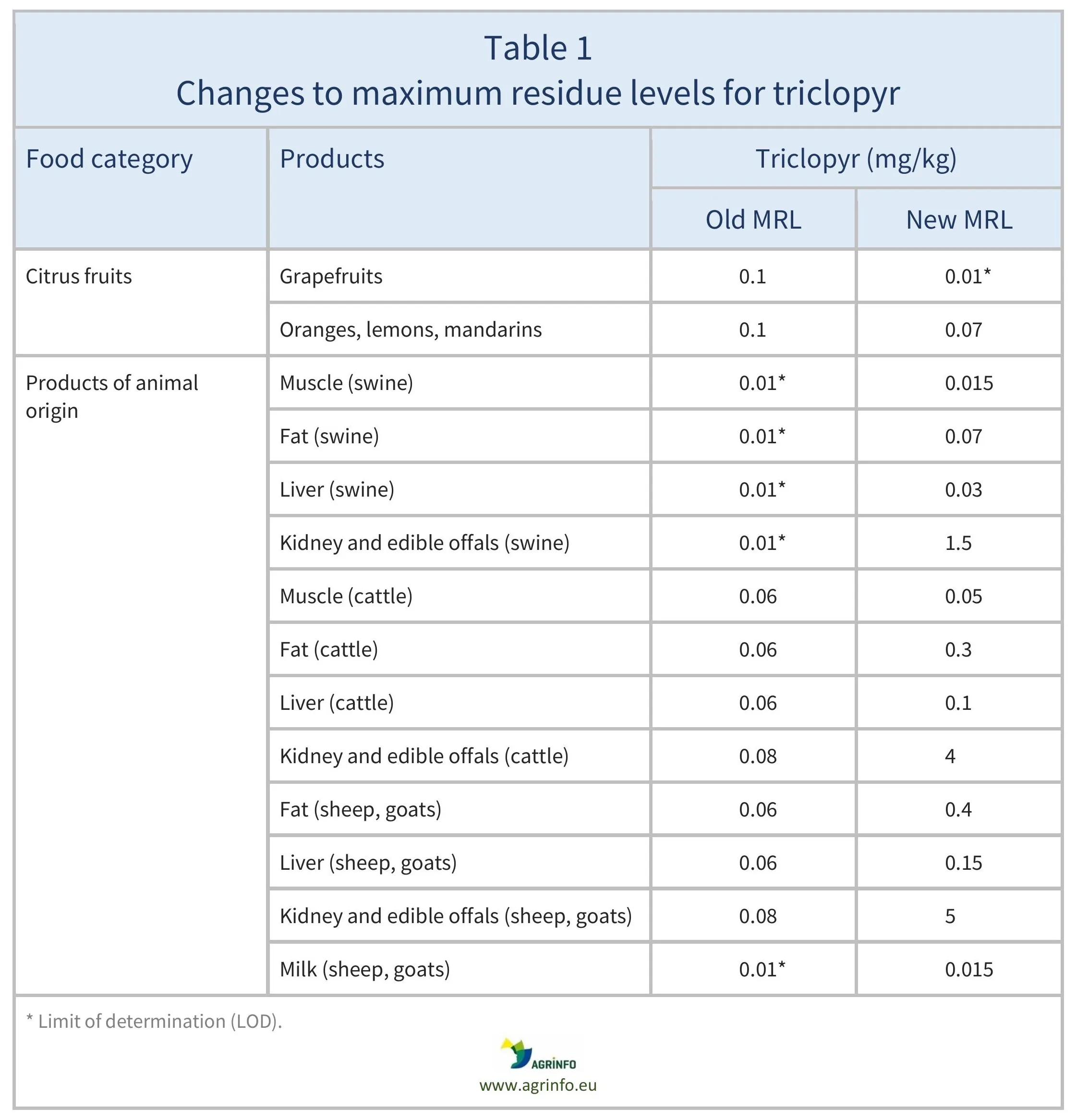
Source: based on Regulation 2026/1314
Disclaimer: Under no circumstances shall COLEAD be liable for any loss, damage, liability or expense incurred or suffered that is claimed to have resulted from the use of information available on this website or any link to external sites. The use of the website is at the user’s sole risk and responsibility. This information platform was created and maintained with the financial support of the European Union. Its contents do not, however, reflect the views of the European Union.
EU amends triclopyr MRLs on certain products, with particular impact on citrus fruits
Commission Regulation (EU) 2026/1314 as regards maximum residue levels for 1,4-dimethylnaphthalene, chlormequat, metribuzin, metribuzin-desamino-diketo (metribuzin-DADK), terbuthylazine and triclopyr in or on certain products
What is changing and why?
The European Union (EU) has amended the maximum residue levels (MRLs) for triclopyr (see Table 1). There will be particular impacts on citrus fruits.
Actions
Exporters of citrus fruits should should review triclopyr residue levels and the possible alternative (chemical or non-chemical) solutions available in anticipation of the MRL changes.
Timeline
The new MRLs will apply from 6 January 2027.
Tables & Figures
Source: based on Regulation 2026/1314
Disclaimer: Under no circumstances shall COLEAD be liable for any loss, damage, liability or expense incurred or suffered that is claimed to have resulted from the use of information available on this website or any link to external sites. The use of the website is at the user’s sole risk and responsibility. This information platform was created and maintained with the financial support of the European Union. Its contents do not, however, reflect the views of the European Union.