
EU list of high-risk organic and in-conversion products from non-EU countries
- Organic production
Summary
The European Union (EU) has notified to the World Trade Organization (WTO) a proposed list of high-risk organic and in-conversion products from non-EU countries (G/TBT/N/EU/1232).
Products are listed as high-risk on the basis of established or suspected cases of major, critical, or repeat non-compliances that affect the integrity of the organic products or production. The list also specifies the percentage of consignments that must be subject to identity/physical checks and representative sampling in both the exporting country and on import into the EU.
The proposed list for 2027 identifies high-risk products from five countries: ginger, tea, and soyabeans from China; bananas from Ecuador; avocados, bananas, and cocoa from Peru; soyabeans from Togo; and sultanas from Türkiye.
EU proposes list of high-risk organic and in-conversion products originating from non-EU countries, and their control rates
Draft Commission Implementing Regulation establishing a list of high-risk organic and in-conversion products originating from third countries and their control rates [scroll down to download]
Update
The European Union (EU) has notified to the World Trade Organization (WTO) a proposed list of high-risk organic and in-conversion products from non-EU countries (G/TBT/N/EU/1232).
Products are listed as high-risk on the basis of established or suspected cases of major, critical, or repeat non-compliances that affect the integrity of the organic products or production. The list also specifies the percentage of consignments that must be subject to identity/physical checks and representative sampling in both the exporting country and on import into the EU.
The proposed list for 2027 identifies high-risk products from five countries: ginger, tea, and soyabeans from China; bananas from Ecuador; avocados, bananas, and cocoa from Peru; soyabeans from Togo; and sultanas from Türkiye.
Impacted Products
Organic products, ginger, tea, soyabeans, bananas, avocados, cocoa, sultanas
What is changing?
This proposal establishes an EU list of high-risk organic and in-conversion products imported from non-EU countries, together with the minimum rates of additional controls applicable to each product–country combination.
A product may be classified as high-risk where there have been major, critical, or repeated non-compliances, or suspicions of non-compliance, affecting the integrity of organic production or products.
Additional controls will take place at two stages:
- before export to the EU by recognised control authorities or control bodies operating in the exporting country
- on import into the EU by Member State competent authorities at border control posts or points of release for free circulation.
The proposed list identifies high-risk products from five countries:
- China: ginger, tea, and soyabeans
- Ecuador: bananas
- Peru: avocados, bananas, and cocoa
- Togo: soyabeans
- Türkiye: sultanas.
Depending on the product–country combination, between 5 and 20% of consignments would be subject to identity/physical checks and representative sampling in both the exporting country and on import into the EU. See Table 1 for details.
The European Commission will review the list at least once a year, taking into account new information on established or suspected non-compliances affecting the integrity of organic or in-conversion products. Changes to the list will be based on information from the Organic Farming Information System (OFIS), EU Member State official controls, supervisory activities, on-the-spot examinations, and Commission audits of recognised control authorities and control bodies.
Why?
The listing and associated control rates are intended to improve fraud detection, verify compliance with EU organic rules, and protect consumer confidence in the integrity of imported organic products.
Timeline
The Regulation will enter into force on the third day after publication in the Official Journal of the European Union. It will apply from 1 January of the year following its entry into force, allowing authorities and control bodies time to prepare for the additional controls.
What are the major implications for exporting countries?
Exports listed as high-risk will face more frequent documentary, identity, and physical checks, including sampling, both before export and on arrival in the EU.
Recommended Actions
The WTO consultation closed on 12 October 2026.
The European Commission’s Have your say consultation on this proposal closed on 24 August 2026.
Background
Under the new EU organic regime, Regulations 2021/1698 and 2021/2306 set out specific rules on the controls to be applied to consignments of high-risk organic or in-conversion products intended for import into the EU.
According to Regulation 2021/1698 (Art. 8), high-risk products originating from non-EU countries are listed so that consignments can be subject to a specified intensity of identity and physical checks, as well as sampling by control authorities and control bodies in exporting countries and by the competent authorities of EU Member States.
Regulation 2024/2975 introduced some amendments to the original rules. Previously, 100% of consignments of high-risk organic products were to be sampled and controlled, and 100% of consignments would also undergo identity and physical checks by EU Member States on import. Experience with controls on imports of organic products from non-EU countries, including notifications of contaminations by EU Member States to OFIS, showed that compliance can be ensured with a frequency of checks that is below 100% of consignments. Recognising this, as well as the potential burden on operators and authorities, the European Commission introduced greater flexibility, allowing the share of consignments tested to be lower than 100%.
Sources
Draft Commission Implementing Regulation establishing a list of high-risk organic and in-conversion products originating from third countries and their control rates [scroll down to download]
Tables & Figures
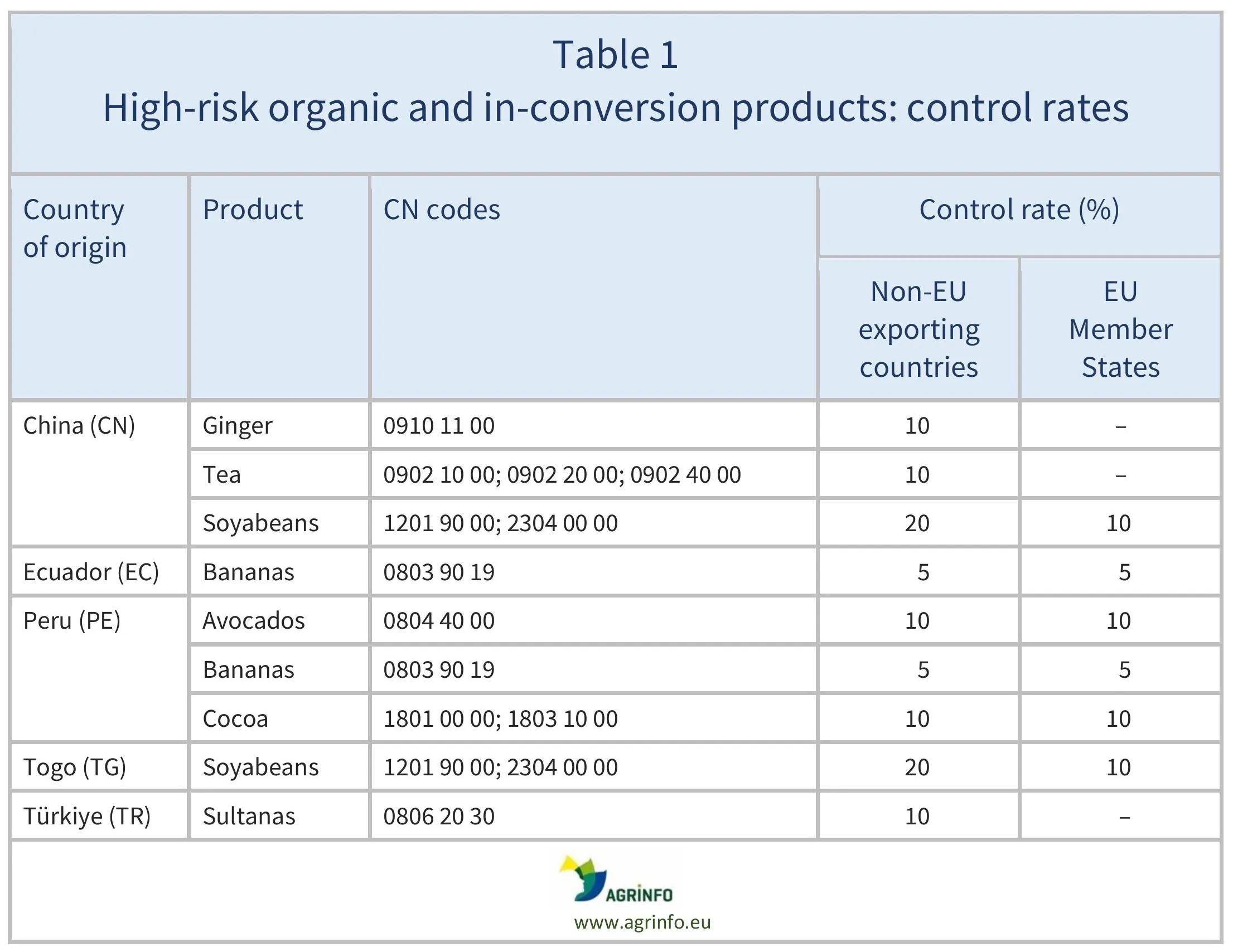
Source: Draft Annex
Disclaimer: Under no circumstances shall COLEAD be liable for any loss, damage, liability or expense incurred or suffered that is claimed to have resulted from the use of information available on this website or any link to external sites. The use of the website is at the user’s sole risk and responsibility. This information platform was created and maintained with the financial support of the European Union. Its contents do not, however, reflect the views of the European Union.
EU proposes list of high-risk organic and in-conversion products originating from non-EU countries, and their control rates
Draft Commission Implementing Regulation establishing a list of high-risk organic and in-conversion products originating from third countries and their control rates [scroll down to download]
What is changing and why?
The European Union (EU) has issued a public consultation on its proposed list of high-risk organic and in-conversion products from non-EU countries. Products are listed as high-risk on the basis of established or suspected cases of major, critical, or repeat non-compliances that affect the integrity of the organic products or production. The list also specifies the percentage of consignments that must be subject to identity/physical checks and representative sampling in both the exporting country and on import into the EU.
The proposed list identifies high-risk products from five countries: ginger, tea and soyabeans from China; bananas from Ecuador; avocados, bananas, and cocoa from Peru; soyabeans from Togo; and sultanas from Türkiye. Depending on the product–country combination, between 5 and 20% of consignments would be subject to identity and physical checks. See Table 1 for details.
The European Commission will review the list at least once a year, taking into account new information on established or suspected non-compliances affecting the integrity of organic or in-conversion products or production.
Actions
The World Trade Organization consultation closed on 12 October 2026.
The European Commission’s Have your say consultation on this proposal closed on 24 August 2026.
Timeline
The Regulation will enter into force on the third day after publication in the Official Journal of the European Union. It will apply from 1 January of the year following its entry into force, allowing authorities and control bodies time to prepare for the additional controls.
Tables & Figures
Source: Draft Annex
Disclaimer: Under no circumstances shall COLEAD be liable for any loss, damage, liability or expense incurred or suffered that is claimed to have resulted from the use of information available on this website or any link to external sites. The use of the website is at the user’s sole risk and responsibility. This information platform was created and maintained with the financial support of the European Union. Its contents do not, however, reflect the views of the European Union.