
EU-Mercosur Partnership Agreement
- Food safety
- Sustainable food systems
- Trade
- Trade policy
Summary
The European Union (EU) has published the certificates of origin and quota authorisation certificates that must be used by operators from Argentina, Brazil, Paraguay, and Uruguay (Mercosur founding countries) to benefit from the preferential tariffs and quotas that have been established by the Interim Mercosur Agreement.
This Interim Agreement on Trade (iTA), which applies from 1 May 2026, covers only the trade-related aspects of the EU Mercosur Partnership Agreement (EMPA) that was signed between the two sides in January 2026. The EMPA will apply in full once it has been fully ratified by all parties.
EU and Mercosur complete technical negotiations on Partnership Agreement
Interim Agreement on Trade [iTA] between the European Union, of the one part, and the Common Market of the South, the Argentine Republic, the Federative Republic of Brazil, the Republic of Paraguay and the Oriental Republic of Uruguay, of the other part
[Please note: due to the size of the iTA, this report provides links to more accessible European Commission documents.]
Notice of the European Commission [2026/874] on quota authorisation certificates
Notice of the European Commission [2026/875] on certificates of origin
Update
The European Union (EU) has published the certificates of origin and quota authorisation certificates that must be used by operators from Argentina, Brazil, Paraguay, and Uruguay (Mercosur founding countries) to benefit from the preferential tariffs and quotas that have been established by the Interim Mercosur Agreement.
This Interim Agreement on Trade (iTA), which applies from 1 May 2026, covers only the trade-related aspects of the EU Mercosur Partnership Agreement (EMPA) that was signed between the two sides in January 2026. The EMPA will apply in full once it has been fully ratified by all parties.
Impacted Products
All products
Impact on EU import tariffs
Publication of documents required to export under the iTA
The EU has published the quota authorisation certificates (Notice 2026/874) and certificates of origin (Notice 2026/875) that must be used by operators from Argentina, Brazil, Paraguay, and Uruguay in order to benefit from the preferential tariffs and quotas established by the iTA.
General tariff reductions
The list of products and categories subject to tariff reductions can be found in the Tariff Elimination Schedule (Appendix to Annex 2-A) [download], listed in the column “28 June 2019”.
For most products exported from Mercosur countries to the EU, import duties will be removed gradually over an agreed time period, with the length of that period (5, 8, 9, 11, 16 years) depending on the product. That time period starts on 1 May 2026.
An explanation of the schedule for tariff reductions in each category can be found in Table 1 below.
Tariff rate quotas
For the following products, today’s import tariffs will not be reduced, but quotas are created (Appendix to Annex 2-A):
- fresh and frozen beef (BF1 and BF2) with specific quotas for high-quality fresh, chilled, and frozen beef
- fresh and frozen pig meat (PK)
- poultry preparations and bone-in poultry meat (PY 1 and PY 2)
- milk powders (MP)
- cheese (CE)
- infant formula (IF)
- maize/sorghum (ME)
- rice (RE)
- sugar for refining (SR) and other sugars (OS)
- eggs (EG1) and egg albumins (EG2)
- honey (HY)
- rum (RM)
- sweetcorn (SC)
- maize/cassava starch and derivatives (SH1/SH2)
- ethanol (EL)
- garlic (GC).
The details of these quotas are set out in section B of Annex 2-A.
Specific tariff reductions
Some products today have “mixed duties”: an ad valorem (percentage of value of product) duty, and a fixed euro/weight duty. For some products, including cucumbers, artichokes, and courgettes, the ad valorem component of the duties will be removed. These are marked (0/EP, 7/EP, 10/EP). A specific duty of €75 per tonne is set for fresh bananas (BA) on the Agreement entering into force. Specific duty reductions are also foreseen for yoghurts (FP 50%) and butter (FP 30%), cereal germ and rolled flakes (50%). Further details for these tariffs can be found in section A of Annex 2-A.
Sensitive products
Certain products are designated as “sensitive products” and import duties will not be reduced on these, including certain customs categories related to lamb/sheep, milk/cream and whey, wheat, fish, and sugar. These are marked “E” in the tariff schedule.
Impact on food safety and plant health measures
The iTA includes a chapter on sanitary and phytosanitary measures (chapter 6) affecting agri-food trade. The Agreement intends to improve the exchange of information between the EU and Mercosur, with an obligation for the parties to the Agreement (i.e. EU and Mercosur countries) to systematically update information on changing import requirements, and to respond to specific requests for information within 15 days (Art. 6.11). It also creates a subcommittee (Art. 6.18) that will meet at least once a year to discuss any problems related to regulations. The iTA foresees particular support for Paraguay in relation to providing technical assistance and potentially allowing longer periods for the country to adjust to new measures (Art. 6.19).
Timeline
The iTA applies from 1 May 2026 (European Commission 2026).
What are the major implications for exporting countries?
Negotiators of the Agreement argue that the deal offers major mutual benefits both in trade and in strengthening geopolitical, sustainability, and security cooperation. European Commission President Ursula von der Leyen described it as “a win–win agreement, which will bring meaningful benefits to consumers and businesses, on both sides” (European Commission 2024).
Background
EU negotiations with the Mercosur States (Argentina, Brazil, Paraguay, and Uruguay) started in 2000. The trade deal was first completed in 2019. However, certain EU Member States and the European Parliament indicated that they would only approve the deal if stronger commitments were given by Mercosur countries in relation to stopping deforestation, protecting the climate, and protecting labour rights. The trade negotiations led to major concerns raised by farmers protesting in Brussels in 2024 (Di Mambro 2024).
The EU–Mercosur Partnership Agreement (EMPA) was signed on 16 January 2026. The Interim Agreement on Trade applies until all parties have ratified the EMPA. All Mercosur countries (Argentina, Brazil, and Uruguay, and most recently Paraguay), have already completed their ratification procedures. The EU Member States have also approved the EMPA but the European Parliament has not yet formally ratified it, and has requested the European Court of Justice to rule on whether the EU–Mercosur Agreement complies with EU law, a legal process that could take up to 2 years. The Parliament’s action followed weeks of protest about the new deal, in particular from the EU’s agricultural community.
Resources
Di Mambro, A. (2024) Map: farmers protests lead to concessions almost everywhere. Euractiv, 4 March.
European Commission (2024) EU and Mercosur reach political agreement on groundbreaking partnership. Press release, 6 December.
European Commission (2026) EU-Mercosur Agreement to provisionally apply from 1 May 2026, Daily news, 23 March.
Sources
Interim Agreement on Trade [iTA] between the European Union, of the one part, and the Common Market of the South, the Argentine Republic, the Federative Republic of Brazil, the Republic of Paraguay and the Oriental Republic of Uruguay, of the other part
Notice of the European Commission [2026/874] on quota authorisation certificates
Notice of the European Commission [2026/875] on certificates of origin
Tables & Figures
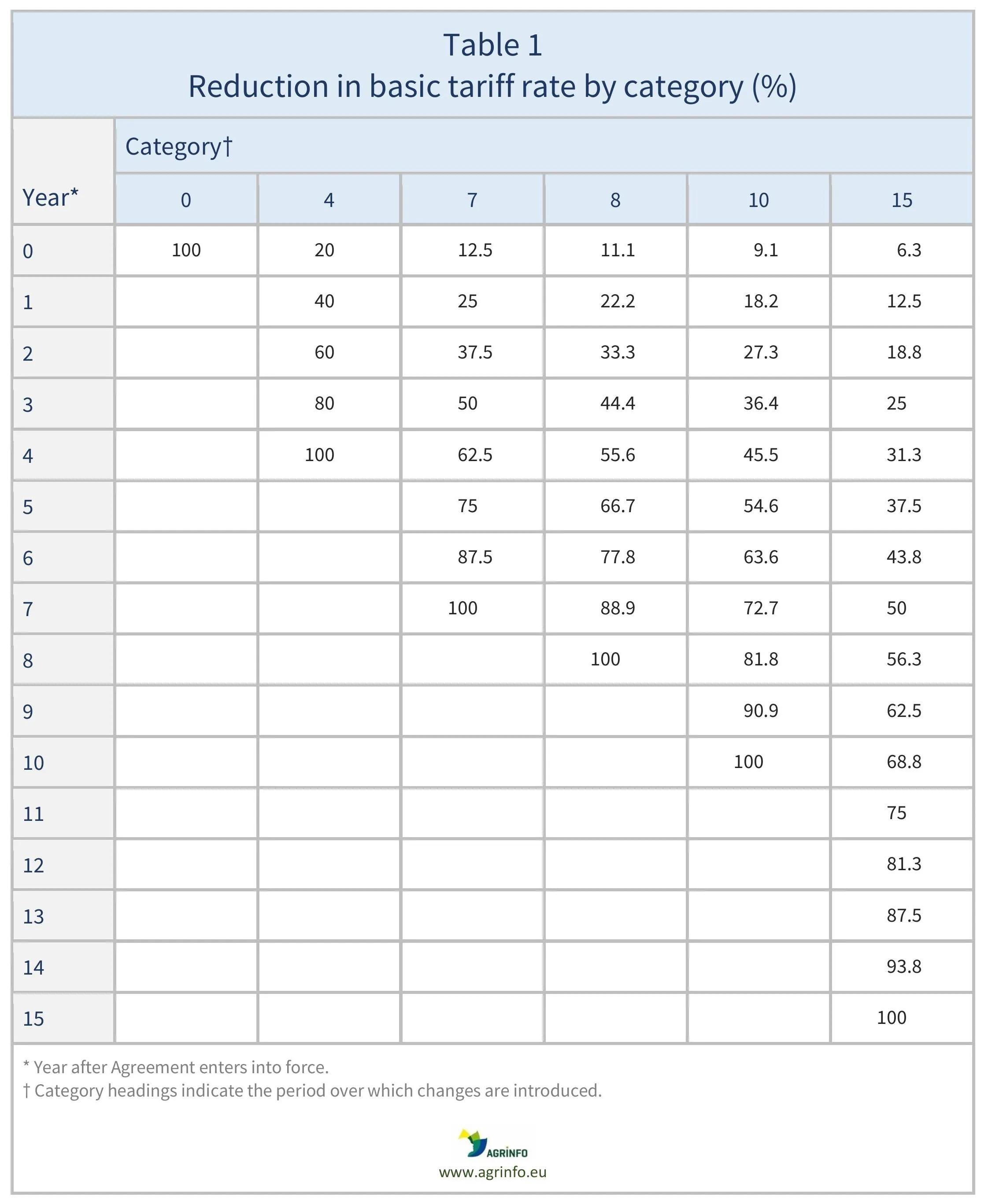
Source: based on Appendix to the Tariff Elimination Schedule (Annex 2-A)
Disclaimer: Under no circumstances shall COLEAD be liable for any loss, damage, liability or expense incurred or suffered that is claimed to have resulted from the use of information available on this website or any link to external sites. The use of the website is at the user’s sole risk and responsibility. This information platform was created and maintained with the financial support of the European Union. Its contents do not, however, reflect the views of the European Union.
EU and Mercosur complete technical negotiations on Partnership Agreement
Interim Agreement on Trade [iTA] between the European Union, of the one part, and the Common Market of the South, the Argentine Republic, the Federative Republic of Brazil, the Republic of Paraguay and the Oriental Republic of Uruguay, of the other part
[Please note: due to the size of the iTA, this report provides links to more accessible European Commission documents.]
Notice of the European Commission [2026/874] on quota authorisation certificates
Notice of the European Commission [2026/875] on certificates of origin
Impact on EU import tariffs
The EU has published an Interim Agreement on Trade (iTA), which covers only the trade-related aspects of the EU Mercosur Partnership Agreement (EMPA) signed in January 2026. Other non-trade aspects of the EMPA will only come into force once it has been fully ratified by all Mercosur and EU Member States.
The EU has also published the quota authorisation certificates (Notice 2026/874) and certificates of origin (Notice 2026/875) that must be used by operators from Argentina, Brazil, Paraguay, and Uruguay in order to benefit from the preferential tariffs and quotas that are set out in the iTA.
Impact on EU import tariffs
The EU will remove import tariffs on the majority of agri-food products from Mercosur countries (Argentina, Brazil, Paraguay, Uruguay) over time periods ranging from 0 to 16 years. For sensitive products such as lamb, sugar, and dairy, tariffs remain unchanged. Tariff rate quotas are introduced for certain goods including beef, poultry, sugar, and ethanol, maintaining existing tariffs but setting volume limits for reduced tariffs. Specific tariff reductions are applied to some products, including mixed-duty items and agricultural goods such as bananas, butter, and cereals (see the Full Report for more detail).
The iTA includes a chapter on sanitary and phytosanitary measures that promotes information exchange, technical assistance, and regulatory discussions.
Timeline
The iTA applies from 1 May 2026.
Tables & Figures
Source: based on Appendix to the Tariff Elimination Schedule (Annex 2-A)
Disclaimer: Under no circumstances shall COLEAD be liable for any loss, damage, liability or expense incurred or suffered that is claimed to have resulted from the use of information available on this website or any link to external sites. The use of the website is at the user’s sole risk and responsibility. This information platform was created and maintained with the financial support of the European Union. Its contents do not, however, reflect the views of the European Union.