
EU–Mercosur Interim Trade Agreement: management of tariff rate quotas
- Tariffs & quotas
- Trade
Summary
The EU–Mercosur Interim Trade Agreement (ITA), which provisionally applies from 1 May 2026, establishes tariff rate quotas (TRQs) for certain agri-food products.
Regulation 2026/996 sets out the rules that allow these quotas to be opened and managed.
Notice 2026/874 provides the certificate that must be used to accompany products imported under TRQ arrangements.
Regulation 2026/1727, published in July 2026, corrects certain errors and omissions in Regulation 2026/996.
EU sets rules for implementing Mercosur tariff rate quotas
Commission Implementing Regulation (EU) 2026/1727 of 10 July 2026 amending Implementing Regulations (EU) 2020/761 and (EU) 2020/1988 as regards some provisions introduced by Implementing Regulation (EU) 2026/996
Commission Implementing Regulation (EU) 2026/996 of 29 April 2026 amending Implementing Regulations (EU) 2020/761 and (EU) 2020/1988 regarding the creation, amendment and management of certain tariff quotas following the Interim Agreement on Trade between the European Union, of the one part, and the Common Market of the South, the Argentine Republic, the Federative Republic of Brazil, the Republic of Paraguay and the Oriental Republic of Uruguay, of the other part
Notice of the European Commission [2026/874] [Quota Authorisation Certificate]
Update
The EU–Mercosur Interim Trade Agreement (ITA), which provisionally applies from 1 May 2026, establishes tariff rate quotas (TRQs) for certain agri-food products.
Regulation 2026/996 sets out the rules that allow these quotas to be opened and managed.
Notice 2026/874 provides the certificate that must be used to accompany products imported under TRQ arrangements.
Regulation 2026/1727, published in July 2026, corrects certain errors and omissions in Regulation 2026/996.
Impacted Products
Beef, eggs, egg albumen, garlic, honey, maize, pigmeat, poultry, rice, sorghum, starch derivatives, sugar, sweetcorn
What is changing?
The ITA between the European Union and the Mercosur States (Argentina, Brazil, Paraguay, Uruguay) provisionally applies from 1 May 2026.
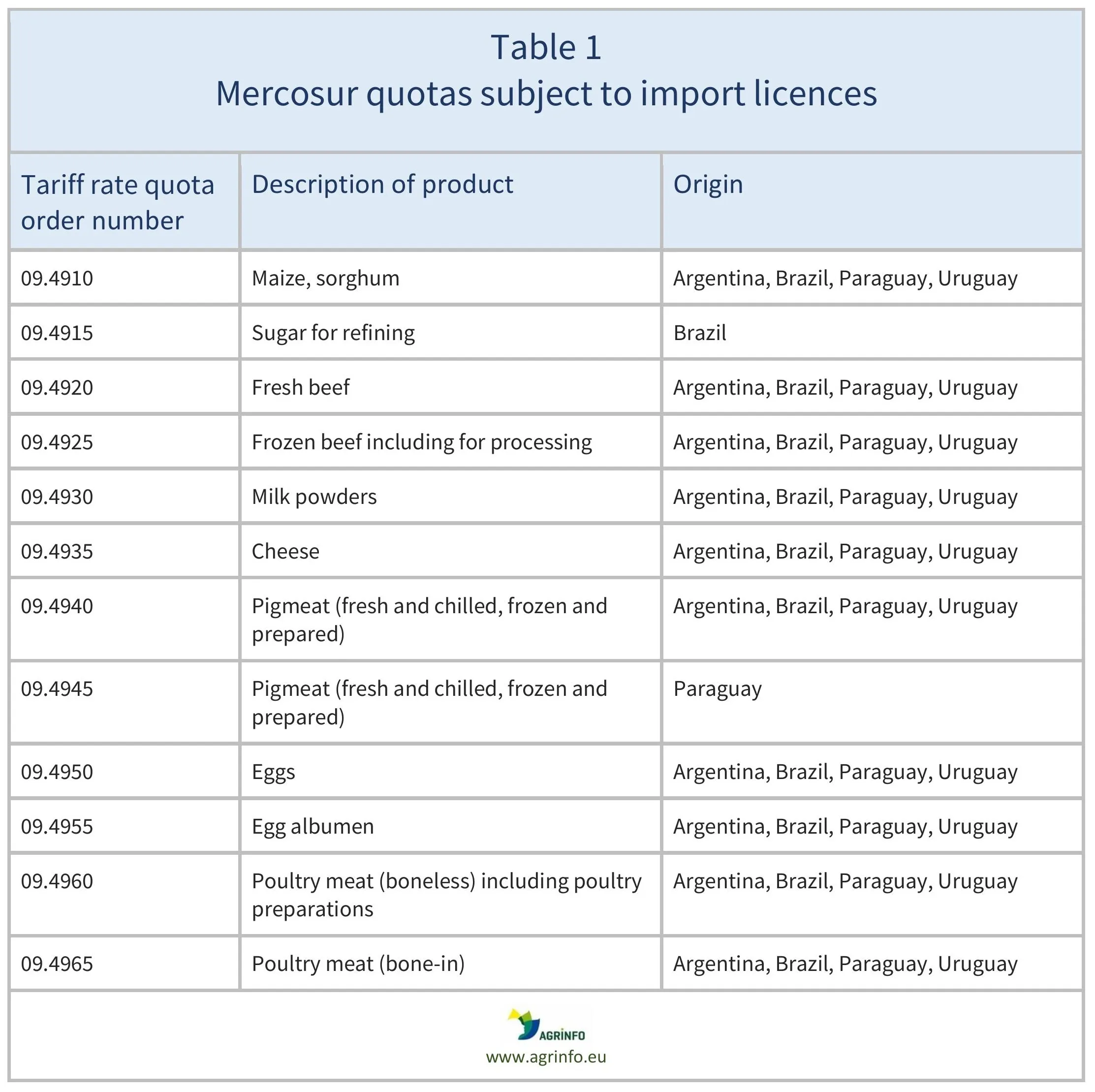
The Agreement establishes the agri-food quotas listed in Table 1, for which import licences are required. Details of each quota, including quota period, quantity, and import licence requirements, are given in Regulation 2026/996, Annex I.
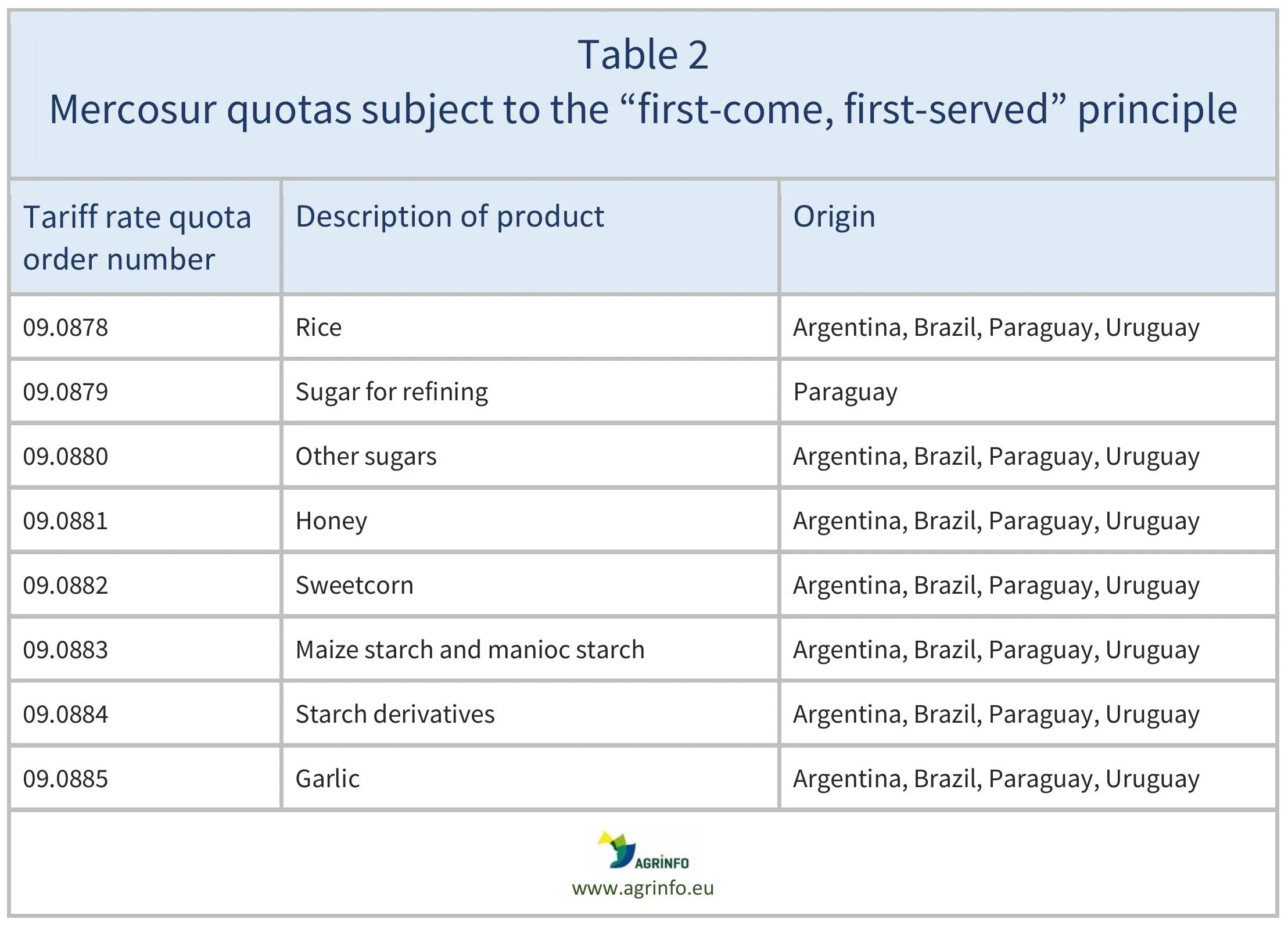
The ITA also establishes the agri-food quotas which are managed according to the principle of “first-come, first-served” (Table 2). Regulation 2026/996, Annex II sets out details of each quota.
Products imported under all these quotas must be accompanied by the certificate in Notice 2026/874.
Corrections
Regulation 2026/1727 of July 2026 corrects certain errors and omissions in earlier Regulations:
- introduces a minimum quantity for proof of trade (to be eligible to access the quota): 25 tonnes for fresh beef (order number 09.4920) and for frozen beef including frozen beef intended for processing (09.4925) in Regulation 2020/761, Annex VIII
- replaces the reference “origin: Mercosur” with “origin: Paraguay” for pigmeat (09.4945) in Regulation 2020/761, Annex X
- introduces missing conversion coefficients that convert product weight to carcass weight equivalent for beef, pork, and poultry in Regulation 2020/761, Annex XVI, Part D
- lowers the quantity of honey available under the quota 09.0881 in the last quarter of 2026 in Regulation 2020/1988, Annex I, as imports in May and June exceeded the quota quantity available.
Why?
New quotas established under the EU–Mercosur ITA must be incorporated into the existing EU legislation on the creation and management of TRQs.
Timeline
The quotas and the system for managing them apply from 1 May 2026.
Background
European Union agricultural TRQs can be managed in two different ways depending on the product and its origin, and reflecting the sensitivity of the product in relation to the EU market. The TRQs may be managed according to:
- the “first-come, first-served” principle described in Regulation 2020/1988
- a system of import licences where importers can apply for and be allocated certain quantities of the product, described in Regulation 2020/761.
For further information on the EU’s agreement with Mercosur countries, see EU–Mercosur Partnership Agreement.
Resources
Commission Implementing Regulation (EU) 2020/1988 laying down rules for the application of Regulations 1308/2013 and 510/2014 as regards the administration of import tariff quotas in accordance with the first come, first served principle
Commission Implementing Regulation (EU) 2020/761 laying down rules for the application of Regulations 1306/2013, 1308/2013 and 510/2014 as regards the management system of tariff quotas with licences
Sources
Commission Implementing Regulation (EU) 2026/1727 of 10 July 2026 amending Implementing Regulations (EU) 2020/761 and (EU) 2020/1988
Commission Implementing Regulation (EU) 2026/996 regarding the creation, amendment and management of certain tariff quotas following the Interim Agreement on Trade between the European Union, of the one part, and the Common Market of the South, the Argentine Republic, the Federative Republic of Brazil, the Republic of Paraguay and the Oriental Republic of Uruguay, of the other part
Notice of the European Commission [2026/874] [Quota Authorisation Certificate]
Disclaimer: Under no circumstances shall COLEAD be liable for any loss, damage, liability or expense incurred or suffered that is claimed to have resulted from the use of information available on this website or any link to external sites. The use of the website is at the user’s sole risk and responsibility. This information platform was created and maintained with the financial support of the European Union. Its contents do not, however, reflect the views of the European Union.
EU sets rules for implementing Mercosur tariff rate quotas
Commission Implementing Regulation (EU) 2026/1727 of 10 July 2026 amending Implementing Regulations (EU) 2020/761 and (EU) 2020/1988
Commission Implementing Regulation (EU) 2026/996 regarding the creation, amendment and management of certain tariff quotas following the Interim Agreement on Trade between the European Union, of the one part, and the Common Market of the South, the Argentine Republic, the Federative Republic of Brazil, the Republic of Paraguay and the Oriental Republic of Uruguay, of the other part
Notice of the European Commission [2026/874] [Quota Authorisation Certificate]
What is changing and why?
The Interim Trade Agreement (ITA) between the European Union and the Mercosur States (Argentina, Brazil, Paraguay, Uruguay) provisionally applies from 1 May 2026. The ITA establishes tariff rate quotas (TRQs) for certain agri-food products.
Regulation 2026/996 sets out the rules that allow these quotas to be opened and managed (see Tables 1 and 2). The certificate that must be used to accompany products imported under TRQ arrangements can be found in Notice 2026/874.
In July 2026, the EU adopted Regulation 2026/1727 correcting some errors and omissions in Regulation 2026/996.
Timeline
The quotas and the system for managing them apply from 1 May 2026.
Disclaimer: Under no circumstances shall COLEAD be liable for any loss, damage, liability or expense incurred or suffered that is claimed to have resulted from the use of information available on this website or any link to external sites. The use of the website is at the user’s sole risk and responsibility. This information platform was created and maintained with the financial support of the European Union. Its contents do not, however, reflect the views of the European Union.