
Maximum residue levels for chlormequat
- Food safety
- Pesticide MRLs
Summary
The European Union (EU) has reduced the maximum residue levels (MRLs) for chlormequat on wheat, cultivated fungi, and certain animal products.
EU reduces chlormequat MRLs on wheat, fungi, and animal products
Commission Regulation (EU) 2026/1314 of 15 June 2026 amending Annexes II, III and V to Regulation (EC) No 396/2005 of the European Parliament and of the Council as regards maximum residue levels for 1,4-dimethylnaphthalene, chlormequat, metribuzin, metribuzin-desamino-diketo (metribuzin-DADK), terbuthylazine and triclopyr in or on certain products
Update
The European Union (EU) has reduced the maximum residue levels (MRLs) for chlormequat on wheat, cultivated fungi, and certain animal products.
Impacted Products
Fungi, mosses, lichens, swine (all), cattle (all), sheep (liver), sheep (fat), sheep (edible offals), goat (all), horse (all), poultry (liver, kidney, edible offals), other farmed terrestrial animals (all), milk (all), birds’ eggs (domestic fowl), wheat
What is changing?
The EU has reduced the MRL for chlormequat on wheat from 7 to 6 mg/kg, and has reduced the MRLs on certain animal products and cultivated fungi, as summarised in Table 1.
Previously, the EU raised the MRL for chlormequat on oats from 15 to 30 mg/kg (Regulation 2026/140).
Why?
When a temporary MRL is set, it is reviewed periodically to take account of new monitoring data submitted by food operators. If there is no data, or if the data shows that residues are no longer detectable, then the MRL is lowered to the limit of determination (LOD, the lowest level that can be detected using the most modern and reliable analytical methods).
In the case of chlormequat on oyster mushrooms, the latest data submitted showed that the residues detected were under 2 mg/kg (but still higher than the LOD of 0.01 mg/kg). So in this case, the MRL is reduced from the previous level of 6 mg/kg down to 2 mg/kg (not as low as the LOD). The same applies in the case of cultivated fungi, where the MRL is reduced from 0.9 to 0.6 mg/kg.
Regarding animal products, chlormequat may be used on oilseeds or cereals that are used as animal feed, with potential carry-over of residues in food products of animal origin. EFSA (2024) concluded that this carry-over could be accommodated by lowering the MRLs for most animal products (with the exceptions of sheep kidney, and poultry muscle and fat) (see Table 1).
The MRL for chlormequat on oats was raised following a request to modify the previous MRL, which was considered safe based on a risk assessment by the European Food Safety Authority (EFSA 2025).
Timeline
The new MRLs will apply from 6 January 2027.
The MRL on oats has applied since 11 February 2026.
Background
MRLs are set in accordance with the rules set out in Regulation 396/2005. For information on current MRLs for other substances, please consult the EU Pesticide Residues database.
For further information on the EU’s process and principles for setting MRLs, see Regulation of pesticide residues in the EU – Questions and Answers.
Resources
EFSA (2024) Assessment of fall-back MRLs for revoked CXLs previously implemented in the EU legislation and review of the JMPR evaluation of the toxicological data related to pyrasulfotole, pyraziflumid, spiropidion and tetraniliprole. EFSA Journal, 22(5): e8693.
EFSA (2025) Modification of the existing maximum residue level for chlormequat in oat. EFSA Journal, 23(4): e9385.
Commission Regulation (EU) 2026/140 as regards maximum residue levels for acequinocyl, chlormequat, metalaxyl-M, pyraclostrobin, sulfoxaflor and trifloxystrobin in or on certain products
Sources
Commission Regulation (EU) 2026/1314 as regards maximum residue levels for 1,4-dimethylnaphthalene, chlormequat, metribuzin, metribuzin-desamino-diketo (metribuzin-DADK), terbuthylazine and triclopyr in or on certain products.
Tables & Figures
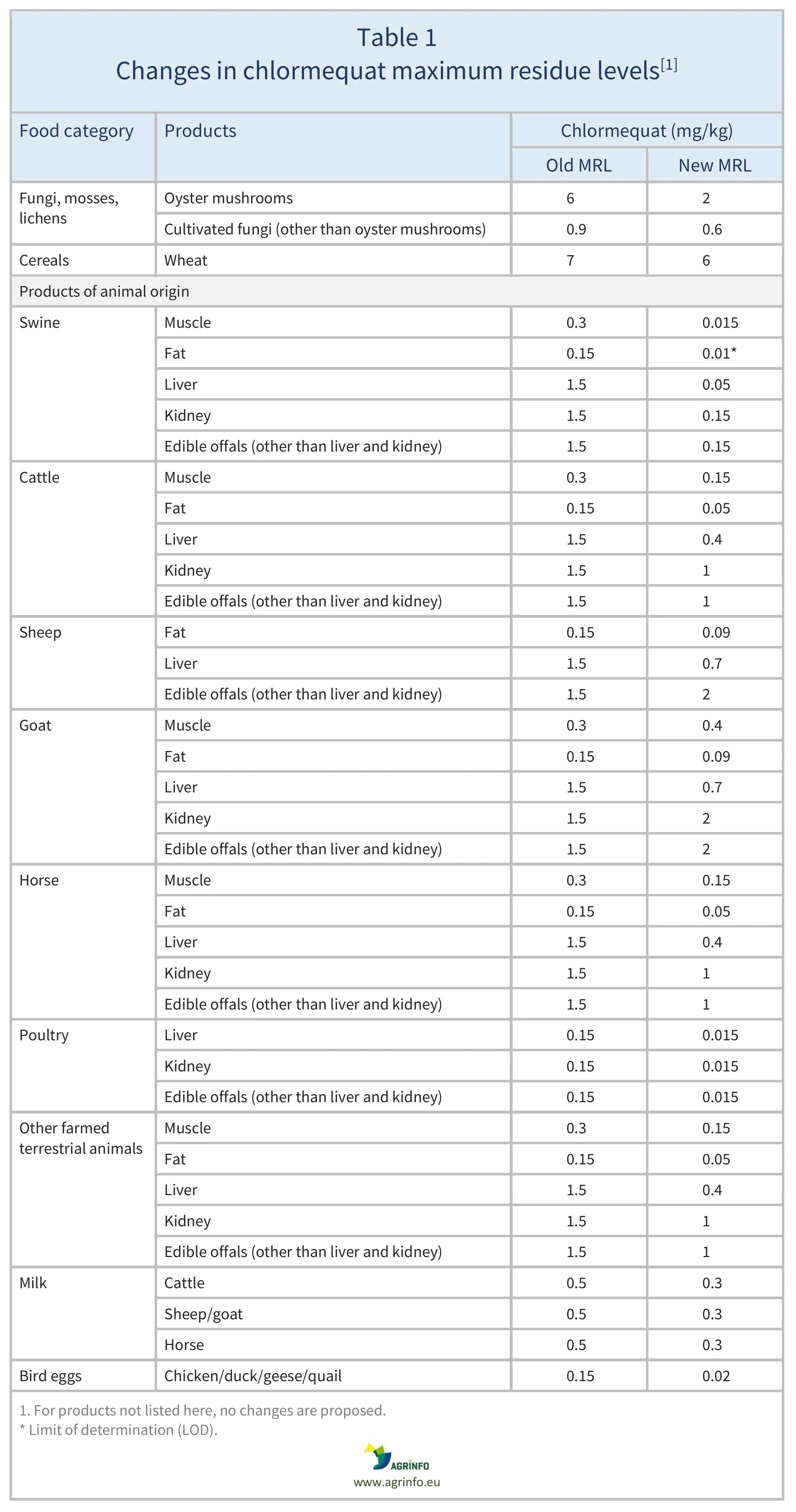
Source: based on Regulation 2026/1314.
Disclaimer: Under no circumstances shall COLEAD be liable for any loss, damage, liability or expense incurred or suffered that is claimed to have resulted from the use of information available on this website or any link to external sites. The use of the website is at the user’s sole risk and responsibility. This information platform was created and maintained with the financial support of the European Union. Its contents do not, however, reflect the views of the European Union.
EU reduces chlormequat MRLs on wheat, fungi, and animal products
Commission Regulation (EU) 2026/1314 as regards maximum residue levels for 1,4-dimethylnaphthalene, chlormequat, metribuzin, metribuzin-desamino-diketo (metribuzin-DADK), terbuthylazine and triclopyr in or on certain products.
What is changing and why?
The European Union (EU) has reduced the maximum residue level (MRL) for chlormequat on wheat, cultivated fungi, and most animal products (see Table 1).
When a temporary MRL is set, it is reviewed periodically to take account of new monitoring data submitted by food operators. If there is no data, or if the data shows that residues are no longer detectable, then the MRL is lowered to the limit of determination (LOD, the lowest level that can be detected using the most modern and reliable analytical methods).
In the case of chlormequat on oyster mushrooms, the latest data submitted showed that the residues detected were under 2 mg/kg (but still higher than the LOD of 0.01 mg/kg). So in this case, the MRL is reduced from the previous level of 6 mg/kg down to 2 mg/kg (not as low as the LOD). The same applies in the case of cultivated fungi, where the MRL is reduced from 0.9 to 0.6 mg/kg.
Regarding animal products, chlormequat may be used on oilseeds or cereals that are used as animal feed, with potential carry-over of residues in food products of animal origin. The MRLs have therefore been reduced for most animal products (with the exceptions of sheep kidney, and poultry muscle and fat).
Timeline
The new MRLs will apply from 6 January 2027.
The MRL on oats has applied since 11 February 2026.
Tables & Figures
Source: based on Regulation 2026/1314.
Disclaimer: Under no circumstances shall COLEAD be liable for any loss, damage, liability or expense incurred or suffered that is claimed to have resulted from the use of information available on this website or any link to external sites. The use of the website is at the user’s sole risk and responsibility. This information platform was created and maintained with the financial support of the European Union. Its contents do not, however, reflect the views of the European Union.