
New generalised scheme of tariff preferences (GSP)
- Trade policy
Summary
The European Union (EU) has established special trade arrangements for lower- and middle-income countries outside the EU. These arrangements – known as standard generalised scheme of preferences (GSP), GSP+, and Everything But Arms (EBA) – provide reduced tariffs on products exported to the EU from the countries listed in Table 1.
In 2026, EU law makers approved a revised GSP that applies from 1 January 2027. The new scheme continues to offer preferential tariffs to 63 low- and middle-income countries. This includes more extensive trade benefits, under the GSP+ scheme, for eligible countries that commit to strengthening their protection of human rights and labour standards, and to respect international agreements on climate change and environmental protection. Least developed countries will still benefit from zero-duty access to the EU on all products except arms.
For all special trade arrangements, the new scheme reinforces countries’ obligations to commit to human rights and environmental protection, by adding to the existing list of conventions that beneficiaries need to ratify and implement. It also eases the criteria on “economic vulnerability” that countries need to fulfil to attain GSP+ status. The rules also allow all GSP countries (standard, GSP+, and EBA) to treat materials from other countries in their region as if they originated in the exporting country (“regional cumulation”) in order to meet the rules of origin.
Due to the challenges currently faced by the EU rice sector, a specific safeguard mechanism has been created to respond automatically to surges in rice imports.
For the first time, the EU is linking preferential trade access to the performance of partner countries in readmitting their own nationals where they are found to have entered the EU illegally.
EU revises generalised scheme of tariff preferences (GSP)
Regulation (EU) 2026/1395 of the European Parliament and of the Council of 17 June 2026 on applying a generalised scheme of tariff preferences and repealing Regulation (EU) No 978/2012
Update
The European Union (EU) has established special trade arrangements for lower- and middle-income countries outside the EU. These arrangements – known as standard generalised scheme of preferences (GSP), GSP+, and Everything But Arms (EBA) – provide reduced tariffs on products exported to the EU from the countries listed in Table 1.
In 2026, EU law makers approved a revised GSP that applies from 1 January 2027. The new scheme continues to offer preferential tariffs to 63 low- and middle-income countries. This includes more extensive trade benefits, under the GSP+ scheme, for eligible countries that commit to strengthening their protection of human rights and labour standards, and to respect international agreements on climate change and environmental protection. Least developed countries will still benefit from zero-duty access to the EU on all products except arms.
For all special trade arrangements, the new scheme reinforces countries’ obligations to commit to human rights and environmental protection, by adding to the existing list of conventions that beneficiaries need to ratify and implement. It also eases the criteria on “economic vulnerability” that countries need to fulfil to attain GSP+ status. The rules also allow all GSP countries (standard, GSP+, and EBA) to treat materials from other countries in their region as if they originated in the exporting country (“regional cumulation”) in order to meet the rules of origin.
Due to the challenges currently faced by the EU rice sector, a specific safeguard mechanism has been created to respond automatically to surges in rice imports.
For the first time, the EU is linking preferential trade access to the performance of partner countries in readmitting their own nationals where they are found to have entered the EU illegally.
What is changing?
The EU has established special trade arrangements for certain lower- and middle-income countries outside the European Union (listed in Table 1).
The revised GSP includes the following key elements.
GSP+
Reinforcement of human and labour rights, and environmental protection (Art. 9)
To benefit from GSP+ tariff preferences, countries must give a binding undertaking to maintain ratification of all relevant conventions (listed in Annex VI of Regulation 2026/1395) and to ensure their effective implementation. The new GSP adds to the list the following additional international conventions:
- Paris Agreement (2015)
- Convention on the Rights of Persons and Disabilities (2006)
- Optional Protocol to the Convention on the Rights of the Child on the involvement of children in armed conflict (2000)
- Convention concerning Labour Inspection in Industry and Commerce, No 81 (1947)
- Convention concerning Tripartite Consultations to Promote the Implementation of International Labour Standards, No 144 (1976)
- United Nations Convention against Transnational Organized Crime (2000).
The European Commission will monitor whether the relevant conventions have been ratified and are being implemented.
Standard GSP and EBA countries are not required to ratify and implement the relevant conventions, but they are expected to respect the principles laid down in these conventions. Preferential tariffs can be temporarily withdrawn if these principles are seriously and systematically violated.
Lower GSP+ graduation thresholds (Annex V)
To be eligible for the more favourable tariff preferences under GSP+, a country must be considered to be “vulnerable” due to a lack of trade diversification. Under the new scheme, the vulnerability criteria are being eased to allow a larger number of countries to access the GSP+ scheme. Under the revised criteria, a country is considered vulnerable if its seven largest groups of products (“sections”) covered by the GSP and exported to the EU make up on average more than 75% of its total exports to the EU (a sign of weak trade diversification). A second criterion to qualify as “vulnerable” under the current scheme, that a country’s exports must be less than 9% of total exports from all GSP countries, is removed.
Transparency (Art. 49)
The new rules aim to improve monitoring and implementation of GSP+ obligations through increased participation of stakeholders.
Standard GSP
Lower product graduation thresholds for standard GSP countries (Art. 8)
Under the current standard GSP, where a beneficiary country has average imports of more than a 57% share of total imports of a specific product from standard GSP countries, that country’s preferential access may be suspended. Under the new standard GSP, that threshold is reduced to 47%. This does not apply to GSP+ or EBA countries.
EBA
Safeguard mechanism for rice imports
Where imports of a product cause serious difficulties for EU producers, preferential tariffs can be removed and normal tariffs reintroduced. A special surveillance mechanism will allow the European Commission to introduce safeguard measures more quickly where imports of agricultural products create disturbances on the EU market.
The new GSP introduces a specific automatic safeguard mechanism that will remove preferential tariffs for rice originating in EBA beneficiary countries, where there is a surge of imports above historical levels (an increase of more than 45% above the average yearly import quantity over the previous 10 years) (Art.34).
Rules on cumulation (Art. 39)
For exporters to benefit from lower import tariffs, EU rules of origin require products to “originate in the beneficiary country”. These rules can limit the market access gains that GSP countries can make, particularly where supply chains cross borders. The scheme allows beneficiary countries to submit requests to the European Commission for “regional cumulation”, allowing beneficiary countries to treat materials originating in their region as if they originated in their own country. Regional cumulation only applies to certain agri-food products; Regulation 2015/2446, Art. 55). Cumulation can be requested if:
- the beneficiary country can demonstrate a specific trade, development, or financing need
- it will not create trade difficulties (trade diversion) for other eligible countries
- the beneficiary country can demonstrate that it is required to meet the rules of origin for the relevant products.
The GSP also permits extended cumulation, allowing beneficiary countries to treat materials originating in a country with which the EU has a free trade agreement as if they originated in their own country. However, extended cumulation does not apply to food products (CN Chapters 1–24); Regulation 2015/2446, Art. 56.
Readmission of nationals (Art. 22)
Under the new scheme, GSP preferences may be withdrawn temporarily if a beneficiary country does not cooperate with the EU regarding the readmission of their own nationals who are illegally present in the EU. Withdrawal would only occur where there are “serious and systematic shortcomings” regarding obligations on international readmissions. Readmission of nationals applies to all three schemes; however for EBA countries there will be a transition period and the provision will apply from 1 January 2029.
Timeline
The new GSP applies from 1 January 2027.
What are the major implications for exporting countries?
Opportunities/gains
The basic structure and benefits of the new GSP system, generally considered to be beneficial to developing countries and the Sustainable Development Goals, have not significantly changed. The new GSP does not change EBA zero-duty access, but larger EBA exporters of rice (Cambodia and Myanmar) could face uncertainty due to the introduction of a specific safeguard mechanism for rice.
Standard GSP countries competing in a sector previously dominated by one GSP beneficiary may see new openings on the EU market, as tariff preferences for that dominant country will be removed more rapidly than currently. This will not apply to GSP+ or EBA countries.
The GSP creates opportunities for beneficiary countries to negotiate additional flexibility on rules of origin by requesting regional cumulation for certain agri-food products. But the evidence needed to secure such cumulations may be complicated to provide.
Potential challenges
The introduction of a stronger special surveillance mechanism for a more rapid introduction of safeguards potentially provides a less secure legal basis for long-term preferential access to the EU market for GSP partners. Increasing uncertainty around long-term guarantees of preferences may discourage investment in, and orientation towards, the EU market. The introduction of a specific automatic safeguard mechanism for rice imports may raise doubts about the long-term stability of the European market for rice exporters.
The increased number of relevant human rights and labour rights conventions, such as the Convention concerning Labour Inspection in Industry and Commerce, could be a challenge for GSP+ beneficiaries. Current beneficiaries will have to reapply for access to the GSP+ arrangement and demonstrate their adherence to the additional obligations in order to maintain current trade preferences.
The addition of commitments regarding readmission of nationals creates an obligation that may be a challenge for some GSP beneficiary countries with weak administrative capacities. Given the political sensitivities around migration, and its untypical inclusion in preferential trade arrangements (Francavilla 2023), it is uncertain how these requirements may affect trade preferences.
Recommended Actions
Countries that are currently GSP+ beneficiaries and wish to continue to benefit from the scheme should submit a new request in line with the revised eligibility criteria by 31 December 2028. Existing tariff preferences will be maintained while that request is reviewed. Eligible countries seeking to gain or retain GSP+ status should start the process of ratifying and implementing the human and labour rights conventions that are now listed in this Regulation.
Background
The generalised scheme of tariff preferences (GSP) aims to assist lower-income countries to integrate into the world economy, reduce poverty, and support sustainable development by protecting core human rights and the environment.
The current GSP has three trading arrangements:
- Standard GSP: for lower- and lower-middle-income countries, providing removal or reduction of import tariffs on approximately two-thirds of EU tariff lines (listed in Annex III of Regulation 2026/1395).
- GSP+: removes import tariffs for many of the same tariff lines as the standard GSP (Annex III). This improved preferential access is granted to vulnerable lower- and lower-middle-income countries that implement international conventions related to human rights and/or labour rights.
- Everything But Arms (EBA): special arrangement for least-developed countries – 0% import tariffs and zero quotas for all products except arms and ammunition.
The eligible beneficiary countries are listed in Table 1.
The current GSP, which was originally intended to apply from 2014 to 2023, has been subject to lengthy negotiations and was extended until the end of 2027.
Resources
European Commission: Generalised scheme of preferences.
European Commission (2021) Study in support of an impact assessment to prepare the review of GSP Regulation No 978/2012: Final report.
European Commission (2026) New Generalised Scheme of Preferences approved for application in 2027. News Article, 28 April.
European Parliament (2022) Report on the proposal for a regulation of the European Parliament and of the Council on applying a generalised scheme of tariff preferences. Committee on International Trade.
Francavilla, C. (2023) Migration paranoia jeopardizes EU trade and development scheme. Human Rights Watch, 6 June.
Commission Delegated Regulation (EU) 2015/2446 as regards detailed rules concerning certain provisions of the Union Customs Code.
Sources
Regulation (EU) 2026/1395 on applying a generalised scheme of tariff preferences
Tables & Figures
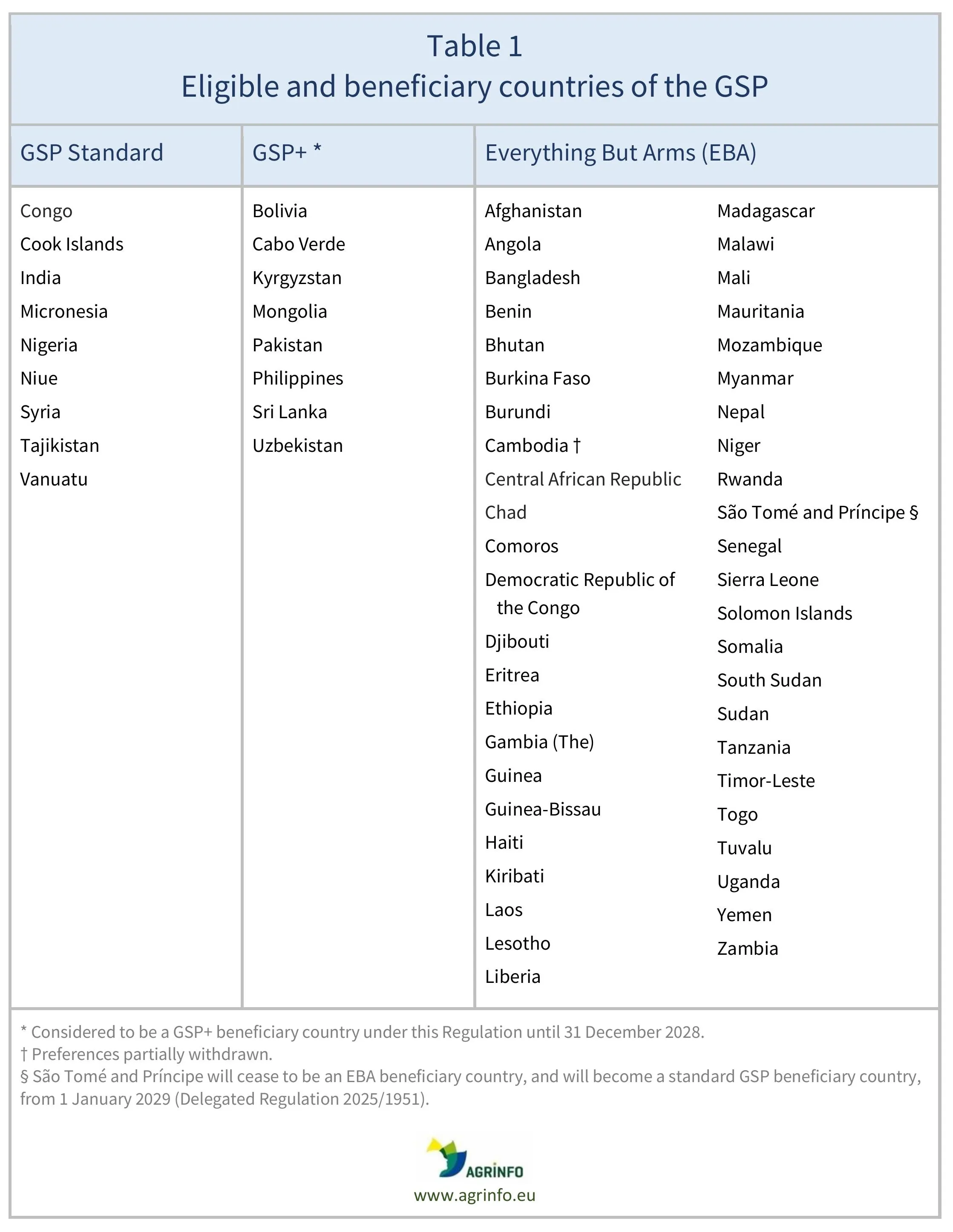
Source: based on Regulation (EU) 2026/1395, Annex I
Disclaimer: Under no circumstances shall COLEAD be liable for any loss, damage, liability or expense incurred or suffered that is claimed to have resulted from the use of information available on this website or any link to external sites. The use of the website is at the user’s sole risk and responsibility. This information platform was created and maintained with the financial support of the European Union. Its contents do not, however, reflect the views of the European Union.
EU revises generalised scheme of tariff preferences (GSP)
Regulation (EU) 2026/1395 on applying a generalised scheme of tariff preferences
What is changing and why?
The European Union (EU) has established special trade arrangements for certain lower- and middle-income countries outside the EU. These arrangements provide reduced tariffs on products exported to the EU from the countries listed in Table 1.
The EU has approved a new updated scheme. This maintains the three basic types of GSP status:
- Standard GSP: for lower- and lower-middle-income countries, providing removal or reduction of import tariffs on approximately two-thirds of EU tariff lines (listed in Annex III of Regulation 2026/1395).
- GSP+: removes import tariffs for many of the same tariff lines as the standard GSP (Annex III). This improved preferential access is granted to vulnerable lower- and lower-middle-income countries that implement international conventions related to human rights and/or labour rights.
- Everything But Arms (EBA): special arrangement for least-developed countries – 0% import tariffs and zero quotas for all products except arms and ammunition.
In 2026, EU law makers approved a new revised GSP that applies from 1 January 2027.
The revised GSP includes the following key elements.
GSP+
- Reinforcement of human and labour rights, and environmental protection: Additional international conventions have been included that must be respected in order for countries to benefit from enhanced preferential tariffs under the GSP+ scheme.
- Simplification of countries’ access to GSP+ status: Only countries that are economically “vulnerable” have access to the enhanced market access provided by GSP+ status. The new scheme removes certain economic vulnerability conditions, allowing a larger number of countries access to GSP+.
- Transparency: The new rules aim to improve monitoring and implementation of GSP+ obligations through increased participation of stakeholders.
Standard GSP
- Allowing more competition among standard GSP countries: Under the current standard GSP, where a beneficiary country has average imports of more than a 57% share of total imports of a specific product from standard GSP countries, that country’s preferential access may be suspended. Under the new standard GSP, that threshold is reduced to 47%. This does not apply to GSP+ or EBA countries.
EBA
- Safeguard mechanism for rice imports: Where there is a surge of imports above historical levels, a new specific automatic safeguard mechanism will remove preferential tariffs for rice originating in EBA beneficiary countries.
All special trade arrangements
- Rules on cumulation: The scheme allows GSP countries to request “regional cumulation” (allowing beneficiary countries to treat certain materials originating in their region as if they originated in their own country). This can help exporting countries to meet rules of origin that allow a product to qualify for preferential market access.
- Readmission of nationals: Under the new scheme, GSP preferences may be withdrawn if a beneficiary country significantly fails to cooperate with the EU regarding the readmission of their own nationals who are illegally present in the EU.
Actions
Countries that are currently GSP+ beneficiaries and wish to continue to benefit from the scheme should submit a new request in line with the revised eligibility criteria by 31 December 2028. Existing tariff preferences will be maintained while that request is reviewed. Eligible countries seeking to gain or retain GSP+ status should start the process of ratifying and implementing the human and labour rights conventions that are now listed in this Regulation.
Timeline
The new scheme will apply from 1 January 2027.
Tables & Figures
Source: based on Regulation (EU) 2026/1395, Annex I
Disclaimer: Under no circumstances shall COLEAD be liable for any loss, damage, liability or expense incurred or suffered that is claimed to have resulted from the use of information available on this website or any link to external sites. The use of the website is at the user’s sole risk and responsibility. This information platform was created and maintained with the financial support of the European Union. Its contents do not, however, reflect the views of the European Union.