
Mineral oil hydrocarbons in food
- Contaminants
Summary
The European Union (EU) intends to set maximum permitted limits (maximum levels) of mineral oil aromatic hydrocarbons (MOAH) in certain foods. For most foods, the new maximum levels apply from 1 January 2027, but a later application date will apply for some foods.
The foods affected by the proposal are oilseeds, oil fruits, animal and vegetable fats and oils, tree nuts, pulses, cereal grains and products derived from cereals, milk, dairy products, cocoa beans and cocoa products, confectionary, spices, dried herbs, teas and herbal infusions, compound or processed foods containing these ingredients, foods for infants and young children, food supplements, and food additives.
From 2026 to 2029, the European Commission also recommends the monitoring of MOAH for certain other foods for which no maximum levels are set, and mineral oil saturated hydrocarbons (MOSH) for a wider range of foods. For these products, the Commission will recommend MOAH and MOSH “indicative levels”. If products are found to contain MOAH or MOSH that exceed indicative levels, they will not necessarily be excluded from the EU market (except where levels are very high), but it should lead to investigations by operators into the source of contamination.
The European Commission has updated its Frequently Asked Questions document on the proposed Regulation.
For further information, see the resources from AGRINFO’s June 2026 webinar on New EU rules for mineral oil aromatic hydrocarbons:
- Presentations (PowerPoint)
- Webinar video
- Now available – Questions and answers arising from the webinars.
EU to set maximum levels for mineral oil aromatic hydrocarbons in food
Draft Commission Regulation amending Regulation (EU) 2023/915 as regards maximum levels of mineral oil aromatic hydrocarbons in food
Draft Annex [on maximum levels]
Draft Commission Recommendation on the monitoring of mineral oil hydrocarbons in food
Draft Commission Implementing Regulation amending Regulation (EC) No 333/2007 as regards the methods of sampling and analysis for the control of levels of mineral oil hydrocarbons in foodstuffs
Draft Annex [on sampling and analysis]
Update
The European Union (EU) intends to set maximum permitted limits (maximum levels) of mineral oil aromatic hydrocarbons (MOAH) in certain foods. For most foods, the new maximum levels apply from 1 January 2027, but a later application date will apply for some foods.
The foods affected by the proposal are oilseeds, oil fruits, animal and vegetable fats and oils, tree nuts, pulses, cereal grains and products derived from cereals, milk, dairy products, cocoa beans and cocoa products, confectionary, spices, dried herbs, teas and herbal infusions, compound or processed foods containing these ingredients, foods for infants and young children, food supplements, and food additives.
From 2026 to 2029, the European Commission also recommends the monitoring of MOAH for certain other foods for which no maximum levels are set, and mineral oil saturated hydrocarbons (MOSH) for a wider range of foods. For these products, the Commission will recommend MOAH and MOSH “indicative levels”. If products are found to contain MOAH or MOSH that exceed indicative levels, they will not necessarily be excluded from the EU market (except where levels are very high), but it should lead to investigations by operators into the source of contamination.
The European Commission has updated its Frequently Asked Questions document on the proposed Regulation.
For further information, see the resources from AGRINFO’s June 2026 webinar on New EU rules for mineral oil aromatic hydrocarbons:
- Presentations (PowerPoint)
- Webinar video
- Now available – Questions and answers arising from the webinars.
Impacted Products
Oilseeds and oil fruits, animal and vegetable fats and oils, tree nuts, pulses, cereal grains (including rice), milk, dairy products, milk, dairy products, cocoa beans, cocoa products, spices, dried herbs, dry tea and herbal infusions (as instant products or used as an ingredient food), compound and processed foods containing these ingredients, food supplements, food additives, foods for infants and young children
What is changing?
Maximum levels
As mineral oil aromatic hydrocarbons (MOAH) are dangerous to humans, the EU is proposing to set maximum permitted levels of these substances in certain foods (see Table 1).
For processed/compound products for which no specific maximum level (ML) is set in Table 1, until 1 January 2030 the ML must be calculated, taking into account:
- changes in the MOAH concentration resulting from drying, diluting, or other processing
- the proportion of the ingredients in the product
- the limit of quantification (LOQ); the ML cannot be below the LOQ.
Further guidance on these calculations can be found in the FAQ document (European Commission 2026), pages 5–8 and Annex.
Commission recommendations for EU Member State monitoring
For certain foods, the European Commission also recommends EU Member States, in collaboration with food operators, to monitor:
- MOAH (in foods for which maximum levels have not been set)
- mineral oil saturated hydrocarbons (MOSH)
This monitoring aims to ensure that consumers are not being increasingly exposed to these substances.
For monitoring purposes, “indicative levels” will be set for MOAH (see Table 2) and MOSH (see Table 3).
If MOAH or MOSH in these foods exceed the recommended indicative levels, these products will not necessarily be excluded from the EU market, but the source of contamination should be investigated. When EU Member States, based on national risk assessment, consider that a particular product is not safe because levels of MOAH or MOSH are very high, that product will not be permitted onto the market (General Food Law Regulation 178/2002 (Art. 14)).
Foods for which no maximum levels or indicative levels have been set
MOAH contamination mostly occurs through processing, so for certain foods – such as fresh fruit and vegetables, fresh meat, seafood, and eggs – contamination is not expected. On 13 May 2026, the Standing Committee on Plants, Animals, Food and Feed (SCoPAFF) adopted a Joint Statement providing enforcement guidance in relation to foods for which no maximum levels are set. If such foods are found to contain MOAH above the LOQ (indicating an unusual level of contamination) and, following a national risk assessment, control authorities consider that the products are a risk to the consumer, those foods could be withdrawn or recalled from the market. However, control authorities are not recommended or expected to focus MOAH controls on such products.
Sampling and laboratory analysis
To ensure that controls of MOH by competent authorities are carried out consistently, the EU has developed detailed requirements for sampling methods and laboratory analyses (see Draft Annex on sampling and analysis).
Why?
In 2023, the European Food Safety Authority (EFSA) updated its risk assessment on MOH in food with regard to human health (EFSA 2023). Maximum levels are set for MOAH, which EFSA considered to have potential genotoxic and carcinogenic activity.
Mineral oil saturated hydrocarbons (MOSH) bioaccumulate in various organs. EFSA considers that, according to present knowledge, the current exposure to MOSH does not raise concerns for human health (EFSA 2023). However, the consequences of long-term accumulation of MOSH have not yet been investigated and remain uncertain. The EU will adopt recommendations on MOSH in parallel to the MOAH maximum levels.
Maximum levels for contaminants are set considering the maximum levels that can be met when using the best available practices. This is known as the “ALARA” (as low as reasonably achievable) principle. Maximum levels are generally set at the LOQ. However, for certain foods it has been demonstrated that, even if good practices are applied, a maximum level at the LOQ cannot be met. For these products, timetables have been set for lowering the maximum levels (see Table 1).
Timeline
The maximum levels for MOAH were approved on 13 May 2026 by EU Member States; formal adoption is targeted for October 2026.
The new maximum levels will apply from 1 January 2027, except in the specific cases listed in Table 1 where a later application date applies.
What are the major implications for exporting countries?
The rules today
Currently there are no maximum levels for MOAH and MOSH under EU law. EU Member States apply a common approach to controlling food containing MOAH, which helps them to ensure that food is safe as required by the General Food Law Regulation 178/2002 (Art. 14). This approach is set out in a joint statement in the Summary Report of 21 April 2022: when MOAH are found during official controls of food, Member States should “withdraw and, if necessary, [...] recall products from the market” when the limit of quantification (LOQ) is exceeded.
These LOQs are:
- 0.5 mg/kg for dry foods with a low fat/oil content (≤4% fat/oil)
- 1 mg/kg for foods with a higher fat/oil content (>4% fat/oil, ≤50% fat/oil)
- 2 mg/kg for fats/oils or foods with >50% fat/oil.
While not set in EU law, this agreed approach helps EU Member States to ensure that food is safe, as required by the General Food Law Regulation 178/2002 (Art. 14).
Impacts of maximum limits on trading partners
The current agreed approach among EU Member States of removing foods “where necessary” has not always been applied consistently across the EU, creating ambiguity and uncertainty for food operators.
Maximum levels will provide greater clarity. For certain products, these levels are higher than the LOQs currently used for enforcement. Operators should expect a more consistent approach to enforcement by EU control bodies: foods exceeding MOAH maximum levels will not be permitted to enter the EU market. Operators should also anticipate that due to increased controls of MOAH by competent authorities, European buyers may require suppliers to provide evidence that foods exported to the EU comply with the new maximum levels.
Preparing for compliance with new maximum limits
There are numerous potential sources of MOAH, and testing for them is complex. Although controls for mineral oils are already in place in the EU, setting maximum levels is likely to mean buyers will request suppliers to demonstrate compliance with the new levels. In the short term, there may be significant work required in many value chains to identify sources of MOAH and strategies to prevent their presence. This in turn may require an increase in analytical capacity to test for MOAH.
Recommended Actions
Food suppliers in all sectors should increase monitoring of MOAH and MOSH to identify any presence of these substances in their products. When MOAH or MOSH are identified in food, suppliers should check all steps of the supply process, identify the sources of contamination, and develop measures to avoid further contamination of their products. Guidance is available on preventing the transfer of undesired MOAH into food (FoodDrink Europe 2018).
In many non-EU countries, the capacity for analysing MOAH may be limited. The European Union Reference Laboratory for Processing Contaminants (EURL-PC) has compiled an indicative list of laboratories that are able to analyse food for content of total MOAH in accordance with the required LOQs. The list is available on request by sending an email to eurl-pc@food.dtu.dk with “GET MOAH LAB LIST” in the subject field.
The European Commission’s Joint Research Centre (JRC) has published Guidance on sampling, analysis, and data reporting for monitoring MOH in food and food contact materials (Bratinova et al. 2023).
Background
Mineral oil hydrocarbons
Mineral oil hydrocarbons fall into two main classes:
- mineral oil saturated hydrocarbons (MOSH)
- mineral oil aromatic hydrocarbons (MOAH).
Mineral oil hydrocarbons enter the food chain at various points: through environmental contamination during harvesting, through accidental contact with lubricants during processing, or as a result of migration from food contact materials. Recycled paperboard may contain residues of printing ink solvents that can easily migrate to food.
For more information see the European Commission webpage Mineral Oil Hydrocarbons (MOH).
Analysis of MOAH
The method for MOAH analysis is liquid chromatography–gas chromatography–flame ionisation detection (LC-GC-FID) with subsequent flame ionisation detection. The European Commission’s Joint Research Centre (JRC) has published Guidance on sampling, analysis, and data reporting for monitoring mineral oil hydrocarbons in food and food contact materials (Bratinova et al. 2023). When needed, for example in cases of suspected interferences, characterisation of interferences should be done on the basis of a comprehensive gas chromatography (GC×GC).
The European Commission has updated its FAQs on the draft regulatory measures on MOH in food (European Commission 2026).
Resources
Bratinova, S., Hoekstra, E. and Robouch, P. (2023) Guidance on sampling, analysis and data reporting for the monitoring of mineral oil hydrocarbons in food and food contact materials. European Commission, Joint Research Centre.
EFSA (2023) Update of the risk assessment of mineral oil hydrocarbons in food. EFSA Journal, 21(9): e08215.
European Commission (2022) Standing Committee on Plants, Animals, Food and Feed: Section Novel Food and Toxicological Safety of the Food Chain, 21 April 2022. Summary Report.
European Commission (2026) FAQ document on the regulatory measures on mineral oil hydrocarbons (MOHs) in food-Rev.3.
FoodDrink Europe (2018) Toolbox on reducing the transfer of mineral oils into food.
Sources
Draft Commission Regulation amending Regulation (EU) 2023/915 as regards maximum levels of mineral oil aromatic hydrocarbons in food [PLAN/2023/2345]
Draft Annex on maximum levels [PLAN/2023/2345]
Draft Commission Recommendation on the monitoring of mineral oil hydrocarbons in food [PLAN/2023/2727]
Draft Commission Implementing Regulation amending Regulation (EC) No 333/2007 as regards the methods of sampling and analysis for the control of levels of mineral oil hydrocarbons in foodstuffs [PLAN/2023/2726]
Draft Annex on sampling and analysis [PLAN/2023/2726]
Tables & Figures
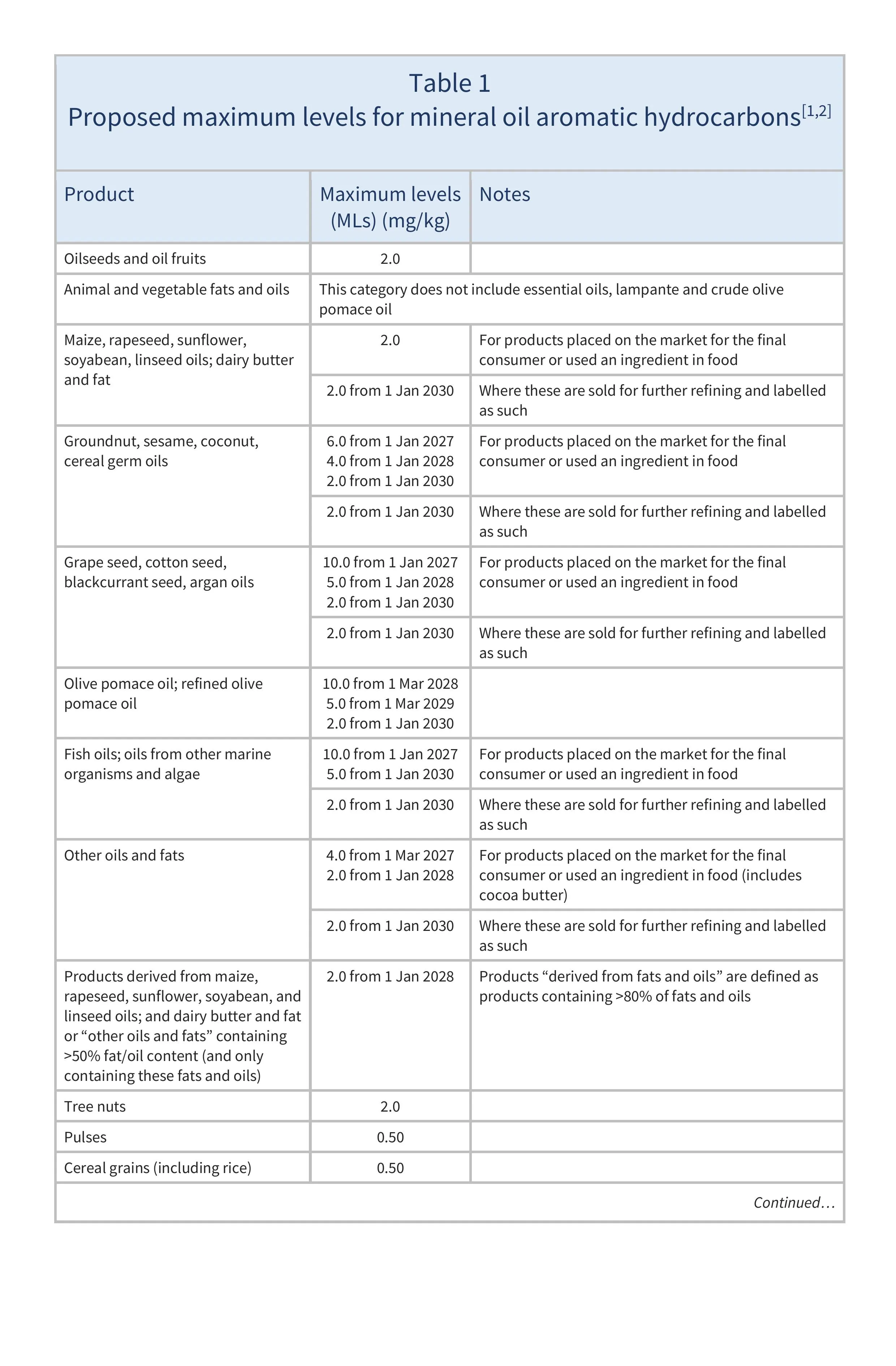
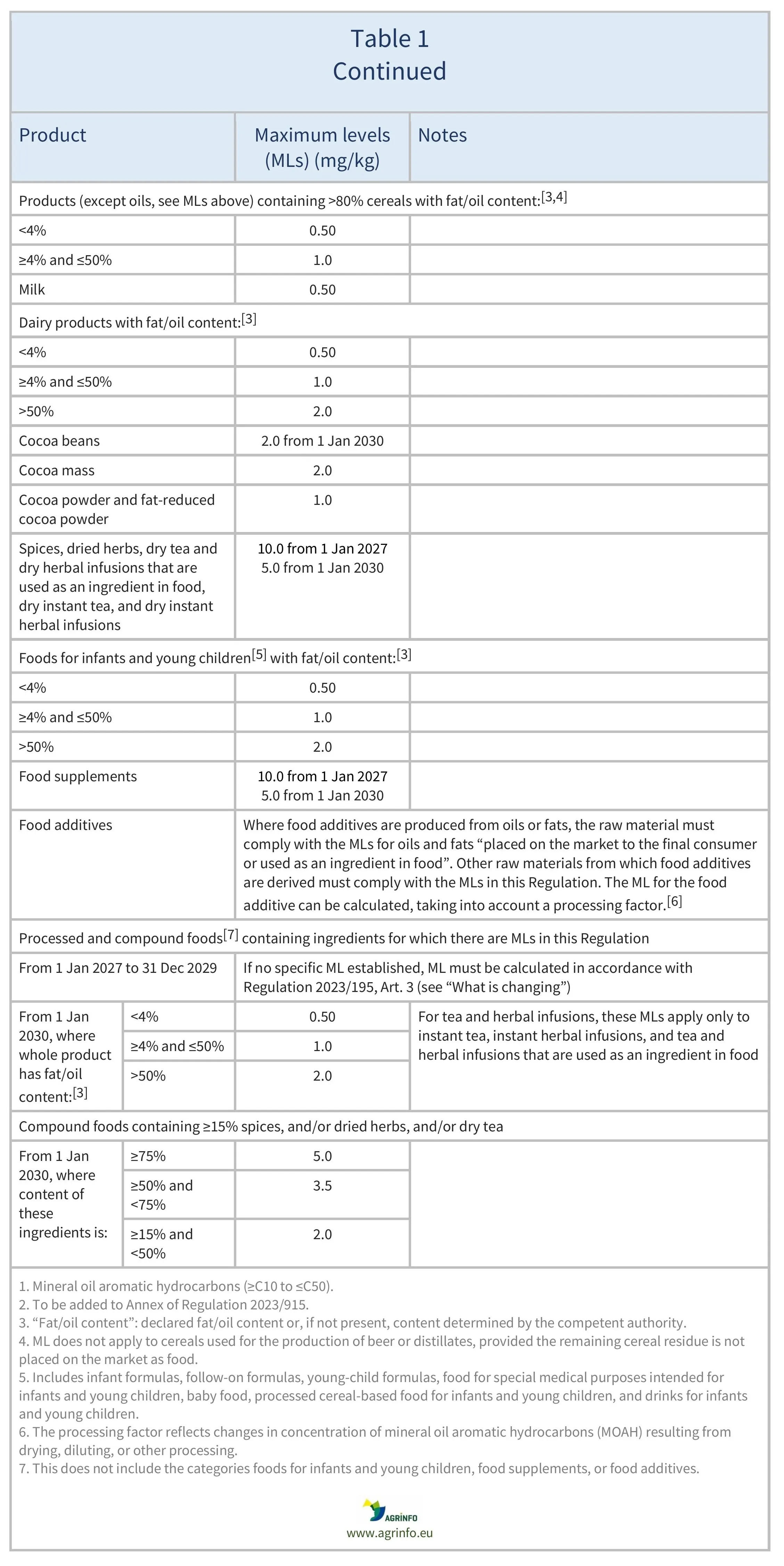
Source: Draft Annex [on maximum levels]
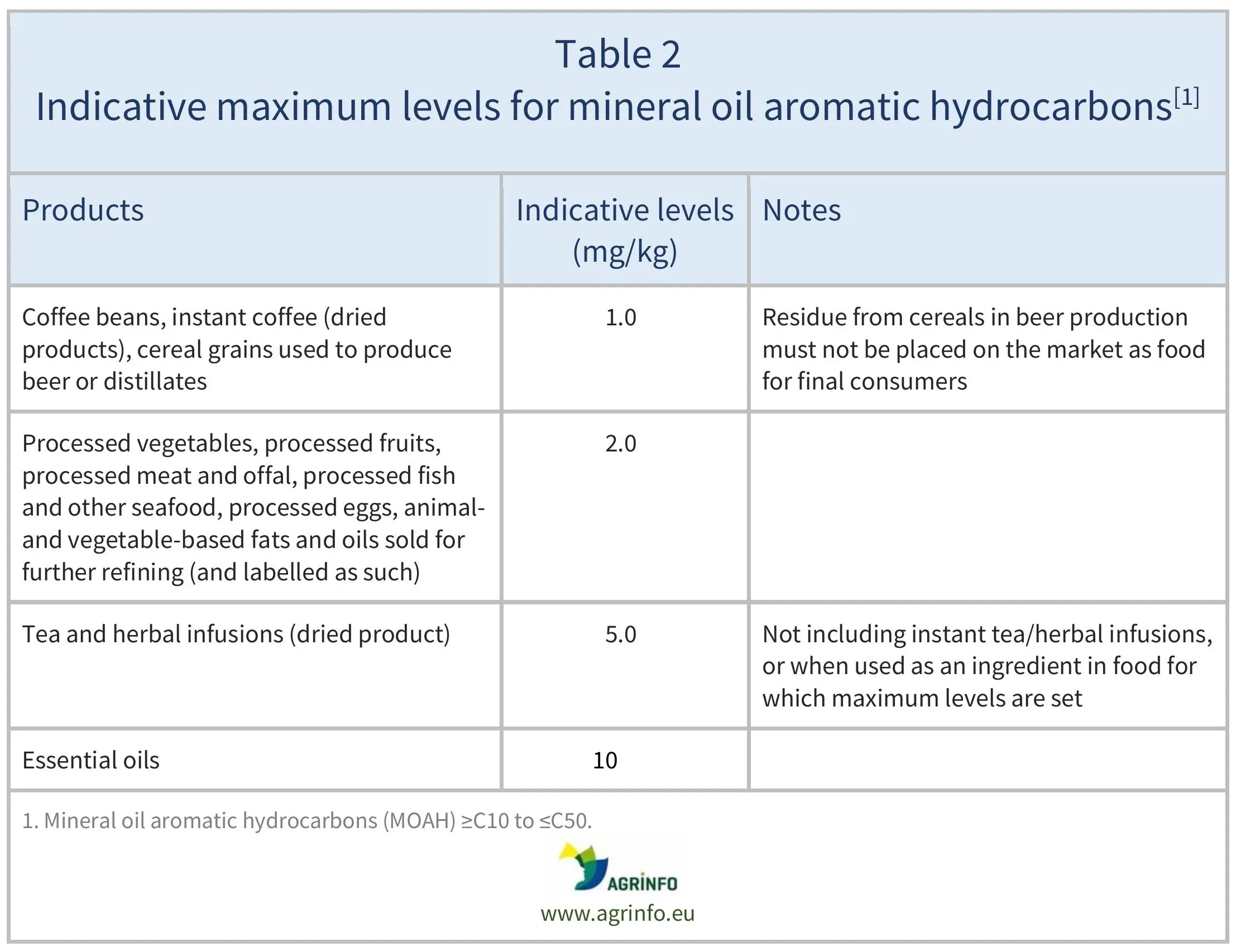
Source: Draft Commission Recommendation on the monitoring of mineral oil hydrocarbons in food
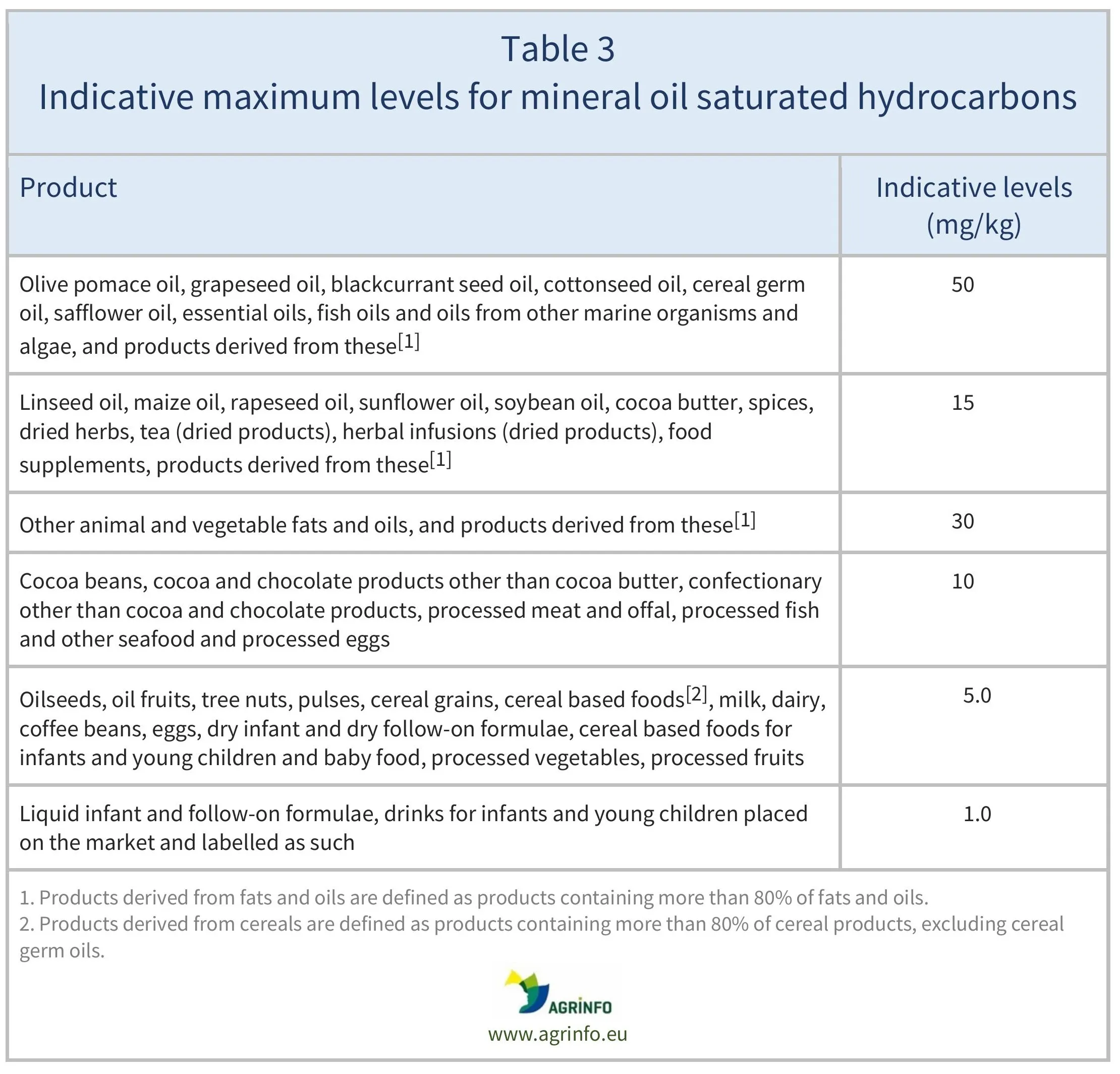
Source: Draft Commission Recommendation on the monitoring of mineral oil hydrocarbons in food
Disclaimer: Under no circumstances shall COLEAD be liable for any loss, damage, liability or expense incurred or suffered that is claimed to have resulted from the use of information available on this website or any link to external sites. The use of the website is at the user’s sole risk and responsibility. This information platform was created and maintained with the financial support of the European Union. Its contents do not, however, reflect the views of the European Union.
EU to set maximum levels for mineral oil aromatic hydrocarbons in food
Draft Commission Regulation amending Regulation (EU) 2023/915 as regards maximum levels of mineral oil aromatic hydrocarbons in food
Draft Annex [on maximum levels]
Draft Commission Recommendation on the monitoring of mineral oil hydrocarbons in food
Draft Commission Implementing Regulation amending Regulation (EC) No 333/2007 as regards the methods of sampling and analysis for the control of levels of mineral oil hydrocarbons in foodstuffs
Draft Annex [on sampling and analysis]
What is changing and why?
MOAH maximum levels
As mineral oil aromatic hydrocarbons (MOAH) are dangerous to humans, the European Union (EU) is proposing to set maximum permitted levels of MOAH in certain foods (see Table 1).
The EU proposal is a significant change compared to the situation today. Currently, EU Member States can withdraw products or recall them from the market where MOAH levels are higher than the following limits of quantification (LOQ):
- 0.5 mg/kg for dry foods with a low fat/oil content (≤4% fat/oil)
- 1 mg/kg for foods with a higher fat/oil content (>4% fat/oil, ≤50% fat/oil)
- 2 mg/kg for fats/oils or foods with >50% fat/oil.
But these limits are not set in EU law. The EU now intends to reinforce these limits by establishing maximum levels in law.
Commission recommendations for EU Member State monitoring
For certain foods, the European Commission also recommends EU Member States, in collaboration with food operators, to monitor:
- MOAH (in foods for which maximum levels have not been set)
- mineral oil saturated hydrocarbons (MOSH)
For these monitoring purposes, “indicative levels” will be set for MOAH (see Table 2) and MOSH (see Table 3).
If MOAH or MOSH in these foods exceed the recommended indicative levels, these products will not necessarily be excluded from the EU market, but the source of contamination should be investigated. When EU Member States, based on a national risk assessment, consider that a particular product is not safe because levels of MOAH or MOSH are very high, that product will not be permitted onto the market.
Sampling and laboratory analysis
To ensure that controls of MOSH and MOAH by competent authorities are carried out consistently, the EU has also developed detailed requirements for sampling methods and laboratory analyses (see Draft Annex on sampling and analysis).
Actions
Suppliers should increase monitoring of MOSH and MOAH to identify any presence of these substances in their products. When MOSH and MOAH are identified in food, operators should check all steps of the supply process, identify the sources of contamination, and develop measures to avoid further contamination of their products.
Further guidance can be found in the European Commission’s updated Frequently Asked Questions document.
Timeline
The maximum levels for MOAH were approved on 13 May 2026 by EU Member States; formal adoption is targeted for October 2026.
The new maximum levels will apply from 1 January 2027, except in the specific cases listed in Table 1 where a later application date applies.
Tables & Figures
Source: Draft Annex [on maximum levels]
Source: Draft Commission Recommendation on the monitoring of mineral oil hydrocarbons in food
Source: Draft Commission Recommendation on the monitoring of mineral oil hydrocarbons in food
Disclaimer: Under no circumstances shall COLEAD be liable for any loss, damage, liability or expense incurred or suffered that is claimed to have resulted from the use of information available on this website or any link to external sites. The use of the website is at the user’s sole risk and responsibility. This information platform was created and maintained with the financial support of the European Union. Its contents do not, however, reflect the views of the European Union.