
Model health certificates: antimicrobial attestation
- Animal health
- Animal health certification
- Antimicrobial resistance
Summary
From 2026, the European Union (EU) prohibits the use of certain antimicrobials in farmed live animals and their products that are exported to the EU.
In 2024, the model official certificates for entry into the EU (covering all products from farmed animals) were amended so that this prohibition is included in the public health attestation.
From 3 September onwards, these new model certificates must be used including an attestation must be signed by the competent authority confirming that the animals and their derived products have never been treated with prohibited antimicrobials.
EU model health certificates for animal products adapted to cover antimicrobials
Corrigendum to Commission Implementing Regulation (EU) 2024/2020 of 26 July 2024 amending and correcting Annex III to Implementing Regulation (EU) 2020/2235 as regards model certificates for the entry into the Union of consignments of certain categories of animals and certain products of animal origin intended for human consumption, and correcting Implementing Regulation (EU) 2024/399
Corrigendum to Commission Implementing Regulation (EU) 2024/399 of 29 January 2024 amending Annex III to Implementing Regulation (EU) 2020/2235 and Annex II to Implementing Regulation (EU) 2021/403 as regards model certificates for the entry into the Union of consignments of certain products of animal origin and certain categories of animals
Commission Implementing Regulation (EU) 2024/2020
Commission Implementing Regulation (EU) 2024/399
Update
From 2026, the European Union (EU) prohibits the use of certain antimicrobials in farmed live animals and their products that are exported to the EU.
In 2024, the model official certificates for entry into the EU (covering all products from farmed animals) were amended so that this prohibition is included in the public health attestation.
From 3 September onwards, these new model certificates must be used including an attestation must be signed by the competent authority confirming that the animals and their derived products have never been treated with prohibited antimicrobials.
Impacted Products
Livestock, animal products for human consumption (eggs, casings, milk/dairy, honey, aquaculture, etc.)
Exceptions are:
- gelatine, collagen, highly refined products, composite products, wild animals, insects, frogs, snails and reptiles
- animals and food in transit not placed on the EU market
- animals or animal products not intended for human consumption
- samples for product analysis and quality testing not placed on the market.
What is changing?
Delegated Regulation 2023/905 requires that from September 2026, consignments of relevant animals or animal products entering the EU from non-EU countries must be accompanied by an official attestation of compliance with the EU's prohibition on the use of antimicrobial medicinal products.
The model official certificates for entry into the EU of all products from farmed animals have been amended, with the prohibition added into the public health attestation. This addition declares that products were produced from animals that have not been administered antimicrobial medicinal products:
- for growth promotion, or
- for yield increase, or
- included in the list of antimicrobials reserved for the treatment of certain infections in humans.
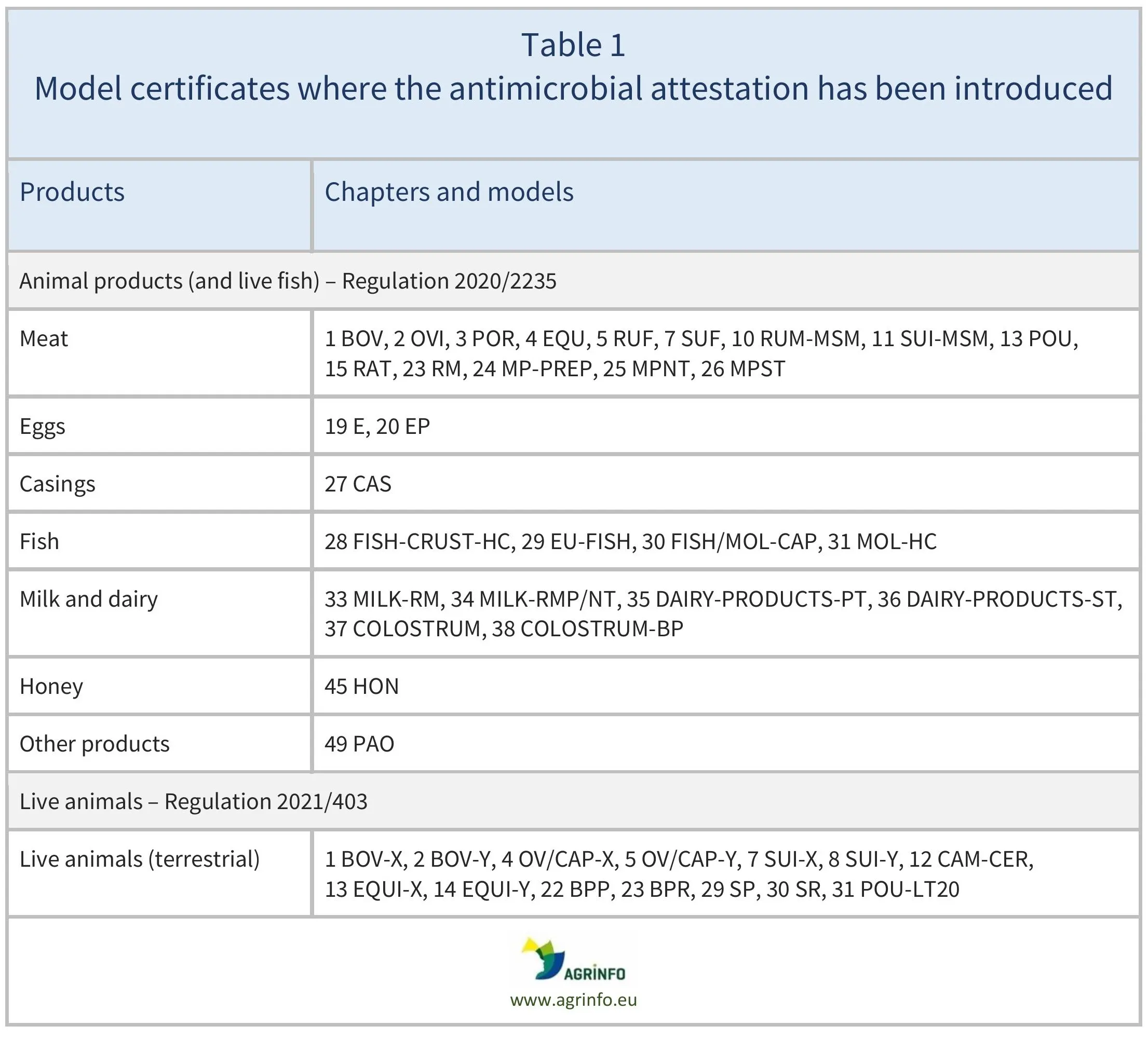
The Annex to Regulation 2024/399 provides the wording of the attestation that must be included in the certificate for each category of animal products (amending Annex III of Regulation 2020/2235), and for each category of live terrestrial animals (amending Annex II of Regulation 2021/403) – see references to the relevant models in Table 1.
For example, the attestation for beef reads:
I, the undersigned official veterinarian declare that, I am aware of the relevant requirements of Regulation (EU) 2019/6 of the European Parliament and of the Council and Commission Delegated Regulation (EU) 2023/905 and hereby certify that fresh meat of domestic bovine animals (including Bison and Bubalus species and their cross-breeds) described in Part I was produced in accordance with these requirements, and in particular, that the animals from which the meat is derived have not been administered antimicrobial medicinal products for growth promotion or yield increase or antimicrobial medicinal products containing an antimicrobial that is included in the list of antimicrobials reserved for the treatment of certain infections in humans laid down in Commission Implementing Regulation (EU) 2022/1255 as set out in Article 3 of Delegated Regulation (EU) 2023/905 and originate from a third country or region thereof listed in accordance with Article 5(2) of Delegated Regulation (EU) 2023/905.
(Source: Regulation 2024/399)
According to the Corrigenda, the footnote in the certificate indicating the date of application has been corrected as follows:
“Applicable to consignments entering the Union as from 3 September 2026.”
is replaced by:
“Applicable to consignments both certified and entering the Union as from 3 September 2026.”
This means that if the certificate is signed before 3 September, the attestation regarding antimicrobials must be crossed out – it does not apply even if the consignment enters the EU after 3 September.
Why?
The official certificates with attestations signed by non-EU country authorities guarantee that only food produced in compliance with the EU legislation is exported to the EU.
Timeline
The new model certificates apply from 3 September 2026.
What are the major implications for exporting countries?
For details on the implications of new rules concerning the use of certain antimicrobials in farmed live animals and their products that are exported to the EU, see Rules on prohibited antimicrobials in imported animal products, and AGRINFO guidance: Use of antimicrobials in farmed animals in the food supply chain).
Competent authorities in exporting countries may need to develop national legislation or adapt their control systems so that they can guarantee compliance.
Recommended Actions
Competent authorities and operators in exporting countries should ensure they use the correct model of the official certificate, and that the relevant attestations are signed from 3 September 2026.
Background
Regulation 2019/6 (Art. 118(1)) requires non-EU country operators exporting animals or animal products to the EU to respect the prohibition on the use of antimicrobial medicinal products that promote growth or increase yield, and on the use of antimicrobials reserved for the treatment of certain infections in humans.
According to Delegated Regulation 2023/905 (Art. 4(1)(b)), consignments of relevant animals or animal products entering the EU from non-EU countries should be accompanied by an official certificate attesting compliance with the EU's prohibition on the use of antimicrobial medicinal products. The existing model certificates are amended to include the relevant attestations of compliance according to Regulation 2019/6 (see Rules on prohibited antimicrobials in imported animal products).
Resources
Regulation 2023/905 as regards the application of the prohibition of use of certain antimicrobial medicinal products in animals or products of animal origin exported from third countries into the Union
Regulation 2019/6 on veterinary medicinal products
European Commission (2024) State of play concerning the implementation of Commission Delegated Regulation (EU) 2023/905, Presentation, Meeting between the European Commission and non-EU Countries, 6 March.
European Commission: Implementing the EU Regulation on veterinary medicines – Delegated and implementing regulations.
AGRINFO Webinar: Use of antimicrobials in farmed animals
AGRINFO guidance: Use of antimicrobials in farmed animals in the food supply chain
Sources
Corrigendum to Commission Implementing Regulation (EU) 2024/2020 amending and correcting Annex III to Implementing Regulation (EU) 2020/2235 as regards model certificates for the entry into the Union of consignments of certain categories of animals and certain products of animal origin intended for human consumption, and correcting Implementing Regulation (EU) 2024/399
Corrigendum to Commission Implementing Regulation (EU) 2024/399 amending Annex III to Implementing Regulation (EU) 2020/2235 and Annex II to Implementing Regulation (EU) 2021/403 as regards model certificates for the entry into the Union of consignments of certain products of animal origin and certain categories of animals
Commission Implementing Regulation (EU) 2024/2020 amending and correcting Annex III to Implementing Regulation (EU) 2020/2235 as regards model certificates for the entry into the Union of consignments of certain categories of animals and certain products of animal origin intended for human consumption, and correcting Implementing Regulation (EU) 2024/399
Commission Implementing Regulation (EU) 2024/399 amending Annex III to Implementing Regulation (EU) 2020/2235 and Annex II to Implementing Regulation (EU) 2021/403 as regards model certificates for the entry into the Union of consignments of certain products of animal origin and certain categories of animals
Disclaimer: Under no circumstances shall COLEAD be liable for any loss, damage, liability or expense incurred or suffered that is claimed to have resulted from the use of information available on this website or any link to external sites. The use of the website is at the user’s sole risk and responsibility. This information platform was created and maintained with the financial support of the European Union. Its contents do not, however, reflect the views of the European Union.
EU model health certificates for animal products adapted to cover antimicrobials
Corrigendum to Commission Implementing Regulation (EU) 2024/2020 amending and correcting Annex III to Implementing Regulation (EU) 2020/2235 as regards model certificates for the entry into the Union of consignments of certain categories of animals and certain products of animal origin intended for human consumption, and correcting Implementing Regulation (EU) 2024/399
Corrigendum to Commission Implementing Regulation (EU) 2024/399 amending Annex III to Implementing Regulation (EU) 2020/2235 and Annex II to Implementing Regulation (EU) 2021/403 as regards model certificates for the entry into the Union of consignments of certain products of animal origin and certain categories of animals
Commission Implementing Regulation (EU) 2024/2020
Commission Implementing Regulation (EU) 2024/399
What is changing and why?
From September 2026, the European Union (EU) will ban the use of certain medicines (antimicrobials) in farmed live animals and their products that are exported to the EU. (See Rules on prohibited antimicrobials in imported animal products for information on the application of Regulation 2023/905; and AGRINFO guidance: Use of antimicrobials in farmed animals in the food supply chain).
In 2024, the model official certificates for entry into the EU (covering all products from farmed animals) were amended so that this prohibition is included in the public health attestation. From 3 September onwards, the attestation must be signed by the competent authority confirming that the animals and their derived products have never been treated with prohibited antimicrobial medicines that promote growth or increase yields, or that are only for use in humans.
References to the model official certificates with the attestations are shown in Table 1.
Actions
Competent authorities and operators in countries exporting animals and animal products to the EU should ensure that the correct model of the official certificate is used, and that the relevant attestations will be signed from 3 September 2026.
Timeline
The new model certificates apply from 3 September 2026.
Disclaimer: Under no circumstances shall COLEAD be liable for any loss, damage, liability or expense incurred or suffered that is claimed to have resulted from the use of information available on this website or any link to external sites. The use of the website is at the user’s sole risk and responsibility. This information platform was created and maintained with the financial support of the European Union. Its contents do not, however, reflect the views of the European Union.