
Latest pesticide non-renewals, withdrawals, restrictions, and non-approvals (2026)
- Food safety
- Pesticide MRLs
- Pesticides
Summary
This report summarises recent European Union (EU) decisions not to renew, or to withdraw, existing approvals for certain pesticide active substances.
While these decisions primarily affect EU producers, they are generally followed by legislation to reduce the maximum residue levels (MRLs) to 0.01 mg/kg or the limit of determination (LOD – the lowest level that can be detected using the most modern and reliable analytical methods). These decisions therefore provide an early indication of upcoming MRL changes, and the likely need to look for alternative solutions on crops for export to the EU.
This report also includes EU non-approval decisions. These are relevant to producers in exporting countries where these substances may be used locally. In such cases, a default MRL of 0.01 mg/kg will be maintained.
Non-renewals, withdrawals, restrictions, and non-approvals of pesticides for use in the European Union: decisions in 2026
Commission Implementing Regulation (EU) 2026/1154 of 28 May 2026 as regards the deletion of methoxyfenozide, penthiopyrad and terpenoid blend QRD 460 from the list of active substances approved under Regulation (EC) No 1107/2009 of the European Parliament and of the Council
Commission Implementing Regulation (EU) 2026/1209 of 9 June 2026 concerning the non-approval of Capsicum oleoresin as a basic substance
Update
This report summarises recent European Union (EU) decisions not to renew, or to withdraw, existing approvals for certain pesticide active substances.
While these decisions primarily affect EU producers, they are generally followed by legislation to reduce the maximum residue levels (MRLs) to 0.01 mg/kg or the limit of determination (LOD – the lowest level that can be detected using the most modern and reliable analytical methods). These decisions therefore provide an early indication of upcoming MRL changes, and the likely need to look for alternative solutions on crops for export to the EU.
This report also includes EU non-approval decisions. These are relevant to producers in exporting countries where these substances may be used locally. In such cases, a default MRL of 0.01 mg/kg will be maintained.
What is changing?
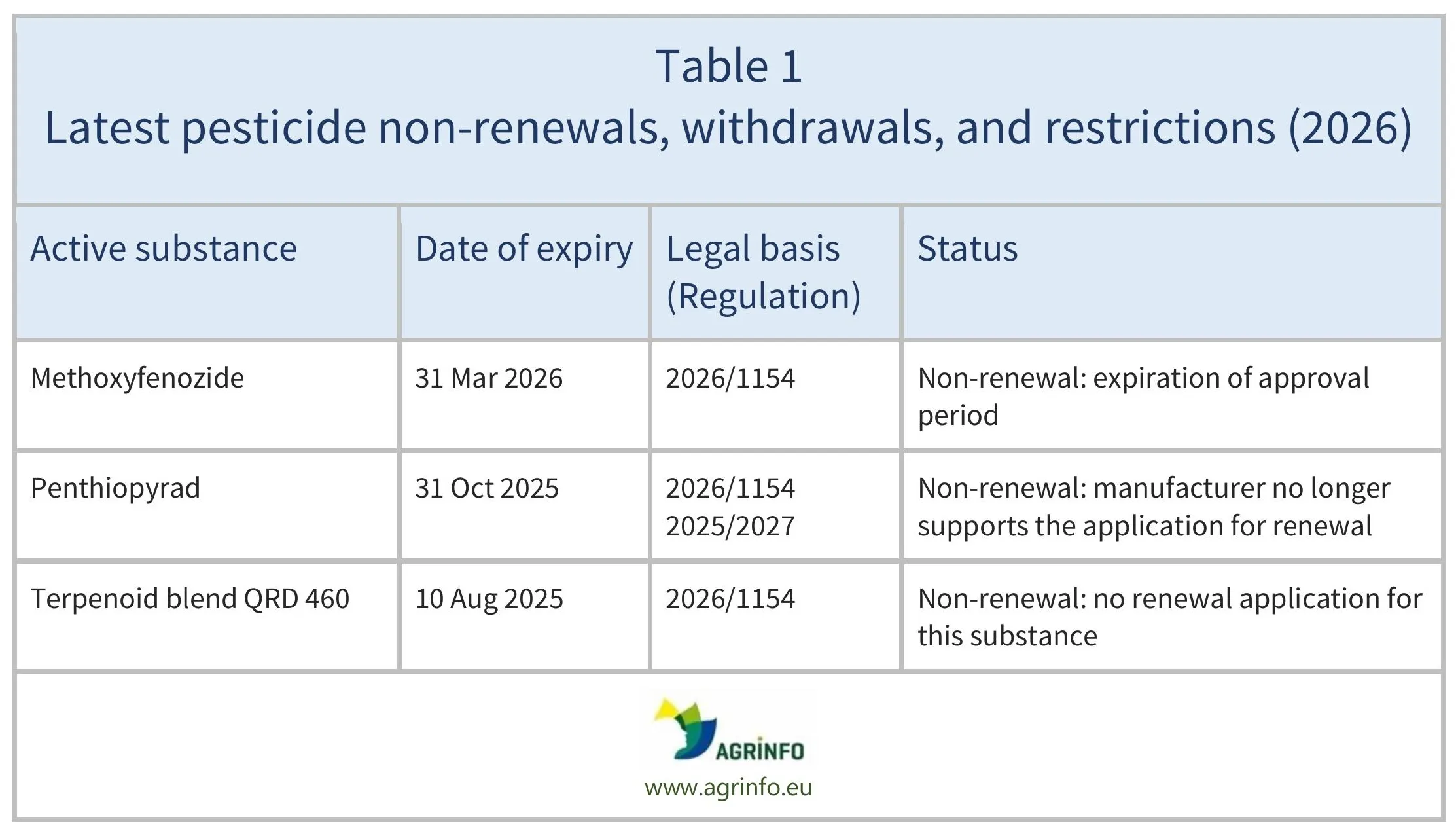
The EU systematically reviews the status of all pesticide active substances that are approved for use within the European Union. Recent non-renewals and withdrawals of approval are summarised in Table 1. To check the expiry or review dates of other pesticide active substances, see the EU Pesticides Database.
In addition to the non-renewals in Table 1, the EU has recently decided not to approve Capsicum oleoresin as a basic substance.
Why?
No requests for renewal were submitted regarding methoxyfenozide, penthiopyrad, and terpenoid blend QRD 460, therefore no review took place and these approvals expired. Regulation 2026/1154 deletes them from the list of approved active substances (under Regulation (EC) No 1107/2009).
Capsicum oleoresin was not approved as a basic substance because the European Food Safety Authority identified concerns regarding its composition and potential risks to human health (EFSA 2025). The applicant subsequently withdrew the application. The European Commission (2023) describes basic substances as “certain substances which are not predominantly used as plant protection products [that] may be of value for plant protection, but the economic interest of applying for approval may be limited”.
Timeline
Expiry dates for the substances affected are listed in Table 1. After these dates, the pesticides can no longer be used in the EU.
The European Commission is expected to follow up with proposals to reduce or remove the MRLs for these substances, which will affect their use on crops for export to the EU. Any changes to MRLs are notified to the World Trade Organization Sanitary and Phytosanitary (WTO SPS) Committee, and details will be provided on the AGRINFO website.
What are the major implications for exporting countries?
Decisions not to renew, or to withdraw, EU approvals for the use of certain pesticide active substances mainly affect their use within the EU. However, following a non-renewal or withdrawal of approval, in most cases the EU starts the process of lowering or removing the associated MRLs. These are typically set at 0.01 mg/kg or the LOD. In many circumstances this means that they can no longer be used on crops for export to the EU, and action is needed.
Recommended Actions
Export sectors affected should start looking for alternative crop protection solutions to methoxyfenozide and penthiopyrad, or to assess possible adaptations of good agricultural practices (GAP).
Background
See AGRINFO reports on decisions on pesticide non-renewals, withdrawals, and restrictions in 2023, 2024, and 2025.
Pesticide active substances are approved for a maximum period of 15 years. Manufacturers may apply for reapproval of a substance for a period not more than 15 years. The EU systematically reviews all active substances.
Substances may be:
- not reapproved: if there is insufficient data to permit reapproval, or because the manufacturer does not seek reapproval
- withdrawn: where specific consumer health or environmental issues are identified, sometimes before the normal expiry date
- restricted: where data supports renewal, but only under new specific conditions of use.
Where an authorisation for an active substance is withdrawn, or expires due to withdrawal of approval or non-renewal, the European Commission will prepare a draft measure to delete the relevant existing MRLs. In practice, the Commission starts this procedure once all existing authorisations for that active substance have been revoked. MRLs are set either to a default value of 0.01 mg/kg, or to the lowest limit technically possible using current analytical methods. MRLs based on the Codex MRLs (CXLs) are not deleted where there is no risk to EU consumers, or no global environmental concern. Changes to MRLs that impact trade are always notified to the WTO SPS Committee.
In 2026 the European Commission proposed to remove the standard requirement to re-evaluate pesticides every 10 years: see Simplification of rules on pesticide MRLs and approvals.
The precise timing of changes to MRLs resulting from the withdrawal or non-renewal of active substances is difficult to predict. In its review of pesticide policy, the Commission committed to “enhance communication efforts on the impacts of the PPP [plant protection product] Regulation on MRLs as well as the timing of the various procedures to make the EU system more predictable for non-EU countries, including for the cut-off criteria” (European Commission 2020).
Import tolerances can be requested in anticipation of potential changes to MRLs (see Overview table 2009–2026), but applicants must demonstrate the existence of relevant good agricultural practices (GAP) in the country of origin, and the safety of the proposed MRLs. Guidelines are available on the requirements and process for establishing MRLs and import tolerances (European Commission 2021). However, the possibility to apply for import tolerances for pesticides that are not approved in the EU is currently under review; see Simplification of rules on pesticide MRLs and approvals.
Resources
EFSA (2025) Overall conclusions on the application for approval of Capsicum oleoresin as a basic substance to be used in plant protection as a mammal repellent applied via seed treatment and foliar spray on various crops and seed types. EFSA supporting publication, 22(8): EN-9621.
European Commission (2020) Evaluation of Regulation (EC) No 1107/2009 on the placing of plant protection products on the market and of Regulation (EC) No 396/2005 on maximum residue levels of pesticides.
European Commission (2021) Technical Guidelines: MRL Setting Procedure in Accordance with Article 6 to 11 of Regulation (EC) No 396/2005 and Article 8 of Regulation (EC) No 107/2009.
European Commission (2023) Working Document on the procedure for application of basic substances to be approved in compliance with Article 23 of Regulation (EC) No 1107/2009
Sources
Commission Implementing Regulation (EU) 2026/1154 as regards the deletion of methoxyfenozide, penthiopyrad and terpenoid blend QRD 460 from the list of active substances approved under Regulation (EC) No 1107/2009
Commission Implementing Regulation (EU) 2026/1209 concerning the non-approval of Capsicum oleoresin as a basic substance
Disclaimer: Under no circumstances shall COLEAD be liable for any loss, damage, liability or expense incurred or suffered that is claimed to have resulted from the use of information available on this website or any link to external sites. The use of the website is at the user’s sole risk and responsibility. This information platform was created and maintained with the financial support of the European Union. Its contents do not, however, reflect the views of the European Union.
Non-renewals, withdrawals, restrictions, and non-approvals of pesticides for use in the European Union: decisions in 2026
Commission Implementing Regulation (EU) 2026/1154 as regards the deletion of methoxyfenozide, penthiopyrad and terpenoid blend QRD 460 from the list of active substances approved under Regulation (EC) No 1107/2009
Commission Implementing Regulation (EU) 2026/1209 concerning the non-approval of Capsicum oleoresin as a basic substance
What is changing and why?
The EU systematically reviews the status of all pesticide active substances that are approved for use within the European Union. Recent non-renewals and withdrawals of approval are summarised in Table 1.
Capsicum oleoresin was not approved as a basic substance because the European Food Safety Authority identified concerns regarding its composition and potential risks to human health, and the applicant subsequently withdrew the application.
Actions
Export sectors affected should start looking for alternative crop protection solutions to methoxyfenozide and penthiopyrad, or to assess possible adaptations of good agricultural practices (GAP).
Timeline
Expiry dates for the substances affected are listed in Table 1. After these dates, the pesticides can no longer be used in the EU.
The European Commission is expected to follow up with proposals to reduce or remove the MRLs for these substances, which will affect their use on crops for export to the EU. Any changes to MRLs are notified to the World Trade Organization Sanitary and Phytosanitary (WTO SPS) Committee, and details will be provided on the AGRINFO website.
Disclaimer: Under no circumstances shall COLEAD be liable for any loss, damage, liability or expense incurred or suffered that is claimed to have resulted from the use of information available on this website or any link to external sites. The use of the website is at the user’s sole risk and responsibility. This information platform was created and maintained with the financial support of the European Union. Its contents do not, however, reflect the views of the European Union.