
Polish national MRLs for carbendazim, glufosinate, and thiophanate-methyl
- Food safety
- Pesticide MRLs
Summary
The Polish Government has published a regulation introducing national rules lowering the maximum residue levels (MRLs) on certain foods for the following pesticides: carbendazim (including benomyl), glufosinate, and thiophanate-methyl. This was notified to the World Trade Organization Sanitary and Phytosanitary Measures (WTO SPS) Committee on 20 May (G/SPS/N/POL/26). These pesticides are not approved for use in the European Union (EU), but can be used on certain products that are exported to the EU provided that the current MRLs are not exceeded.
The reduced MRLs apply only to food put on the Polish market.
This initiative follows similar action taken by France in early 2026 (see French national MRL measures on carbendazim, thiophanate-methyl, glufosinate, and mancozeb).
Poland lowers MRLs for carbendazim, glufosinate, and thiophanate-methyl on certain foods
Regulation 603 of the Minister of Health on the establishment of special requirements for foodstuffs concerning residues of active substances of plant protection products (6 May 2026) [available only in Polish]
Update
The Polish Government has published a regulation introducing national rules lowering the maximum residue levels (MRLs) on certain foods for the following pesticides: carbendazim (including benomyl), glufosinate, and thiophanate-methyl. This was notified to the World Trade Organization Sanitary and Phytosanitary Measures (WTO SPS) Committee on 20 May (G/SPS/N/POL/26). These pesticides are not approved for use in the European Union (EU), but can be used on certain products that are exported to the EU provided that the current MRLs are not exceeded.
The reduced MRLs apply only to food put on the Polish market.
This initiative follows similar action taken by France in early 2026 (see French national MRL measures on carbendazim, thiophanate-methyl, glufosinate, and mancozeb).
Impacted Products
Algae and prokaryotic organisms, apricots, barley, beans/peas in pods, Brussels sprouts, cherries, citrus fruits (grapefruits, lemons, limes, mandarins, oranges), aubergines/eggplants, grapes, honey and other bee products, mangoes, melons, mushrooms, oats, okra/lady’s fingers, papayas, peaches, plums, pome fruits (apples, pears, quinces, loquats, medlars), potatoes, pumpkins, rye, tomatoes, watermelons, wheat
What is changing?
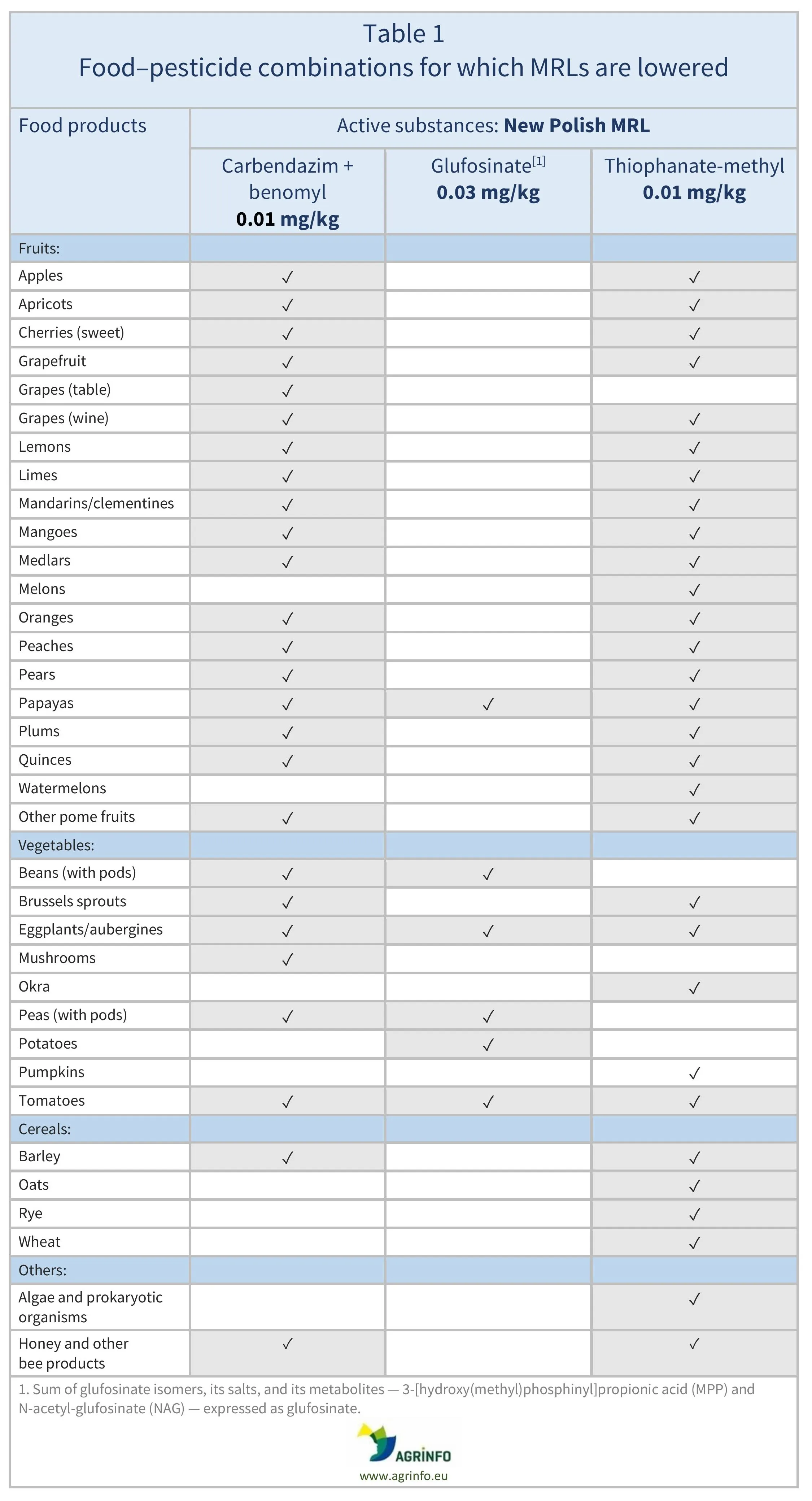
On 6 May 2026, the Polish Government published a regulation reducing national MRLs on certain products to 0.01 mg/kg for carbendazim (including benomyl) and thiophanate-methyl, and to 0.03 mg/kg for glufosinate. The foods affected are listed in Table 1.
In Poland, importing these foods and placing them on the market is now prohibited if they contain residues of any of these pesticides. This measure only applies to the Polish market and does not apply to food sold in other EU countries. These newly established Polish MRLs are therefore not aligned with the EU MRLs currently in force across EU Member States.
Why?
Poland considers that residues of certain pesticides that are no longer approved for use in the EU may pose a health risk, even at low levels. Discussions within the EU on lowering the MRLs for carbendazim, benomyl, and thiophanate-methyl, and a review of glufosinate MRLs, are ongoing. While awaiting EU action, Poland has opted to introduce interim national requirements.
Timeline
The new MRLs apply from 7 June 2026.
This is a temporary national protective measure, initially valid for 12 months, or until the EU adopts MRL regulations on these substances.
Background
Under EU law, where an EU Member State informs the European Commission of a serious risk to human health, animal health, or the environment, and the European Commission does not take measures to address that risk, a Member State may adopt interim protective (emergency) measures (Regulation 178/2002, Arts. 53 and 54).
France also established national MRLs for these pesticides in early 2026 (see French national MRL measures on carbendazim, thiophanate-methyl, glufosinate, and mancozeb) under the same legal provision. On 20 January 2026, the European Commission and EU Member States discussed the French decision. Only one EU Member State supported repealing the French Order, and it was agreed that France may maintain its own emergency measure (European Commission 2026).
EU Member States also did not support an EU-wide emergency measure, and will continue pursuing the following actions that are already in progress.
Carbendazim + benomyl and thiophanate methyl
In February 2026, the European Commission notified the World Trade Organization Sanitary and Phytosanitary Measures (WTO SPS) Committee of a new draft proposal to reduce maximum residue levels (MRLs) to the limit of determination (LOD) on all products (See Maximum residue levels for carbendazim, benomyl, and thiophanate-methyl).
Glufosinate
Glufosinate has not been approved for use in the EU since July 2018 as no application was made by the manufacturer for its reapproval.
For several products that are included in the Polish draft regulation, EU import tolerance MRLs currently remain in place (see the EU Pesticides Database).
Sources
Regulation 603 of the Minister of Health on the establishment of special requirements for foodstuffs concerning residues of active substances of plant protection products (6 May 2026) [available only in Polish]
Tables & Figures
Regulation 603 [Poland]
Disclaimer: Under no circumstances shall COLEAD be liable for any loss, damage, liability or expense incurred or suffered that is claimed to have resulted from the use of information available on this website or any link to external sites. The use of the website is at the user’s sole risk and responsibility. This information platform was created and maintained with the financial support of the European Union. Its contents do not, however, reflect the views of the European Union.
Poland lowers MRLs for carbendazim, glufosinate, and thiophanate-methyl on certain foods
Regulation 603 of the Minister of Health on the establishment of special requirements for foodstuffs concerning residues of active substances of plant protection products (6 May 2026) [available only in Polish]
What is changing and why?
The Polish Government has published a regulation introducing national rules lowering the maximum residue levels (MRLs) on certain foods for the following pesticides: carbendazim (including benomyl), glufosinate, and thiophanate-methyl. The foods affected are listed in Table 1.
These pesticides are not approved for use in the European Union (EU), but can be used on certain products that are exported to the EU provided that the current MRLs are not exceeded.
The reduced MRLs apply only to the Polish market and do not apply to these foods sold in other EU countries. However, France also established national MRLs for these pesticides on certain products in early 2026 (see French national MRL measures on carbendazim, thiophanate-methyl, glufosinate, and mancozeb).
These newly established MRLs in France and Poland are not aligned with the EU MRLs currently in force across EU Member States.
Timeline
The new MRLs apply from 7 June 2026.
This is a temporary national protective measure, initially valid for 12 months, or until the EU adopts MRL regulations on these substances.
Tables & Figures
Regulation 603 [Poland]
Disclaimer: Under no circumstances shall COLEAD be liable for any loss, damage, liability or expense incurred or suffered that is claimed to have resulted from the use of information available on this website or any link to external sites. The use of the website is at the user’s sole risk and responsibility. This information platform was created and maintained with the financial support of the European Union. Its contents do not, however, reflect the views of the European Union.